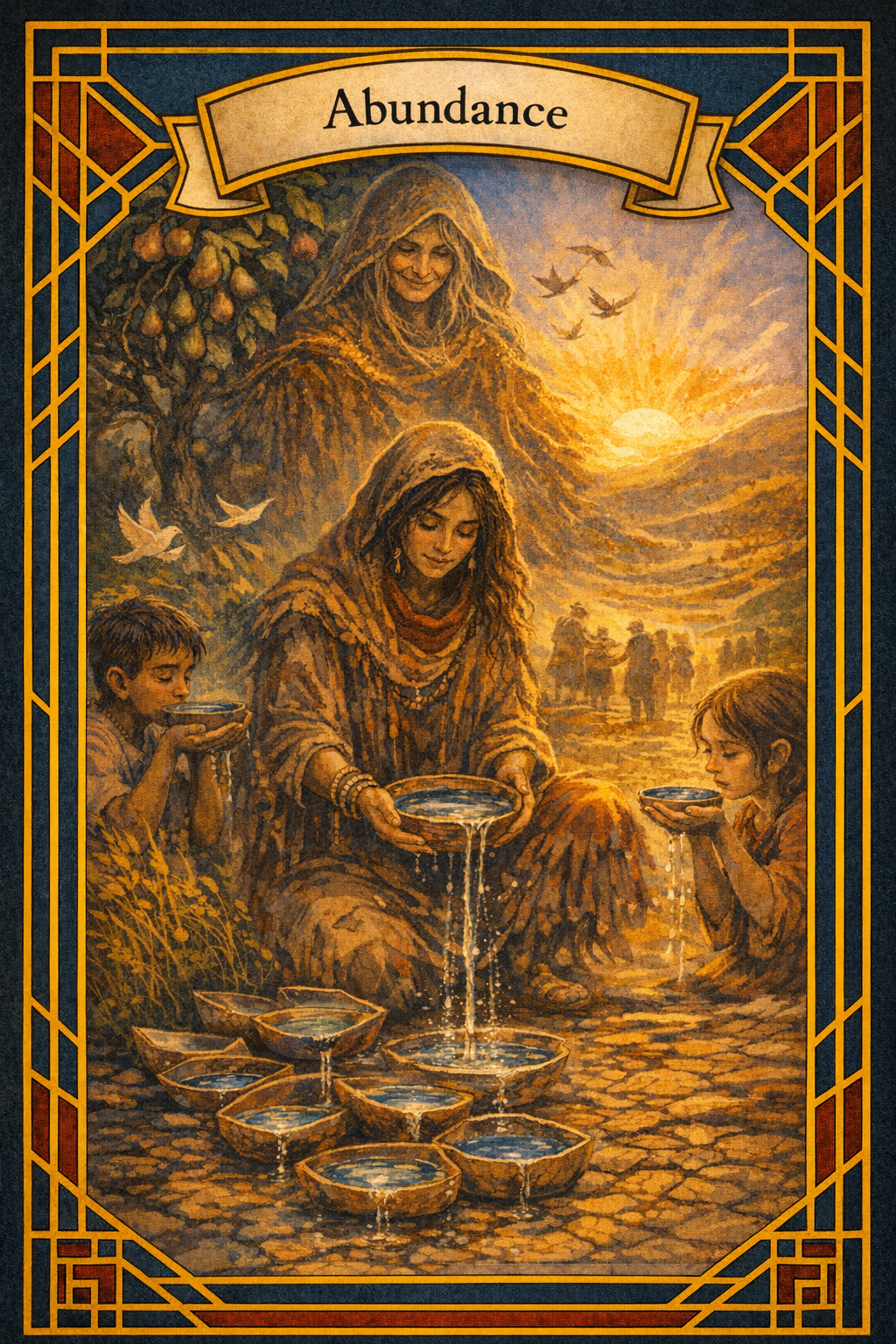
Abundance
In the earliest age—when hunger still had a voice and the earth had not yet learned to keep its promises—there lived a wanderer named Vela who carried an empty bowl made of river-clay. The bowl was unremarkable except for one strange law: it could not be filled by anything taken. Grain stolen from a neighbor’s sack turned to husks. Water drawn in secret seeped away. Even fruit plucked in greed bruised black the moment it touched the rim.
Vela walked through villages where storehouses were locked with iron prayers and fields were measured like wounds. Everywhere, people spoke of abundance as if it were a beast that must be trapped—hoarded behind doors, guarded by suspicion, counted until it felt safe. Yet the more they clutched, the more their hands seemed to close around emptiness.
On the seventh drought, Vela reached a valley split by a cracked riverbed. At its center stood a fig tree that should have been dead, but its branches were heavy with green leaves and pale fruit. Beneath it sat an old woman in a cloak the color of soil after rain. Her eyes were bright as seeds.
“You carry the Bowl of Want,” she said, without looking up. “It is not a curse. It is a teacher.”
Vela knelt and offered the empty bowl.
“I have walked far,” Vela said. “I have learned the taste of refusal. If you have water, I will trade you my last coin.”
The old woman laughed softly. “If you trade, you will stay thirsty. If you ask, you will stay thirsty. If you take, you will stay thirsty. But if you give, you will drink.”
Vela had nothing left but the coin and the bowl. Still, Vela broke the coin in half and pressed it into the dust beside the fig tree—an offering with no witness, no bargain, no expectation. Then Vela turned the bowl upside down and set it over the coin as if to shelter it.
The ground trembled, not like an earthquake but like a sigh. From beneath the bowl came the sound of water remembering itself. When Vela lifted the clay, the dust was dark and wet, and a thin spring had opened where the coin had been buried. The bowl, when dipped, filled cleanly and stayed full.
The old woman rose. Where her feet touched the soil, wild barley stood up as if called by name. “Abundance,” she said, “is not a pile. It is a current. It cannot be possessed without being poisoned. It can only be participated in.”
Vela carried the bowl back through the valley. At first, Vela tried to guard it—covering it, hiding it, walking quickly so no one would see. The water grew stale. The surface filmed over. The bowl became heavy, as if burdened by the fear of losing it.
At the first village, Vela stopped at the well where children waited with cracked lips. Vela poured the water into their cups without being asked. The bowl lightened. The spring’s taste returned.
At the next village, Vela poured into the hands of an exhausted farmer, then into the trough of a mule, then onto the roots of a dying sapling. Each time, the bowl refilled—not from nowhere, but from the world itself, as if the act of giving had opened hidden channels between need and nourishment.
Word spread, as stories do, and people began to follow. Some came with gratitude, some with desperation, some with knives. One night, a man tried to strike Vela and seize the bowl. The clay shattered against a stone.
Everyone froze, waiting for the miracle to die.
But the broken pieces, scattered across the ground, did not become ordinary shards. Each fragment held a small pool of water, each pool clear as morning. The followers, startled into reverence, lifted the pieces and carried them away. By dawn, the single bowl had become dozens of humble vessels, and the road behind Vela glittered with little moving lakes.
The old woman appeared once more at a crossroads, her cloak now threaded with gold grass and pomegranate rind. “You see,” she said. “Abundance is not one treasure. It is many hands learning not to close.”
Vela asked then what the old woman truly was.
“I am the Keeper of Overflow,” she replied, “and I am also the hunger that teaches you where the river should run. I wear both faces so you will not worship fullness and forget the sacredness of lack.”
When Vela died—old, laughing, and unafraid—the fig tree in the cracked valley finally bore fruit the color of sunrise. Its seeds were carried on wind and bird to places that had forgotten how to trust the soil. Wherever those seeds took root, people found that their harvests improved not when they tightened their fences, but when they shared their tools, their time, and their bread.
So the card of Abundance entered the tarot not as a promise of endless wealth, but as a myth of circulation: a reminder that what is hoarded becomes heavy, what is feared becomes scarce, and what is offered freely returns—often multiplied, always changed—through the hidden generosity of the world.