Blind Gate is not a door, though it wears the shape of one. It appears in the deck only when the deck is not looking—when the hand that shuffles is distracted by grief, by hunger, by a question asked too honestly. Readers insist it is an old card, older than the first printed trumps, older than the first painted saints; yet no archive contains its lineage. It turns up in inherited decks with no memory of acquisition, in flea-market packs that should be missing a card but are not, in the pockets of coats no one admits to owning.
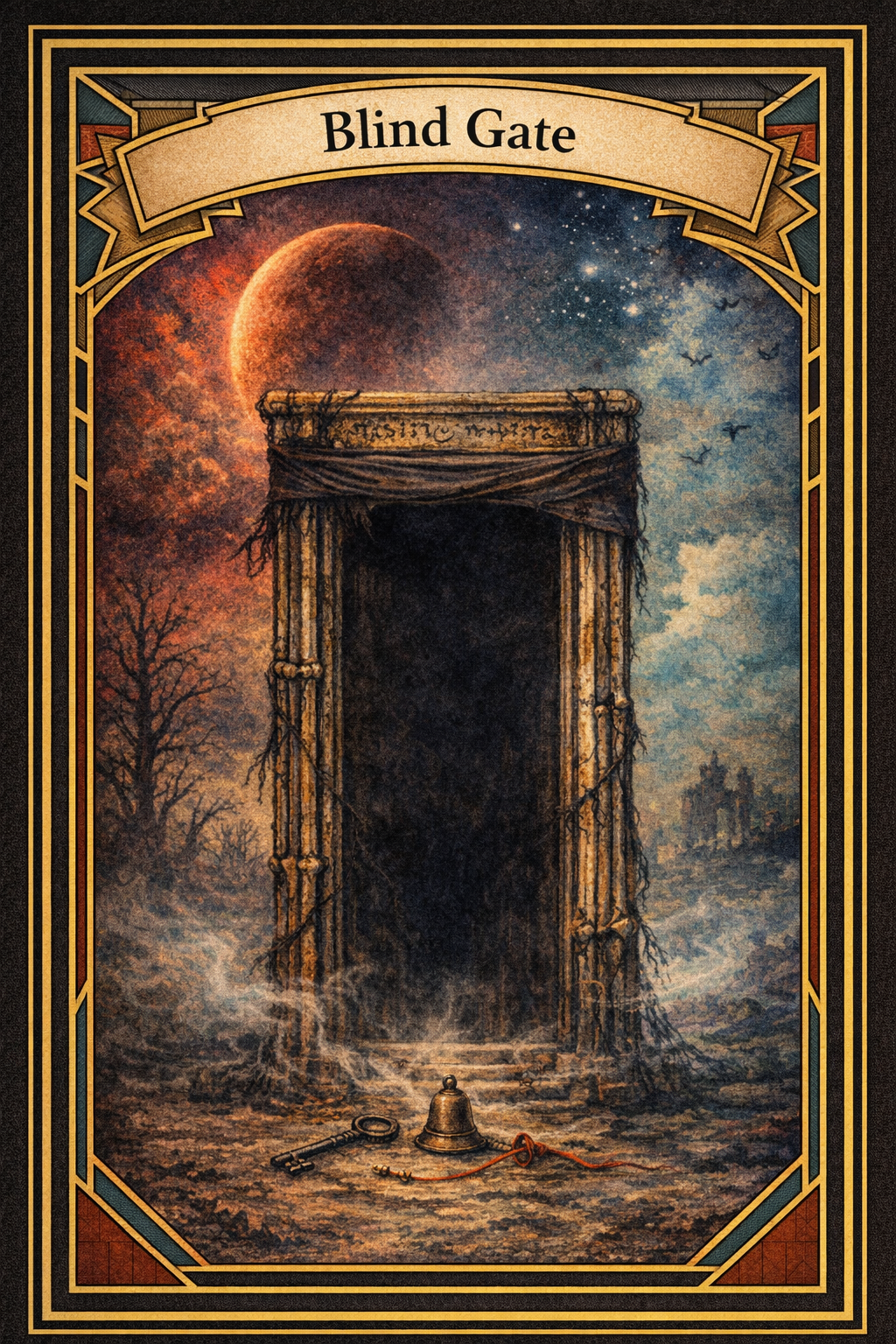
The image is always similar and never the same. A threshold stands where no wall should be: a frame of bone or salt-stained wood, set upright in open air. Where the door ought to be is a pane of perfect darkness, not shadow but absence—an ink that refuses light. Sometimes the frame is wrapped in a blindfold. Sometimes the blindfold is on the viewer. At the base, a small offering: a key without teeth, a bell without clapper, a thread cut cleanly in half. Above the lintel, an inscription in a script that cannot be read twice the same way.
The Blind Gate is said to have been made by the first oathbreaker and the first vowkeeper together, in the moment they realized they were the same person. They wanted a passage that could not be forced, bribed, or prayed open—only approached. So they built a threshold that would not answer sight, because sight is the quickest liar. They set it between what is known and what is survivable, and they tasked it with a single mercy: to stop those who would cross for spectacle, and to admit those who would cross for truth.
In the oldest telling, the Gate was not meant for the living at all. It was a sluice for names. When a person died, their name would drift toward the Gate, and the Gate would decide whether the name should be remembered, transformed, or dissolved. That is why it is blind: memory is a kind of favoritism, and favoritism is a kind of cruelty. The Gate does not judge by face, by blood, by story. It judges by weight—the weight of what you carry and what you refuse to put down.
Those who seek it in waking life do not find it by traveling. They find it by failing. The Blind Gate appears at the edge of plans that collapse, at the seam where certainty tears. It waits in the pause after the last argument, in the quiet after the wrong medicine, in the long minute before you forgive yourself. It is rumored to stand behind every mirror, not as a reflection but as the missing room your reflection refuses to show you.
There are rules, though no one agrees on their wording. The first is that the Gate cannot be seen directly. If you stare into its dark, the dark stares back with your own eyes. People who try to “witness” it report a brief sensation of being read like a letter held to flame—everything legible at once, then gone. The second is that nothing may be carried through it that you are not willing to lose. Coins vanish. Rings tarnish. Letters become blank. The third is that the Gate does not open outward. It opens inward, like a throat, like a thought.
The mythos warns of what happens when someone tries to cheat. The ambitious bring lanterns, and the lanterns fill with seawater. The desperate bring maps, and the maps redraw themselves into circles. The faithful bring prayers, and the prayers return in their own voice, stripped of comfort. The Gate is not hostile; it is precise. It does not punish. It demonstrates.
Those who are admitted describe no single country beyond. Some speak of a corridor lined with doors that lead to the lives they did not choose, each door labeled in handwriting they recognize. Some speak of a field of pale grass where every blade is a name they once used for themselves. Some speak of a city built from unfinished apologies, its streets paved with unsent letters. In every account, there is a sound: a soft click, as of a lock turning in a room where no one is waiting.
The Blind Gate is also a keeper of bargains. Folklore says that if you stand before it with your eyes covered and speak a vow you mean, the Gate will take it and bind it into the world. The vow will become heavier than you, and you will feel it tugging at your ribs whenever you drift from it. If you speak a vow you do not mean, the Gate will accept it anyway—then remove from you the ability to recognize sincerity in others. This is called “the Gate’s kindness,” because it spares you the pain of being believed.
In some regions the card is called The Unnamed, because the Gate is said to be the place where names go when they outgrow their owners. In others it is called The Mercy Door, because it appears most often to those who have reached the end of their own strategies. A rarer title is The Midwife, for it delivers you from one self to the next, and the delivery is never clean.
The Blind Gate’s central paradox is this: it is a threshold that requires surrender, yet it offers power. Not power over others, but over the one thing that most enslaves—your own unexamined story. The Gate does not promise rescue. It promises a choice you cannot make while pretending you are not afraid. It is blind so it cannot be seduced by your performance. It is a gate so you must admit there is something on the other side.
Those who carry the card for long begin to notice small phenomena. Doors in their homes close without drafts. Keys go missing and return warm. They wake with the taste of iron, as if they have bitten down on a secret. Their dreams include thresholds: train doors, mouths, book covers, eyelids. They become sensitive to the moment before change—the inhale before a confession, the hush before a storm. The mythos claims this is the Gate practicing them, teaching them to approach without spectacle.
There is one final story told in whispers among readers who have drawn it too often. They say the Blind Gate is not a place at all but a function: the moment you stop asking what will happen and start asking what you are willing to become. In that moment, something in the world shifts to meet you. A frame appears where there was none. Darkness gathers, not as threat but as privacy. And if you step forward without needing to see, the Gate opens—not to reward you, but to relieve you.
Because the Blind Gate was never meant to keep you out.
It was meant to keep you from crossing until you were ready to arrive.