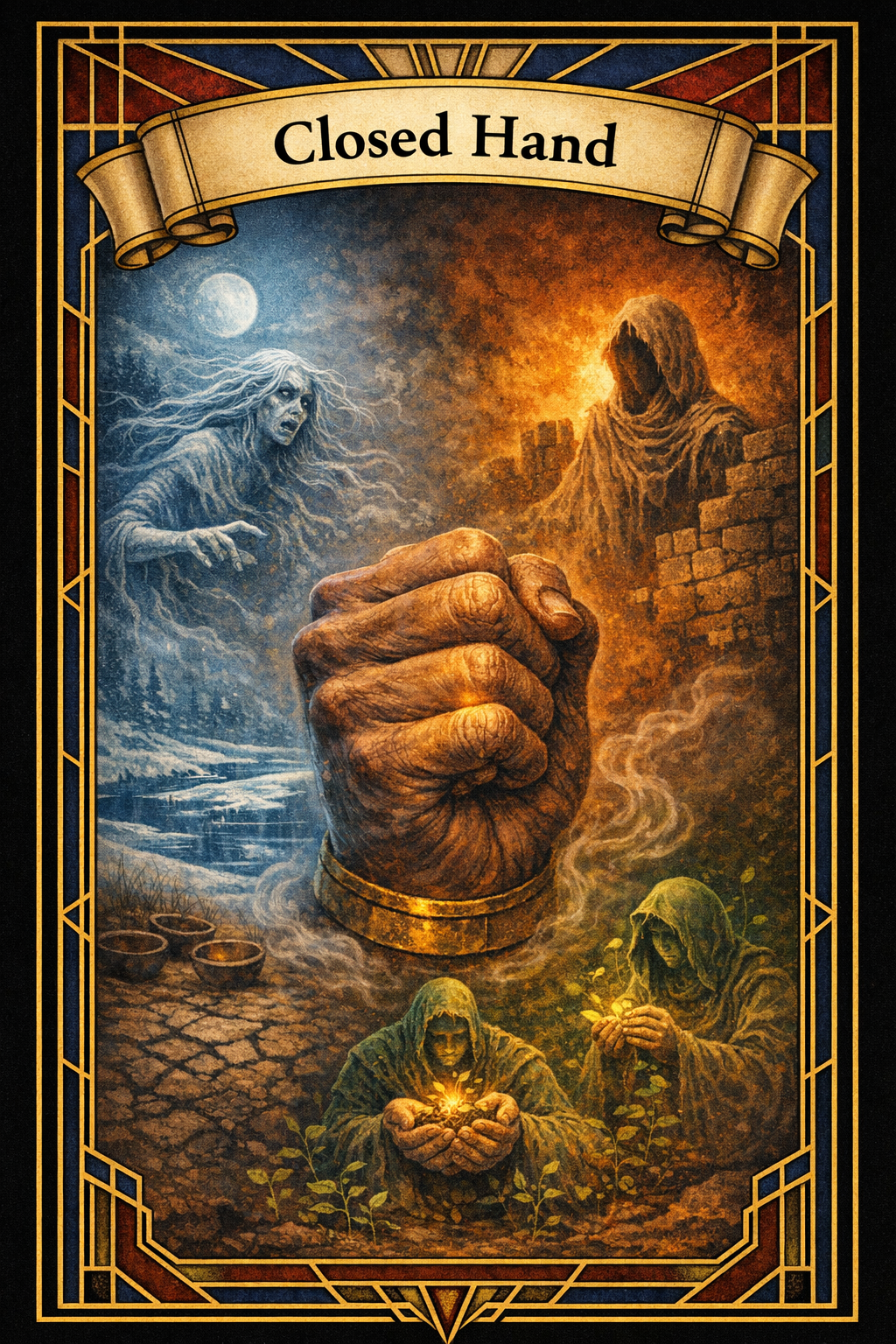
Closed Hand is the card that arrives without knocking. It is said to have been painted last, after the deck was already complete, when the artist realized there was still one truth the other cards refused to hold: that power is not only what is given, built, or taken, but what is withheld.
In the oldest telling, Closed Hand was not a card at all but a gesture taught to mortals by a river-god who had grown tired of being prayed into poverty. Every petition pulled a coin from his palm, every promise a thread from his sleeve, until his fingers trembled with the habit of surrender. One winter, the river froze in mid-breath, and the god could no longer open his hand. The people panicked—no water, no blessing, no easy forgiveness. Yet the ice held the river in a perfect silence, and in that silence the villages learned to listen to one another instead of the current. When spring returned, the god’s fist loosened, but he did not forget what the world had learned while he kept his grip. He pressed his closed knuckles into wet clay and left the first imprint: a hand that would not yield.
From that imprint, the card’s image was born. It shows a fist held at the heart, neither raised to strike nor extended to greet. The thumb crosses the fingers like a sealed vow. Some decks paint a ring of tarnished gold around the wrist, others a frayed cord, but all agree on the same detail: a faint line of light escaping between the curled fingers, as if something inside still burns, unseen and unshared.
The mythos says Closed Hand is guarded by three spirits—Hunger, Boundary, and Seed—each claiming the fist for a different reason. Hunger insists it is the symbol of refusal: the right to say no, to keep what is yours, to deny the world its entitlement to your labor and love. Boundary calls it the gate: the moment you stop being a thoroughfare for other people’s needs and become a place with walls and doors. Seed names it the cradle: what you protect now so it can become more later, the hidden kernel that cannot sprout if constantly displayed and handled.
There is a caution woven through the stories, because the hand that closes can also forget how to open. In one legend, a king drew Closed Hand every new moon and took it as permission to hoard—grain, gold, affection, mercy. His barns grew fat, his people thin. When famine came, he clenched tighter, convinced that release would kill him. The card turned heavy in his palm, as if made of stone. On his last day, they found him with a fist full of dust: everything saved, nothing lived. The moral is repeated by readers who fear its shadow: withholding can be wisdom, but hoarding is a spell that eats its caster.
Yet the card is not an enemy of generosity. Its oldest hymn describes it as “the pause before the gift.” The river-god’s closed hand did not mean he would never give again; it meant he would give by choice, not by compulsion. The fist, in this telling, is not a lock but a latch. It is the moment you check the weight of what you carry and decide what truly belongs to you, what you are ready to offer, and what must remain private until its time.
Those who study the mythos say Closed Hand appears at thresholds: before vows, before bargains, before confessions, before wars. It comes when you are tempted to spend yourself to be loved, or to buy peace with your own erasure. It comes when you are tempted, too, to keep everything because you fear emptiness. The card asks a single question that no other card asks so plainly: What are you holding, and who taught you to hold it that way?
In the final tale, the artist who painted Closed Hand did so with their non-dominant hand, as if to avoid making the gesture too fluent. When the ink dried, they pressed their own fist to the card and whispered a rule into it: “May you never open for a thief, and may you never stay shut for a friend.” That is why, in readings, Closed Hand is treated as a living boundary—firm, imperfect, and sacred—reminding the seeker that the most fateful magic is sometimes not what you do, but what you do not do.