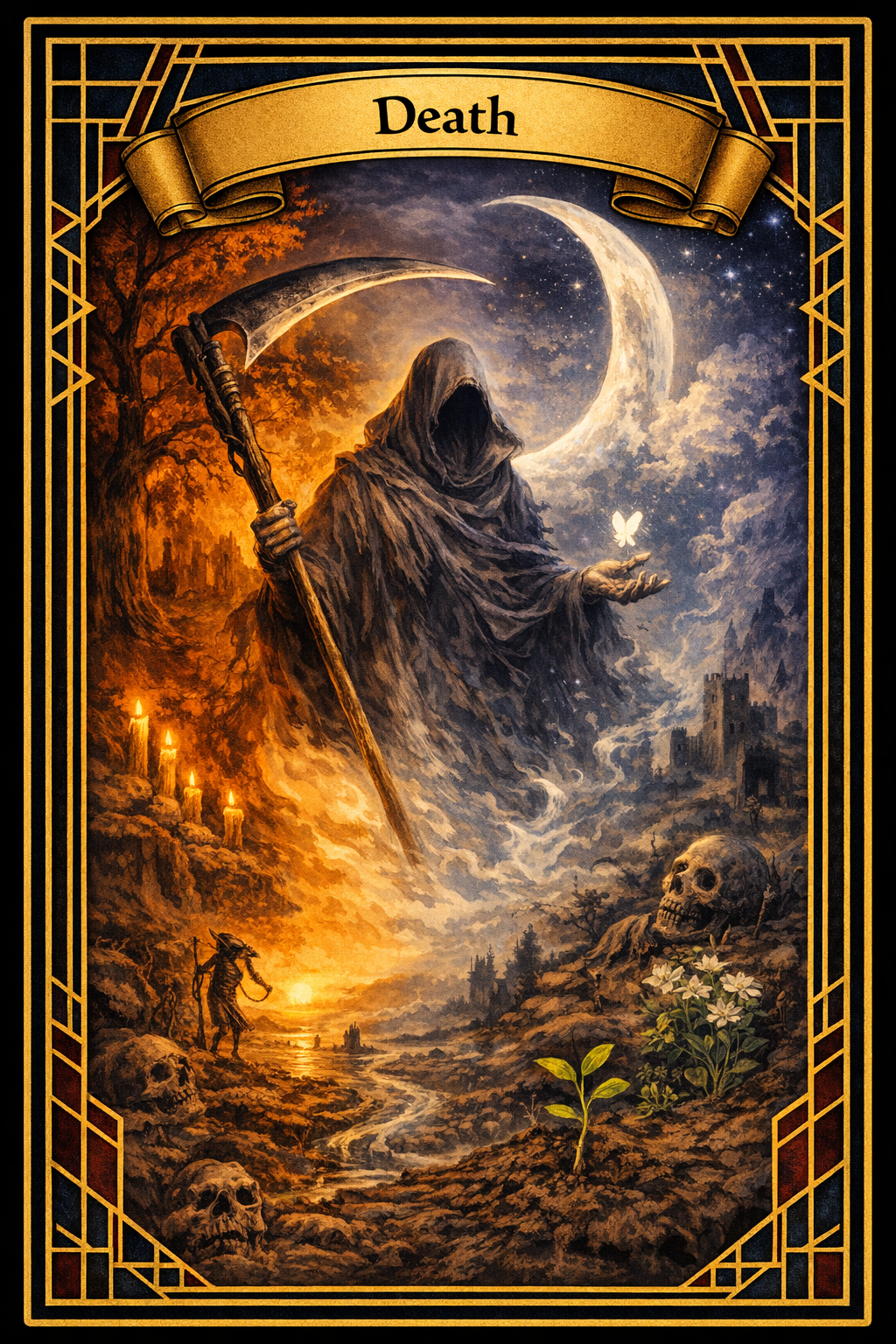
Death — Mythos
They say Death was not born but appointed.
When the first fire learned to go out, the world panicked. Mountains held their breath, rivers refused to empty into the sea, and kings swore oaths that would last forever because forever seemed suddenly possible. In that age, nothing knew how to end, and so nothing truly changed. Wounds stayed open. Grief never ripened into memory. Seeds split the earth and then lingered, half-made, afraid to become.
The gods convened to solve the crisis of continuation. Each offered a remedy: Time offered more hours, Love offered stronger bonds, War offered conquest to distract the living from their fear. None could answer the simple terror of an unfinished world. At last, the smallest of the old powers—an unnamed servant-spirit who had always swept the ash from altars and gathered the husks after harvest—stepped forward and said: I will take what is done and carry it away.
The gods laughed, then fell silent, because the thought was perfect.
They gave the servant a mantle stitched from the last breath of every creature that had ever exhaled. They placed in their hands a tool that was not a weapon but a key: a scythe whose curve matched the crescent of the moon, meant to separate ripe from unripe, finished from unfinished. They named this figure Death, not as a curse, but as a function the cosmos could finally rely upon.
Death walked the world and did not hunt. Death harvested.
Where a story had reached its final line, Death closed the book. Where a body had completed its work, Death unfastened the soul like a clasp and let it fall into the dark soil of elsewhere. The first to be taken were the immortal things that had grown stagnant—forests that never shed leaves, empires that never yielded, sorrows that never softened. With each ending, the world loosened its grip and learned the relief of release. Rivers began to empty again. Seeds dared to become.
Yet Death was not satisfied with merely taking. Death became the patron of thresholds: the hinge between seasons, the silence between heartbeats, the moment a name stops fitting and a new one begins to form. In villages, midwives left a bowl of clean water at the door for Death, because every birth is also an ending—of solitude, of one life becoming two. In battlefields, soldiers whispered thanks when Death arrived swiftly, because lingering is its own cruelty. In monasteries, monks painted Death not as a monster but as a gardener, because the scythe is also a tool of care.
There is an old tale of a king who tried to bargain with Death. He built a tower with no doors, no windows, no cracks for wind or fate to enter. He sealed himself inside with food enough for a lifetime and declared victory over the appointed reaper. Years passed. The tower stood unbroken. The king did not die.
He also did not live.
His meals became rituals without hunger. His thoughts circled like trapped birds. His own voice became foreign. When at last Death came—not through stone, but through the king’s realization that he had already ended—Death did not strike. Death simply opened a hand, and the king stepped out, lighter than a sigh, into a world that had moved on without him.
From that story comes the quiet teaching: Death cannot be outwalled, because Death is not a visitor. Death is the moment you stop being what you were.
Those who draw the Death card are said to be standing at the edge of a necessary severing. The myth warns against mistaking the scythe for malice. Death does not arrive to punish; Death arrives to clear. The card’s shadow is clinging—refusing the ending, embalming the past, calling decay “loyalty.” Its blessing is courage—the willingness to let the old self fall away so the next can breathe.
And in the deepest lore, whispered by those who listen at graves and cradles alike, Death is described as the most faithful god: the only one who keeps every promise the world makes.
Everything that begins, ends.
And because it ends, it can begin again.