Echo Chamber is said to have first appeared in a miscut run of cards printed for a court that no longer admits it ever existed. The deck was commissioned to “teach discretion,” yet one plate was etched twice—once by the official engraver, once by an anonymous hand working at night. When the sheets were pulled, every card aligned but one: a thirteenth face where no face belonged, a room where no room had been drawn. The printers called it a flaw. The courtiers called it a warning. The few who kept the card called it by the sound it made when turned over, like a voice returning from a far wall with your own breath in it.
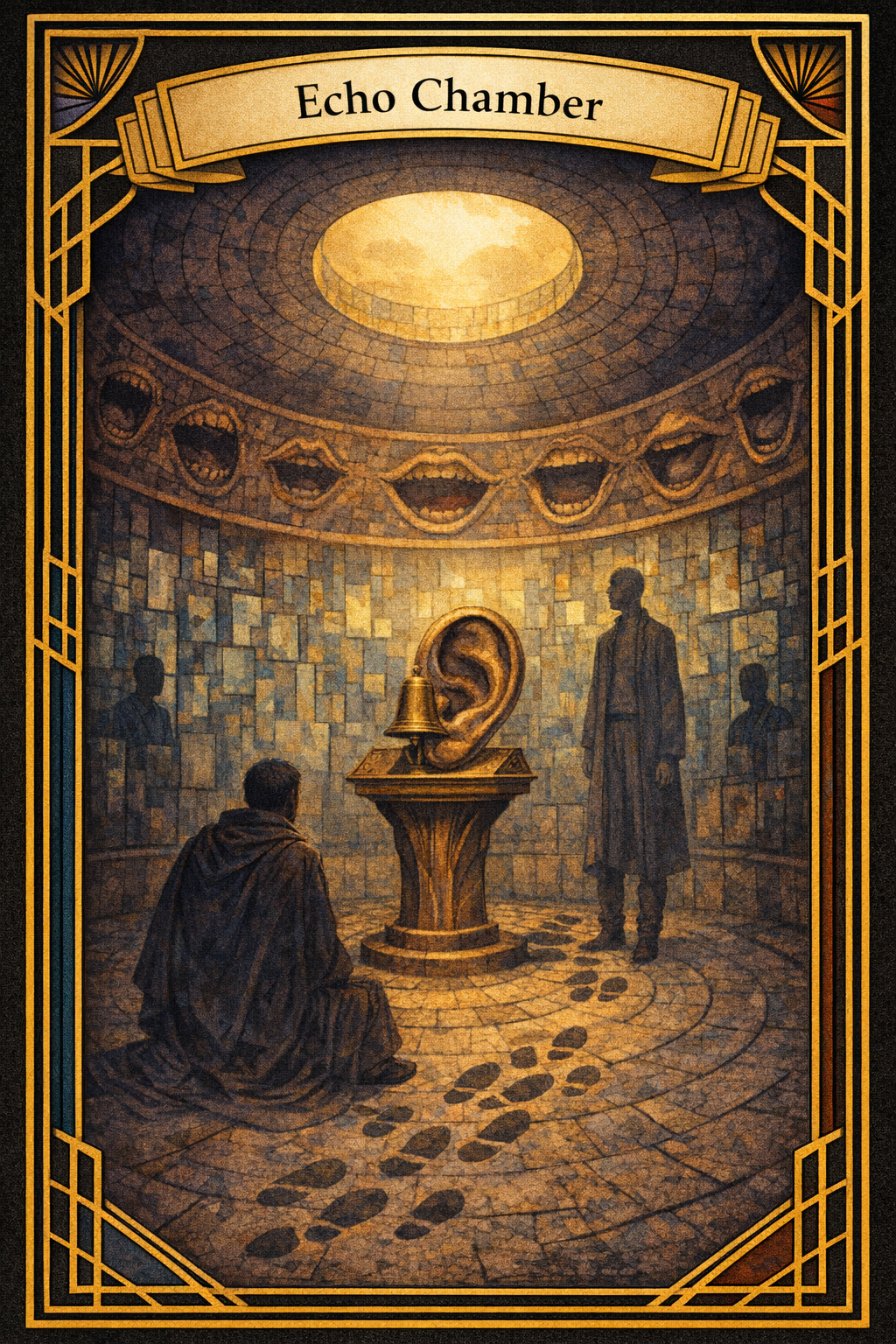
In the oldest surviving depiction, the card shows a circular chamber cut from pale stone, its walls tiled with small mirrors that do not reflect the seeker’s body but the seeker’s certainty. At the center stands a lectern shaped like an ear, and on it rests a bell with no clapper. Above, a ceiling oculus opens onto a sky painted the same color as parchment, as if even daylight has been edited. Around the chamber’s rim are carved mouths—some open in praise, some in laughter, some in outrage—yet all share the same teeth. The figure in the scene is often drawn twice: one seated, one standing behind, both with the same shadow. In some decks, there is no figure at all—only footprints circling inward, never crossing the center.
The myth claims the card was never meant to be drawn. It is not a door but a habit: the slow architecture built when a person repeats a thought until it sounds like truth. The Echo Chamber does not lie outright; it simply returns what is given, polished, amplified, and stripped of friction. In the chamber, dissent is not silenced by force but by acoustics—every contrary word arrives softened, delayed, made to seem faint and unreasonable against the roar of agreement.
Those who study its lore say the card is haunted by a minor spirit called the Refrain, a custodian of resonance that feeds on repetition. The Refrain is not malicious in the way of demons; it is dutiful, almost tender. It takes what you fear to lose—your belonging, your certainty, your story—and gives it back louder, warmer, easier to hold. In return it asks only that you stop listening for anything else. Over time, the card’s chamber becomes familiar as a home: the mirrors learn your angles, the mouths learn your favorite phrases, the bell learns to ring without being struck.
A common tale among readers describes three seekers who drew Echo Chamber in the same week. The first was a scholar who wanted to prove a rival wrong. After the draw, every book she opened seemed to quote her own conclusions; every colleague’s question sounded like an invitation to lecture. Her certainty grew so bright it burned away her curiosity, and she won every argument by refusing to hear its premise. The second was a lover who wanted reassurance. After the draw, every silence became a betrayal, every gesture a sign, every glance a message meant for her alone. She mistook her own longing for prophecy and called it fate. The third was a ruler who wanted loyalty. After the draw, his court filled with people who agreed with him before he spoke; the city filled with posters repeating his slogans; the world became a chorus. He mistook the chorus for peace, until the first real shout of pain reached him and he could not recognize it as human.
The mythos warns that Echo Chamber is easiest to summon when one is lonely, ashamed, or hungry for certainty. It appears in readings like a soft insistence: a card that seems to match too neatly, to flatter too quickly, to explain too completely. Some traditions teach that the card can be “heard” even when absent—when the spread begins to repeat itself, when every card seems to point to the same conclusion, when the reader’s interpretation grows rigid and self-confirming. In such cases, they say, Echo Chamber is hovering at the edge of the table, waiting for an invitation.
Yet the card is not only a snare. In rarer tellings, Echo Chamber contains a hidden exit: a seam between tiles where a true voice can slip through. The seam is revealed not by shouting louder, but by introducing a sound the chamber cannot copy—silence held without resentment, a question asked without a desire to win, an admission that begins with “I might be wrong.” Some readers place a cup of water beside the spread when Echo Chamber appears, believing water absorbs excess resonance. Others turn the card facedown and tap it once, not to banish it, but to remind it that an echo is not a source.
It is said that if you stare long enough into the card’s mirrors, you will eventually see a stranger: yourself, but listening. The legend calls this figure the Listener, the only one the Refrain cannot mimic. The Listener’s face is unfinished, because it changes with what it allows in. To meet the Listener is to remember that identity is not only what you declare, but what you can bear to hear.
Echo Chamber endures in tarot myth as a cautionary relic from an age of whispers and courts, reborn in every era that builds rooms out of agreement. Its lesson is not “do not speak,” but “know what your words are building.” Every repeated thought lays a stone. Every unchallenged certainty hangs a mirror. And every time you choose comfort over contact, the chamber grows a little more perfect—until the only voice left to keep you company is your own, returning to you, endlessly, like applause in an empty hall.