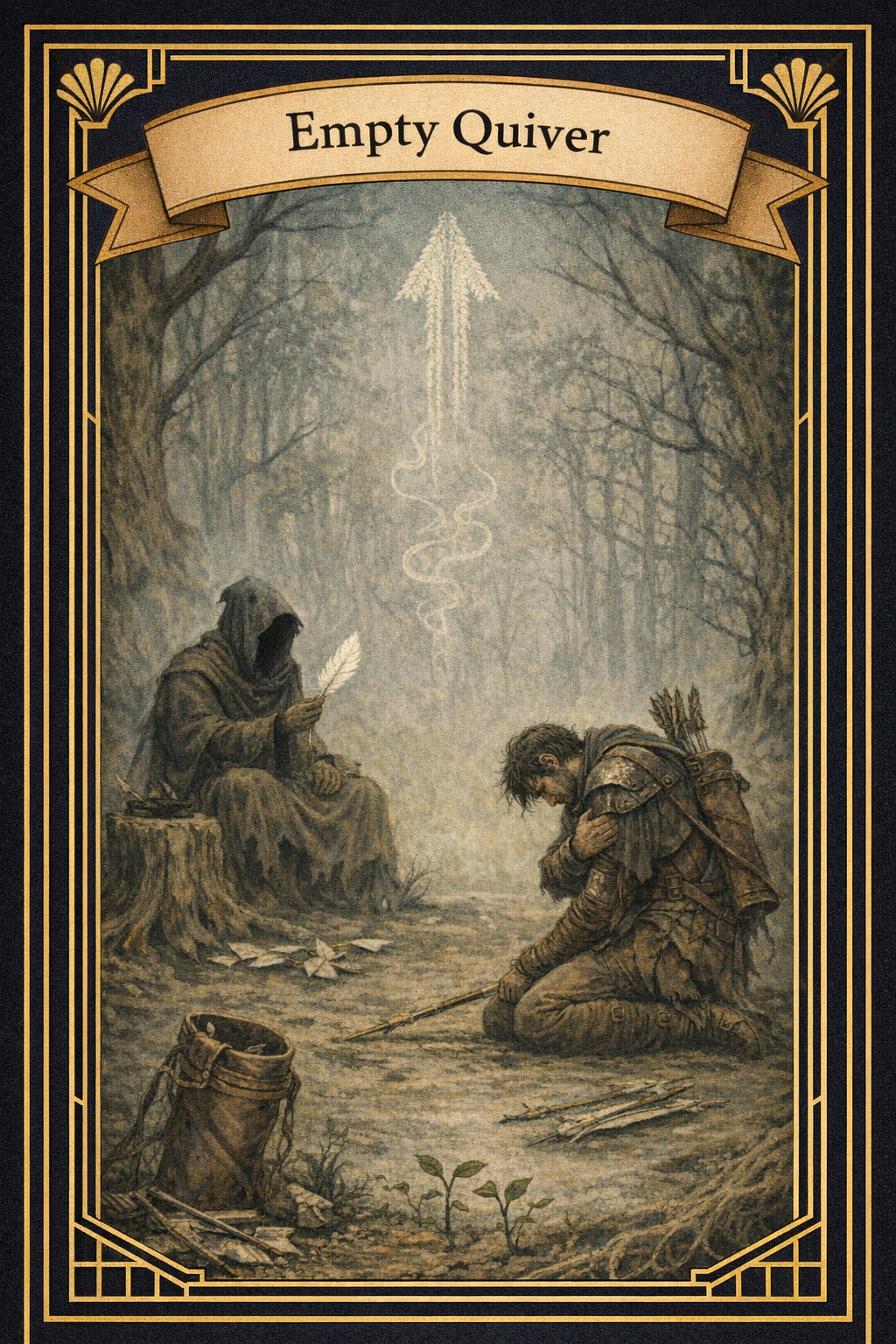
Empty Quiver is the seventeenth arrow and the first silence.
In the oldest telling, there was a hunter who never missed. Their bowstring sang like a sworn oath, their arrows flew like verdicts, and every creature of doubt fell cleanly from the sky. Villages praised the hunter’s certainty; kings paid for it; enemies feared it. The hunter’s quiver was always heavy, always ready—until the day the forest stopped offering targets.
No beast crossed the path. No sign revealed itself. Even the wind held its breath. The hunter walked deeper, furious at the world’s refusal to be solved, and loosed arrow after arrow into emptiness just to prove the arm still worked. The shafts vanished into fog. The bow grew warm with insistence. The quiver thinned. And still nothing answered.
At last, at the heart of the wood, the hunter met a figure seated on a stump as if it had been waiting there since before names: a small, hooded keeper with hands stained by sap and ink. At its feet lay a scatter of arrowheads, dulled and unclaimed.
“Where are my targets?” demanded the hunter.
The keeper lifted a palm. In it rested a single feather, pale as ash.
“You have mistaken aim for meaning,” it said. “You have mistaken motion for direction. You have mistaken the sound of release for the truth of arrival.”
The hunter reached for another arrow and found only leather and air. The quiver was empty.
Shame rose like heat—then panic. Without arrows, what was a hunter? Without the clean certainty of a shot, how could the world be negotiated? The hunter fell to their knees and tried to pull an arrow from the earth, from memory, from pride. Nothing.
The keeper spoke again, softer.
“An empty quiver is not punishment. It is the moment the hand stops reaching behind itself for answers it has already rehearsed.”
The hunter, stripped of their old language, listened. For the first time, the forest had room to speak. The hunter heard things that could not be struck: the tremble of leaves deciding whether to fall, the hush between animal footfalls, the slow insistence of roots. There were truths that fled the arrow—truths that arrived only when pursued ceased.
In some versions, the hunter weeps until the bowstring slackens and becomes a vine. In others, the keeper opens the hunter’s quiver and pours into it not arrows but seeds, each one shaped like a question. In the harshest telling, the hunter wanders home with an empty back and is laughed at—until the village’s war comes and the hunter, having learned to see without aiming, leads them away from the battlefield entirely.
Empty Quiver is the card of spent certainty: the point at which skill no longer suffices and willpower cannot manufacture a target. It is the myth of the pause that saves you from becoming a machine of your own competence.
It is said the card first appeared scratched into the inside of a leather quiver found in a burned grove—no arrows, no bow, only the imprint of a hand that had finally unclenched. Beneath the mark was a single line, written in a script that looked like fletching:
When you cannot shoot, you must choose what you were hunting.