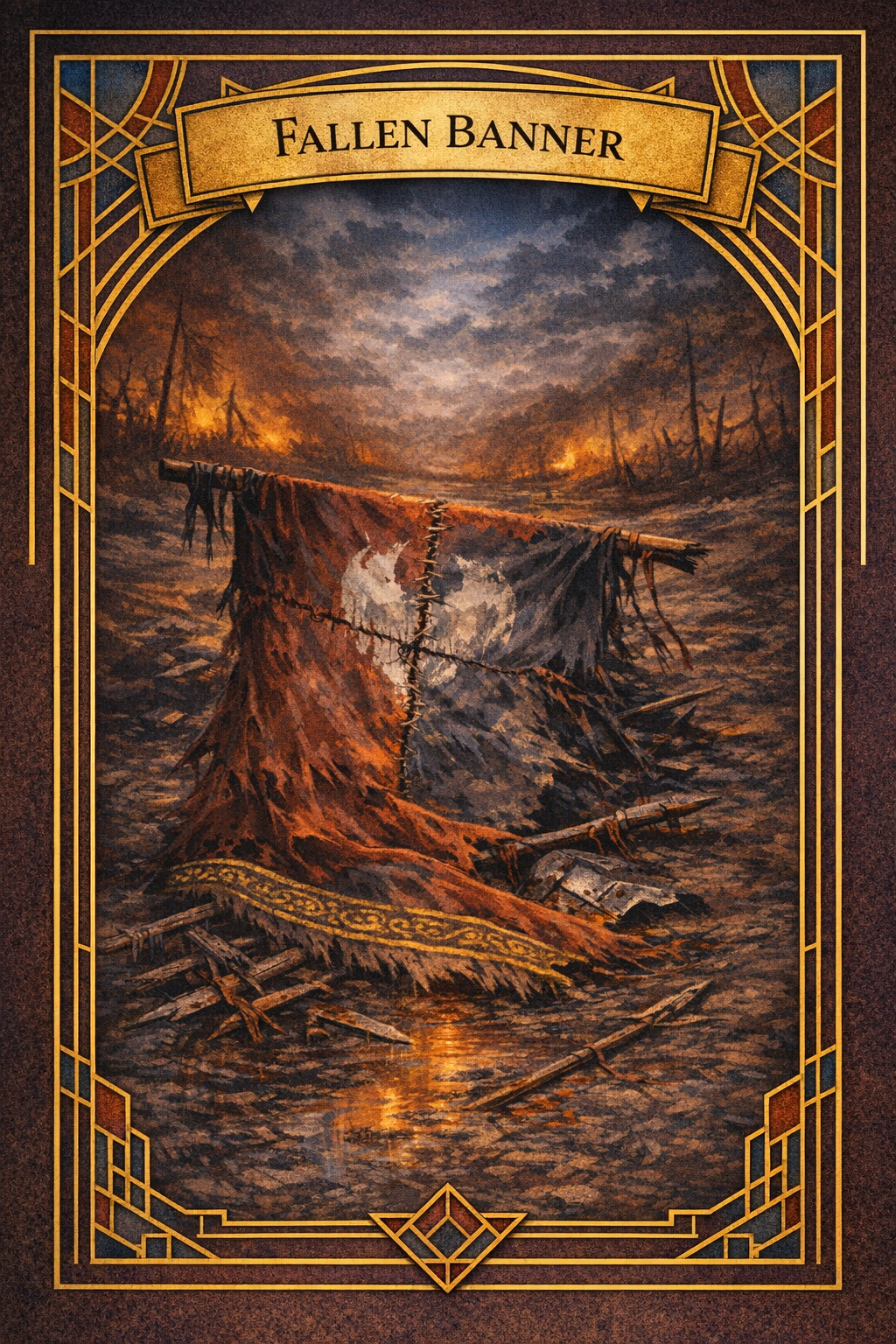
The Fallen Banner is not a card found in any orthodox deck. It is spoken of as an intrusion—an omen that appears when a reading has wandered too close to something unfinished. Old readers call it the thirteenth cloth, the scrap of standard that drifts onto the table when vows have been made in public and broken in private. It is said that the card cannot be sought; it arrives only when someone has already sworn themselves to a cause they no longer believe in.
In the oldest telling, the Fallen Banner began as a war-standard carried at the front of an army that marched under a promise: no conquest without mercy, no victory without repair. The promise was painted in gold thread along the hem so that even the last soldier could read it. When the army won, they did not keep the promise. They took, they burned, they renamed. The banner, ashamed to fly above them, tore itself from the pole in the night wind and fell into the mud between the camps—neither claimed by the victors nor retrieved by the defeated. Dawn found it trampled, stained, and oddly intact: the gold thread still gleaming, the words still legible, as if the vow refused to die even when the cause had.
From that night onward, the banner would not remain cloth. It became a sign that detached itself from history and began haunting decisions. It appeared in council chambers as a folded strip of fabric under the table. It appeared in temples as a frayed ribbon tied where no ribbon had been. It appeared in rebellions as a flag that would not lift in the wind. Those who touched it felt two sensations at once: the heat of conviction and the cold of betrayal—because the Fallen Banner does not judge the cause itself so much as the distance between what was promised and what is being done.
Readers who claim to have drawn it describe the same image: a standard lying across broken spears, its pole snapped, its field split by a seam that has been poorly stitched. The emblem—whatever it once was—has been scraped away, leaving only the outline of where meaning used to be. At the bottom edge, the gold-thread vow remains, but the last word is missing, as if the future is the only part that can no longer be embroidered.
The mythos insists the card is not a prophecy of defeat, but of exposure. It arrives when a person has become the face of something—family, faith, work, love, nation—and can no longer pretend the symbol and the truth are the same. In the tales, kings who drew it found their crowns heavy with other people’s expectations. Generals who drew it heard the dead reciting their speeches. Saints who drew it discovered their miracles had become currency. Lovers who drew it realized they were staying loyal to an idea of someone who no longer existed.
There is also a gentler legend: that the Fallen Banner is carried by no army at all, but by the nameless who clean up after every triumph. The seam down its center is their work, a repair done in haste with whatever thread could be found. In this version, the banner fell not because the vow was broken, but because the weight of representing a cause became too great for any single pole to bear. The card, then, is a reminder that symbols are not meant to be carried forever by one set of hands.
To draw the Fallen Banner is to be asked a question older than victory: What did you promise when you first raised your flag—and who are you now that it has fallen? The myth says the card offers no instruction until the querent answers honestly. If they do, the banner’s cloth becomes, in the mind’s eye, something else: a shroud for what must end, a bandage for what must heal, or a blank field ready for a truer emblem. If they refuse, the banner remains where it fell—between camps—forcing them to live in the uncomfortable borderland between reputation and reality.
Among readers, there is a superstition that you never place the Fallen Banner back into the deck with clean hands. You must touch earth, ash, or salt first, as if acknowledging that every cause, however noble, will someday meet the ground—and that what matters is not whether the banner falls, but whether the vow is lifted again without lying.