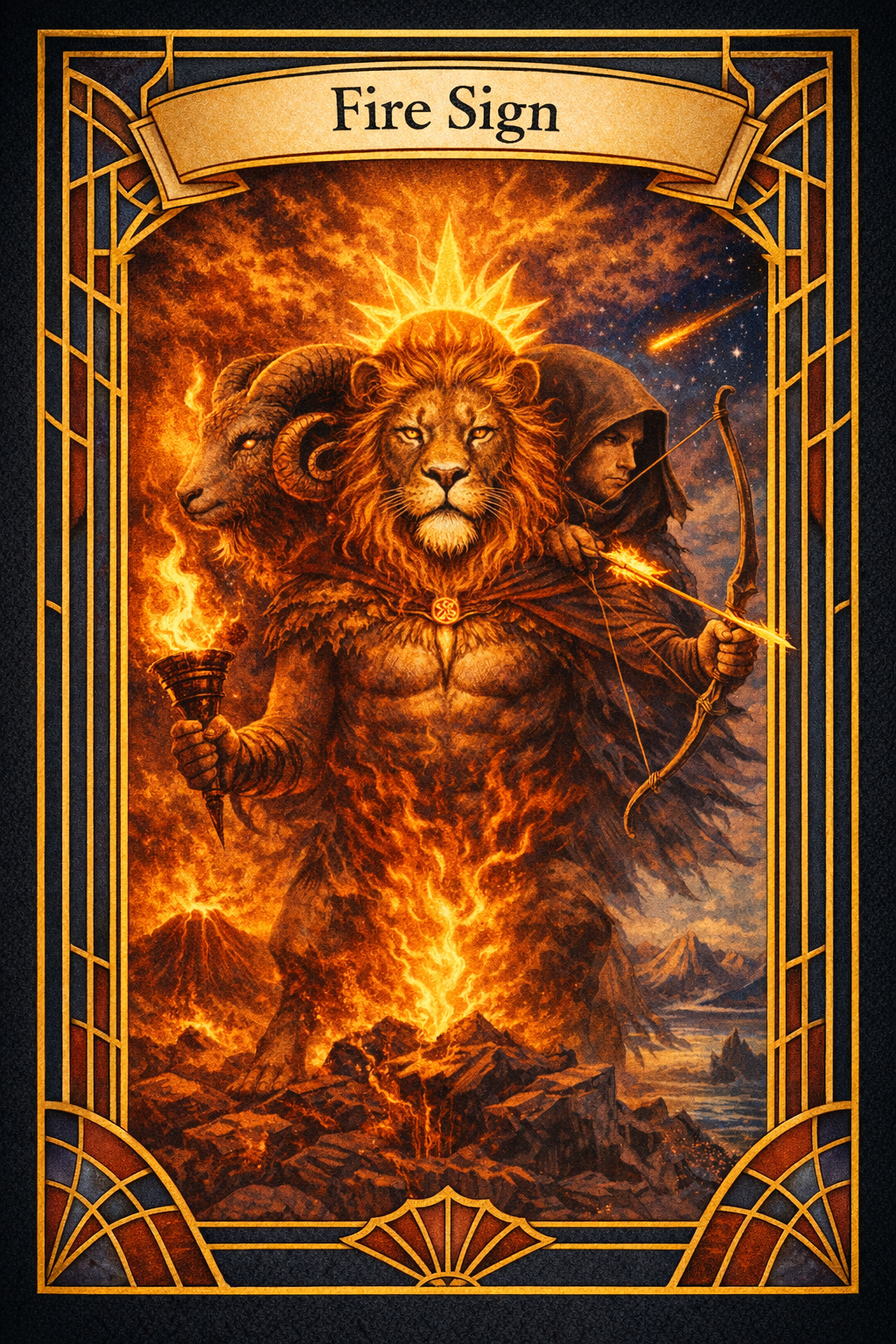
Fire Sign
They say the first flame was not stolen from the gods, but agreed upon—three vows struck in the same breath, three sparks that refused to be separated. When the world was still damp with new-making and the sky had not yet learned to hold its own blue, the Forge of Dawn opened once, and from it stepped the Fire Sign: a single presence with three faces, each burning toward a different horizon.
The first face was the Ram, horned with beginnings. It carried the tinder of firstness—the courage to move before certainty, the holy impatience that turns thought into action. Wherever its hooves struck, the ground remembered how to be a path. The Ram’s fire was the match: brief, bright, and absolute, daring the darkness to argue.
The second face was the Lion, crowned with a sun that never set. It bore the ember of radiance—the warmth that gathers others close, the steady blaze of heart and pride, the insistence that life should be lived loudly and honestly. The Lion’s fire was the hearth: sustaining, generous, and dangerous to those who would starve it with shame.
The third face was the Archer, whose arrow was a comet and whose gaze was always farther than the map. It carried the coal of meaning—the hunger for truth, the laughter that survives ruins, the faith that tomorrow can be hunted and found. The Archer’s fire was the wildfire: untamable, cleansing, and merciless to deadwood.
In the oldest telling, these three were separate stars, each jealous of its own heat. They burned alone until the Night Between Seasons came—a long dusk that threatened to cool the world into stillness. The Ram charged the dark and found it endless. The Lion roared at the void and heard only echo. The Archer loosed arrow after arrow, but the distance swallowed every spark.
So they met at the edge of the unlit sea and made a pact: No flame survives by itself. The Ram would lend the courage to begin, the Lion would lend the courage to be seen, and the Archer would lend the courage to go on. They braided their fires into one sign, a trinity that could not be extinguished by doubt, silence, or despair. The Night Between Seasons broke, not from force, but from the world remembering its own will to burn.
Since then, the Fire Sign appears when a seeker stands at a threshold that requires more than desire. It comes to those who must act without permission, create without applause, or chase a truth that will cost them comfort. Its myth warns that fire can become arrogance, recklessness, and scorched earth—yet it also teaches that controlled flame is the oldest form of hope: a light made by living hands.
Those who draw the Fire Sign are said to feel three things at once: the urge to start, the need to shine, and the call to venture. And if they listen closely, they can hear the card’s quiet law beneath the crackle: Begin. Be bold. Go farther.