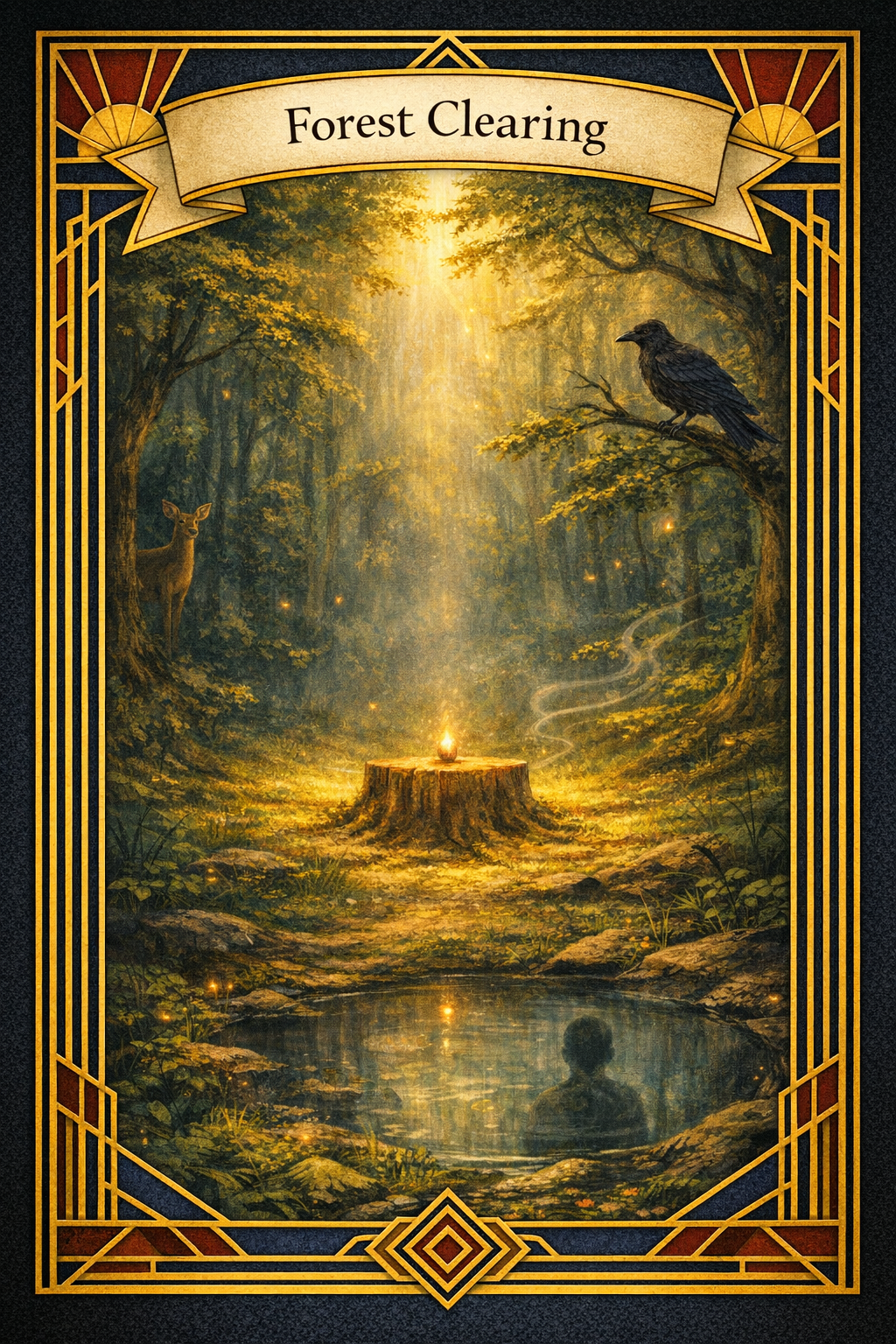
Forest Clearing is the seventeenth hush between trees—the place the woods forget to be a maze. In the oldest stories it was not made by axe or fire, but by consent: the forest itself drawing back its branches the way a crowd parts for a truth it cannot deny. Travelers spoke of it as a wound in the green, and as a healing at the same time.
They say the Clearing first appeared when a hunter lost his way and, in fear, began naming every tree he passed so he would not vanish without record. Birch, ash, alder—each name was a nail driven into panic. The forest listened. It had carried nameless footsteps for centuries, but the hunter’s naming was different: not ownership, but witness. When his voice finally broke, the trees loosened their grip. A circle of light opened, and he stepped into it as if into a held breath. In that circle he could not lie, because there was nowhere for a lie to hide.
Since then the Clearing has been known as the forest’s honest room. It is said to appear only when the seeker has walked long enough to be emptied—when the mind’s undergrowth has been trampled flat by repetition, when excuses have snagged and torn away on brambles. The Clearing does not reward virtue or punish vice; it simply reveals what remains after the story you tell yourself has run out of words.
In the mythos, the Clearing is tended by no single spirit, but by three quiet presences that never show their faces. The First is the Deer-that-Does-Not-Flee, which stands at the edge and watches until your heartbeat matches the rhythm of leaves. The Second is the Crow-that-Does-Not-Caw, which perches above and keeps your secrets without judging them. The Third is the Wind-that-Does-Not-Answer, which moves through you and does not comfort, does not accuse—only passes, as time passes. Together they form a tribunal without verdict, a sanctuary without softness.
Those who enter the Clearing are offered one of two gifts, though the forest never announces which. Some find a stump in the center, freshly cut though no blade has touched it, and on it rests a single seed. Plant it, the stories say, and it will grow into whatever you have been refusing to begin. Others find a shallow pool that reflects not their face but the face of the person they are becoming if they continue as they are. The pool is not prophecy; it is consequence made visible.
No one stays long. The Clearing is not a home; it is a moment of alignment. To linger is to feel the edges of the circle begin to close, not with menace but with inevitability, as if the forest is saying: you have seen enough—now go and live with it. Those who try to mark the way back find their carvings healed over by morning, their ribbons woven into nests, their cairns scattered into the underbrush. The Clearing cannot be hoarded. It is encountered, endured, and left.
In some regions the myth warns that the Clearing can also appear indoors—between two sentences in an argument, in the pause after a door shuts, in the stillness before an apology. Wherever the mind stops running and stands in its own light, the forest has made room.
Thus Forest Clearing became a card for the threshold between confusion and simplicity. Not the end of the journey, but the first place where the traveler can finally see the path they have been walking—without the trees of fear, desire, or habit leaning in to make it look like something else.