Tarot's Landing / Cosmos / Readings
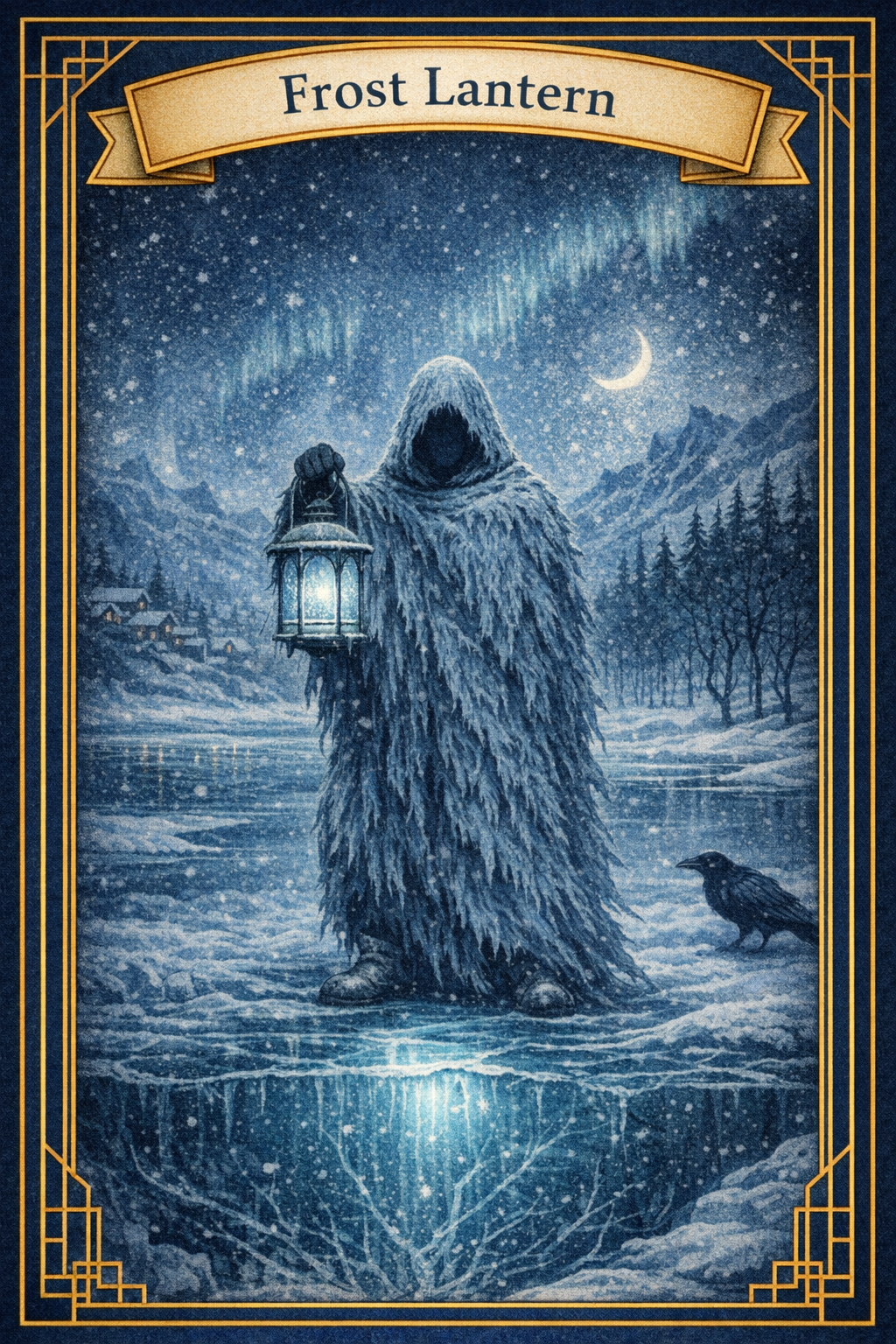
Frost Lantern card art

Card Page

Frost Lantern

In the first winter, when the world’s breath still steamed and the mountains had not yet learned the patience of stone, the night came too early and stayed too long. Wolves forgot their own names. Rivers stiffened in mid-sentence. Even the stars looked brittle, as if one hard thought might shatter them.

It is said a traveler walked then—neither man nor woman, neither young nor old—wrapped in a cloak sewn from the last warm day. They carried no torch, for fire was a thing the cold could steal; no lamp, for oil thickened into silence. They carried only an empty lantern of pale metal, its glass unlit and clouded like a blind eye.

The traveler reached the edge of a village that had begun to unmake itself. Doors were nailed shut from the inside. Bread was rationed by memory. Mothers held their children close, trying to lend them heat with stories, but the stories froze in their mouths. At the center of the square stood a well, capped with ice, and beneath that ice the water still moved—slow, stubborn, alive.

The traveler knelt and lowered the empty lantern into the well.

The villagers watched, thinking it a foolishness born of cold. But when the lantern touched the water, the well did not darken it. The water did not fill it. Instead, the lantern drank the hidden motion of the spring—the part of water that remembers it is not ice. It drew up a light that was not flame: a steady, blue-white radiance, like moonlight taught to be kind.

The traveler lifted the lantern from the well, and the light did not melt the snow. It did not banish winter. It simply made the cold honest. Shadows stopped lying. The wind’s teeth dulled. The villagers could see their own footprints and know they were still moving forward.

Word spread. People came from farther valleys, from roads that had become rumors. Some arrived with frostbitten hands; some with grief so old it had crystallized. Each asked for heat, for summer, for rescue. The traveler offered none of these. They held up the Frost Lantern and said: This is not warmth. This is witness.

Those who walked by its glow found strange mercies. Lost paths revealed themselves as pale threads across drifts. Frozen locks remembered their keys. The dead, buried too shallow in the sudden ground, were seen and honored before snow could erase them. Predators turned away—not from fear, but because the light made them visible, and visibility is a kind of boundary.

Yet the lantern did not shine for everyone.

A merchant tried to buy it, promising stores of coal and casks of wine. The lantern dimmed until it was only glass. A king demanded it, believing he could rule winter itself. The lantern’s light sharpened into a glare that showed the king’s crown as a ring of hoarfrost, beautiful and temporary. A priest begged to enshrine it, to name it miracle and build a doctrine around its glow. The lantern fogged over, refusing to be an altar.

For the Frost Lantern does not belong to those who would use it. It belongs to those who will carry it.

At last the traveler came to a lake sealed in ice so thick it held entire forests of trapped air. Beneath, something ancient slept—some say a sorrow the world could not bear to remember; some say a hunger that learned to imitate peace. The traveler set the lantern upon the ice and watched its light seep downward, thread by thread, into the dark. The lake groaned. The cold deepened. The traveler’s cloak stiffened into a shell of rime. And still the lantern shone, not fighting the ice, but teaching it the shape of truth.

When dawn finally returned—thin as a blade, reluctant as forgiveness—the traveler was gone. Only the lantern remained, half-buried in snow, its glow steady and quiet. Those who found it later discovered it could be lit only in certain hands: hands that had endured, hands that had let something die without letting themselves become stone.

Thus the Frost Lantern entered the hidden deck of the world, a card that appears when the seeker stands at the threshold of numbness—when feeling has frozen, when hope has become too heavy to lift, when the night is long enough to convince the heart it has always been night.

Its myth is simple and severe:

Winter is not defeated by fire alone. Sometimes the only way through is a light that does not promise comfort, only clarity—a lantern that burns with the refusal to lie.

And if you draw it, you are being asked the traveler’s question, the one the light always asks without words:

What will you do, now that you can see?
Interpretation

Frost Lantern — Interpretation

Core Message

Clarity without comfort. The Frost Lantern appears when you can no longer rely on warmth, reassurance, or easy hope—and are being offered something sterner: truthful seeing. This card marks a threshold where numbness, endurance, and honesty become the only viable tools.

Themes

  • Witness over rescue: You may not get immediate relief, but you can get accuracy.
  • Cold honesty: Illusions, excuses, and comforting stories fall away; what remains is real.
  • Endurance with feeling intact: Survival that doesn’t harden into cruelty or denial.
  • Boundaries through visibility: What is revealed can be named, honored, and contained.

What It Signals Now

  • A season where progress is measured by footsteps, not by transformation.
  • The need to stop bargaining (for a shortcut, a savior, a guarantee) and start observing what is actually happening.
  • A moment to acknowledge grief, loss, or fatigue directly—so it doesn’t silently govern you.
  • Guidance that comes as recognition: the path is visible, even if it is not easy.

Guidance / How to Work With It

  • Ask: What is true, even if it isn’t soothing?
  • Choose the next right step, not the perfect outcome.
  • Let the light fall on what’s been avoided: an ending, a pattern, a fear, a relationship dynamic.
  • Practice clean boundaries: name what’s present, what’s yours, and what isn’t.
  • Honor what has died or changed; closure begins with accurate witnessing.

In Relationships

  • Reveals the real temperature of a bond: what is sustainable, what is performative, what is frozen.
  • Encourages truthful conversation over emotional theatrics—naming needs, limits, and realities.
  • Supports grief-work: seeing what cannot be restored, and deciding what can still be carried forward with integrity.

In Work / Creativity

  • A call for audit-level honesty: resources, timelines, motives, and risks.
  • Progress through structure and steadiness, not inspiration.
  • The creative gift here is precision—making something that does not flatter, but endures.

Spiritual / Inner Work

  • A lantern for the long night: it won’t promise dawn, but it will prevent self-deception.
  • Invites a devotion to truth as compassion—not harshness, but refusal to lie to yourself.
  • The question it brings: What will you do, now that you can see?

Reversed Interpretation

Frost Lantern — Reversed Interpretation

Core Message

Clarity turns brittle. The Frost Lantern reversed signals truth used as armor, avoidance disguised as “being realistic,” or an overexposure that numbs rather than guides.

Themes

  • Witness becomes detachment: observing without engaging; naming without caring.
  • Cold truth as a weapon: harsh honesty, moral superiority, or “facts” used to shut down feeling.
  • Numbness mistaken for strength: endurance that has hardened into shutdown.
  • Visibility without integration: seeing what’s wrong but refusing the next step, repair, or grief.

What It Signals Now

  • You may be stuck in assessment mode, endlessly diagnosing while life remains unmoved.
  • A tendency to invalidate needs (yours or others’) because they feel inconvenient, messy, or “too much.”
  • Avoidance of mourning: refusing to acknowledge what ended, leading to stagnation and quiet resentment.
  • Suspicion of warmth: rejecting support, tenderness, or hope as naïve—even when it’s appropriate.

Guidance / How to Work With It

  • Ask: What am I calling “truth” to avoid feeling or choosing?
  • Let accuracy include the full data set: facts and emotions.
  • Practice gentle witnessing: name what’s real without turning it into a verdict.
  • Move from exposure to action: one repairing step, one boundary upheld kindly, one honest request made.
  • If you’re overwhelmed by what you see, narrow the beam: focus on the next workable piece, not the whole winter.

In Relationships

  • Indicates emotional frost: distance, withholding, or “brutal honesty” replacing intimacy.
  • Conversations may become interrogations or audits, where being right matters more than being connected.
  • Suggests a need to thaw defensiveness: speak truth with care, and allow vulnerability to coexist with limits.

In Work / Creativity

  • Perfectionism and cynicism: seeing flaws so clearly that nothing can begin.
  • Overemphasis on risk and constraint; analysis paralysis.
  • Corrective: set a small scope, accept an imperfect draft, and prioritize momentum over immaculate certainty.

Spiritual / Inner Work

  • A sign of spiritual wintering without meaning: austerity that becomes self-punishment.
  • Beware turning discernment into judgment—especially toward your own pain.
  • The question shifts to: What would it look like to let what you see change you, softly, instead of hardening you?

Story Beats

Vignette 1

The Well That Remembers

Dialog: Villager: “No torch survives this cold.” Traveler: “Then we borrow the spring’s motion.” Villager: “That isn’t fire…” Traveler: “No. It’s witness. Walk by it.”

Scene: Nighttime village square in the first winter: heavy snow, nailed-shut doors, shuttered windows, and a capped well glazed with thick ice. A cloaked, androgynous traveler kneels at the well, lowering an empty pale-metal lantern on a chain into a dark opening where water can be seen moving beneath ice. A few villagers in layered furs watch from a cautious semicircle, breath visible, faces gaunt. As the lantern rises, it emits a steady blue-white radiance (not flame), illuminating frost crystals and sharpening shadows without melting snow. The light makes footprints in the snow clearly visible, forming a path leading out of the square. Cinematic, high-contrast moonlit palette with the lantern as the only soft glow.

Vignette 2

Not for Sale

Dialog: Merchant: “Name your price—coal, wine, a wagon of gold.” Traveler: “It won’t shine for wanting.” Merchant: “Then make it.” Traveler: “You can’t own clarity. Only carry it.”

Scene: A wind-scoured road at dusk, snow blowing sideways. A richly dressed merchant in a fur-lined coat and jeweled gloves stands beside a half-buried wagon, offering an open purse and a glinting ring. Opposite, the traveler holds the Frost Lantern at chest height. As the merchant leans in, the lantern’s blue-white glow fades until it looks like ordinary clouded glass, reflecting only the merchant’s greedy face. The traveler remains calm and still, cloak edged with rime. The scene emphasizes contrast: opulent items bright against a bleak white landscape; the lantern visibly dim, refusing to cooperate. Tight framing, tense negotiation posture, no warmth anywhere.

Vignette 3

Threading the Dark Lake

Dialog: Companion (whispering): “Do you feel it under the ice?” Traveler: “Yes. Something pretending to sleep.” Companion: “Will the light melt it?” Traveler: “No. It will tell the truth.”

Scene: A vast frozen lake under a starless, brittle sky. The ice is thick and glassy, filled with trapped air-bubbles like pale forests suspended within. At the center, the traveler sets the Frost Lantern on the ice. Its blue-white light seeps downward in thin, threadlike beams, penetrating into deep black water below. Subtle cracks and stress lines radiate outward; the lake surface looks tense, as if groaning. The traveler’s cloak has stiffened with rime, edges crusted and shell-like. A second figure (a wary companion or distant onlooker) stands back near a snowbank, half-obscured by blowing spindrift. The mood is ominous and quiet: the lantern does not melt anything, but reveals depth, pressure, and an ancient presence hinted at by a darker shape far beneath the ice.