Tarot's Landing / Cosmos / Readings
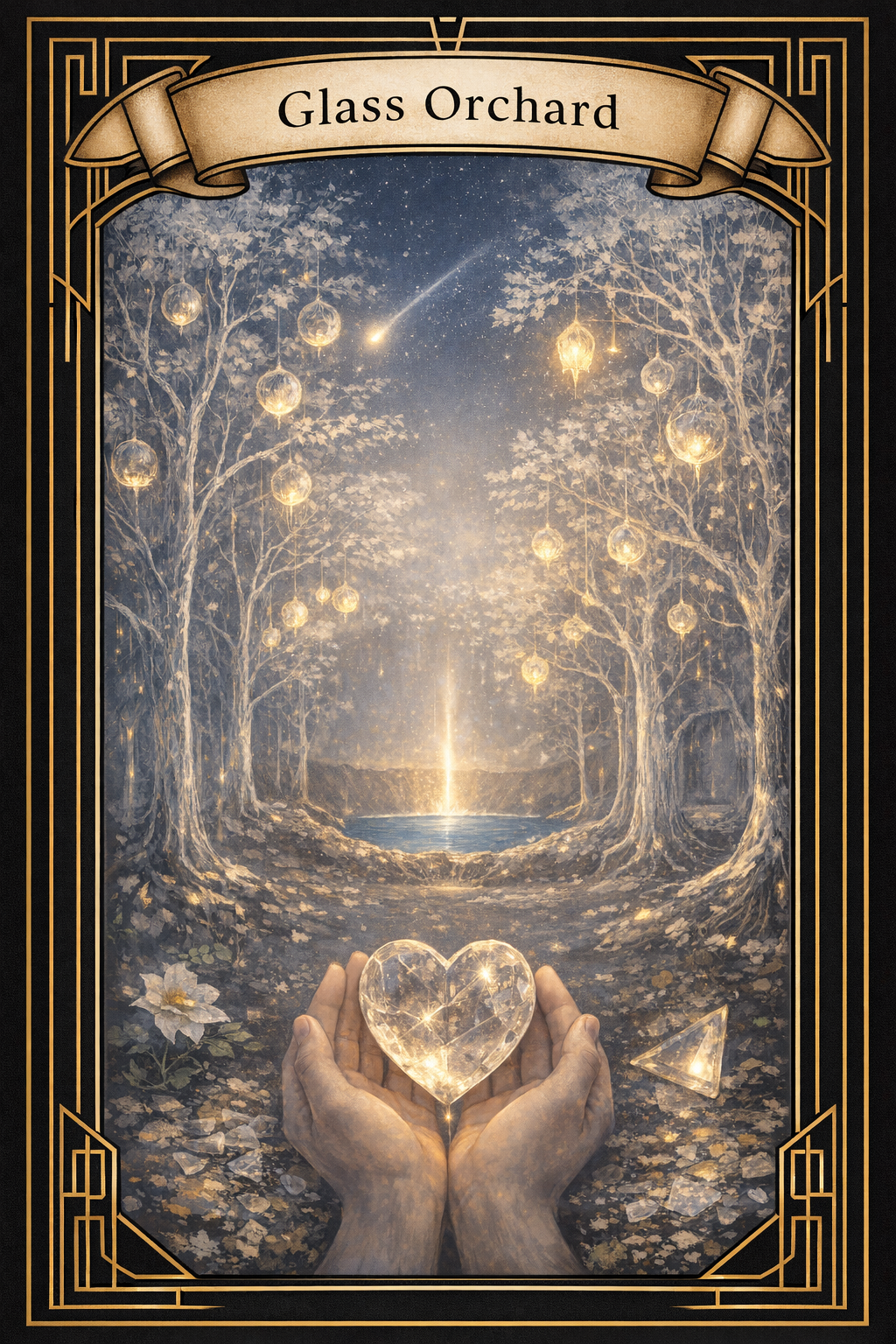
Glass Orchard card art

Card Page

Glass Orchard

Glass Orchard is the card of cultivated fragility: a grove that bears fruit only because it is carefully, constantly tended, and a harvest that shatters the moment it is taken for granted.

In the oldest telling, the Orchard was planted where a meteor of clear stone struck the earth and left a crater that would not fill with water. The villagers found the soil glittering, sharp as ground sugar, and nothing would root in it—until a widow pressed her palms into the dust and wept for a season that never returned. Her grief salted the crater, her patience warmed it, and from that impossible bed rose saplings with translucent bark. Their leaves chimed against one another like thin cups. Their blossoms were small lanterns. Their fruit looked ripe long before it could be touched.

The first keeper of the Orchard learned the law that governs the card: glass does not grow; it is grown. Each tree required a ritual of restraint. To prune too boldly made the branches craze with hairline fractures. To neglect them made the trunks cloud and thicken into useless opacity. The keeper fed the roots with springwater carried in covered jugs so no dust could fall in. She spoke to the trees at dawn, because the Orchard listened best when the world was quiet and the air was cool enough to hold its shape.

When the villagers finally tasted the fruit, they found it held a sweetness that was not flavor but memory: the tartness of first love, the warmth of a lost kitchen, the clean sting of forgiveness. The fruit did not fill the belly. It filled the hollow behind the ribs. Those who ate too much became addicted to what it returned to them and began to steal from one another, not for hunger, but for the right to feel whole again.

So the keeper made a covenant with the Orchard: no fruit would be taken without an offering of something equally delicate. A promise kept against convenience. A truth spoken when silence would have been safer. An apology given without expectation of being absolved. The Orchard accepted only what could break.

In later myths, the Orchard is said to appear at the edge of any life that is becoming too hardened. Travelers describe finding it in a fog, in the heart of a city lot where nothing should grow, or behind a childhood house that no longer exists. The trees always look different, but the sound is the same: a faint, constant tinkling, like distant ice settling. If you enter, you cannot bring armor. The branches will catch it and sing until you remove it, or until you leave.

The card warns that beauty maintained is not the same as beauty possessed. It teaches that what is transparent is not necessarily simple, and what is brittle is not necessarily weak. In the Glass Orchard, the most resilient thing is the hand that learns to hold without gripping.

The final story says the keeper, old and tired, once tried to harvest a perfect fruit—one without a single bubble, seam, or flaw. She reached for it with an unshaking hand, certain she had earned it. The fruit broke at her touch and fell soundlessly into the glittering soil. Where it shattered, a new sapling rose, finer than the rest, bearing fruit that would never be perfect, but would always be true.

Thus the mythos of Glass Orchard: a sanctuary for tenderness, a lesson in stewardship, and a reminder that the most precious harvest is the one you can carry without closing your fist.
Interpretation

Glass Orchard — Interpretation

Essence: Cultivated fragility, stewardship, and tenderness maintained through conscious care. A reminder that what is precious thrives under attention, boundaries, and gentle handling—not possession.

Themes

  • Beauty that must be tended, not taken for granted
  • Restraint as devotion; maintenance as love
  • Transparency without simplicity: clear needs, complex feelings
  • Nourishment that is emotional and mnemonic rather than practical
  • The cost of craving wholeness through external sweetness
  • Holding with an open hand: care without control

When this card appears

  • You are being asked to care for something delicate: a relationship, trust, healing, creativity, sobriety, reputation, or a new life structure that can’t survive rough handling.
  • What you want is available, but it requires ritual and consistency—small, repeated acts done with intention.
  • There is a lesson in limits: what you can access only if you approach without armor, defensiveness, or entitlement.

Guidance

  • Tend the roots: prioritize the conditions that keep something clear—rest, honesty, clean routines, quiet time, and protected space.
  • Prune with humility: refine without overcorrecting. Improvement that is too aggressive creates fractures.
  • Make offerings that can break: choose the brave, delicate acts—an apology, a kept promise, a truthful conversation, a boundary stated kindly and firmly.
  • Savor, don’t binge: if something makes you feel whole, treat it as sacred medicine, not an endless supply. Let it nourish, then step back.

Relationship & emotional meaning

  • A bond can deepen through careful honesty and gentle consistency.
  • Trust is present but brittle; it will not survive grasping, testing, or “proving” games.
  • If reconciliation is sought, it requires soft courage: truth spoken without weapons, accountability without theatrics.

Work, creativity & material meaning

  • Your project is viable if you build protective structure around it: timelines, boundaries, and quality control.
  • Success comes from craftsmanship and patience, not speed.
  • Beware of chasing perfection; it can shatter momentum. Aim for true rather than flawless.

Shadow to watch

  • Addiction to nostalgia, validation, or emotional “sweetness” that replaces real nourishment.
  • Taking what is beautiful as a right instead of a gift.
  • Hardening to avoid vulnerability—becoming opaque to protect yourself.

Core message

What you want can be held—if you hold it without closing your fist. Stewardship, not possession, is the path to lasting beauty.

Reversed Interpretation

Glass Orchard — Reversed Interpretation

Essence: Neglect, grasping, or over-control that turns tenderness into fracture. Beauty treated as entitlement, care treated as optional, and transparency replaced by clouded avoidance.

Themes

  • Taking for granted what requires upkeep
  • Possessiveness: gripping, testing, demanding proof
  • Over-pruning: perfectionism that damages what it tries to refine
  • Emotional bingeing: chasing sweetness instead of nourishment
  • Opacity: avoidance, secrecy, defensiveness, hardened self-protection
  • Broken covenants: promises made for comfort, not kept under strain

When this appears

  • Something delicate is being handled too roughly (words, expectations, timelines, pressure).
  • You may be trying to harvest results before ripeness—forcing clarity, commitment, healing, or creativity.
  • A relationship or process is asking for maintenance, but resentment or fatigue is leading to withdrawal or corners being cut.
  • You’re seeking wholeness through an external source (attention, nostalgia, a person, a habit) and the craving is driving theft—of time, integrity, trust, or self-respect.

Guidance

  • Stop gripping. Loosen demands, interrogations, and “prove it” dynamics; they create cracks.
  • Repair the conditions, not the surface. Restore sleep, routine, honesty, and protected space before expecting sweetness.
  • Choose one breakable offering. A clean apology, a kept promise, a truthful admission—small, real, and sustained.
  • Let it be imperfect. Trade flawlessness for sincerity; aim for “true” and workable, not pristine.
  • If you’re armored, name it. Identify what you’re protecting and what it’s costing; soften strategically, not performatively.

Relationship & emotional meaning

  • Trust is brittle or splintering: defensiveness, scorekeeping, manipulation, or emotional extraction.
  • One or both parties may be using tenderness as a resource rather than a mutual practice.
  • Reconciliation is blocked by entitlement or avoidance; repair requires accountability without theatrics and boundaries without punishment.

Work, creativity & material meaning

  • A project is suffering from rushed harvesting, harsh critique, or constant reworking that kills momentum.
  • Quality is clouding from neglect (missed details, inconsistent care) or from over-control (micromanagement, fear-driven perfectionism).
  • Build structure that protects fragility: fewer commitments, clearer scope, slower iteration, and realistic timelines.

Shadow to watch

  • Addiction to validation, nostalgia, or emotional intensity as a substitute for steadiness.
  • Turning vulnerability into leverage—or refusing vulnerability and calling it strength.
  • “If I can’t have it perfectly, I won’t have it at all.”

Core message

What you’re reaching for will keep breaking until you stop treating it as a possession and return to stewardship: consistent care, honest limits, and an open hand.

Story Beats

Vignette 1

Dawn Tending

Dialog: Easy now—no bold cuts. Hear that chiming? They’re telling you where the strain is. Keep the water covered; one grain of dust and the trunk will cloud.

Scene: Early dawn in a crater-like orchard. Translucent trees with glassy bark and thin, cup-like leaves hang overhead, catching pale blue light. A lone keeper (middle-aged woman, practical clothing, sleeves rolled) kneels beside a sapling, holding small pruning shears with extreme care. In her other hand is a covered ceramic jug of springwater, lid slightly lifted. The air looks cool and still, with faint mist. Leaves and branches create delicate highlights and tiny hairline fractures where trimmed too sharply. The mood is quiet, reverent, and meticulous; subtle glints in the glittering soil like ground sugar.

Vignette 2

The Offering

Dialog: You want fruit? Then give something that can break. Say the truth you’ve been swallowing. Not a coin, not a vow you won’t keep—something fragile, and real.

Scene: A small clearing within the Glass Orchard at twilight. A villager (young adult, anxious posture) stands before a low stone basin at the base of a luminous glass tree. The tree bears lantern-like blossoms and a few ripe-looking, translucent fruits that glow softly. The keeper stands beside the basin, calm but firm, hands open. The villager’s armor and metal trinkets lie off to the side on the ground, as if removed before entering. The basin contains a single delicate object—perhaps a folded paper confession or a thin glass token—symbolizing a fragile offering. The atmosphere feels tense yet intimate; the leaves chime faintly, and the glittering soil reflects the fruit’s light.

Vignette 3

The Perfect Fruit Shatters

Dialog: I thought I’d earned the flawless one. Look—no bubble, no seam… and still it breaks. Maybe the Orchard never wanted perfection. Only a hand that doesn’t close.

Scene: Close-up, emotionally charged scene beneath a mature glass tree. An elderly keeper with weathered hands reaches toward a pristine, crystal-clear fruit hanging at eye level. The moment of contact is captured as the fruit fractures into clean shards, falling silently into sparkling soil. Where it lands, a tiny new sapling is already rising—finer, more delicate, catching light like spun glass. The background shows multiple translucent trunks and chiming leaves, softly out of focus. Lighting is gentle and cool, with a faint halo around the shattered fruit and the newborn sapling. The keeper’s expression is tender, humbled; her hand is open, not grasping.