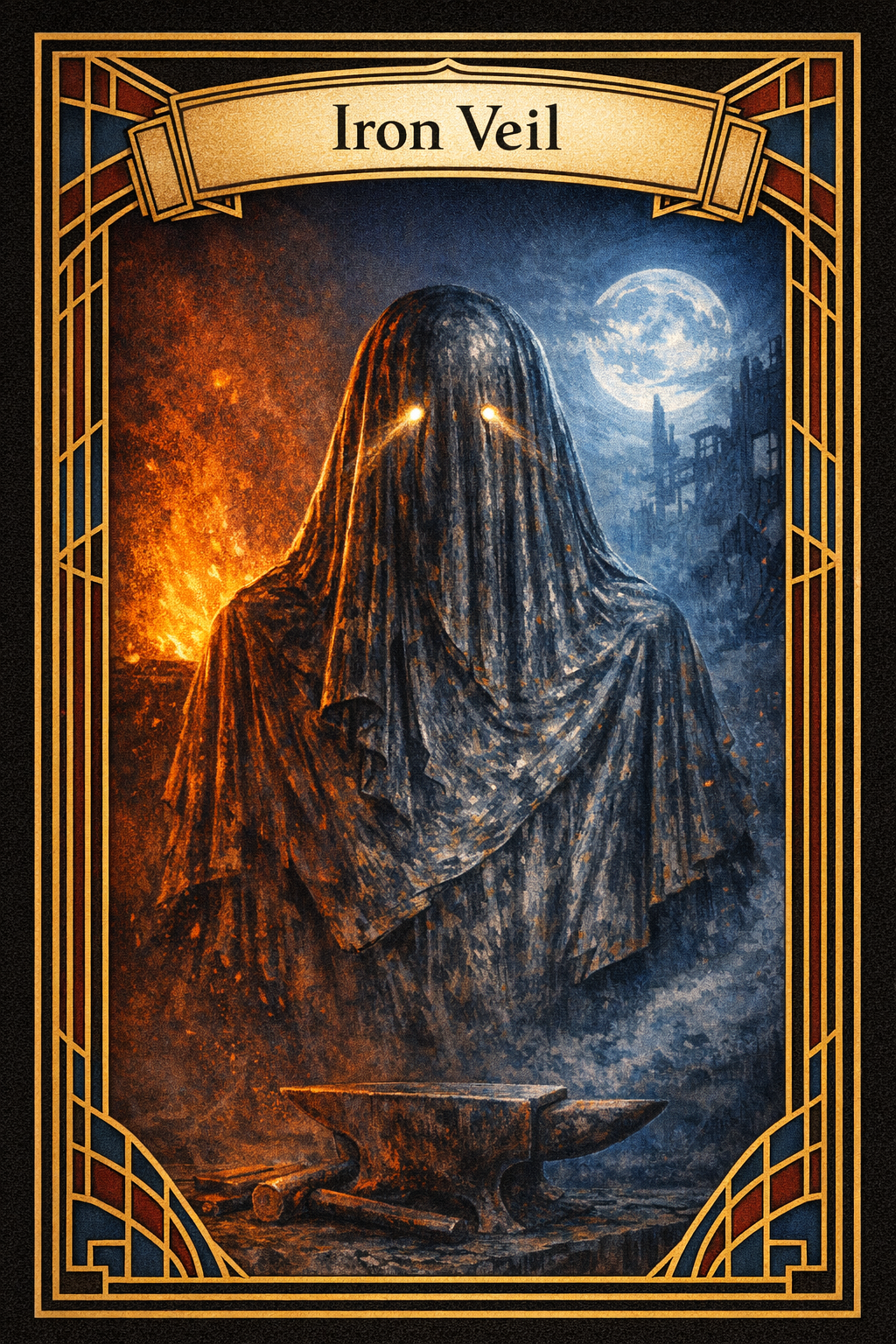
Iron Veil is the card that does not arrive in a deck—it appears. Found slipped between lamination and paper, pressed into the gutter of old books, sewn into coat linings, or left on the anvil after a fire has died, it bears no suit and no number. Its face is a sheet of dark metal, thin as hammered foil, draped like cloth over a silhouette that might be a saint, a prisoner, or an empty stand. Where the eyes should be, two pinholes pierce the iron; when held to the light, they reveal nothing behind them, only light itself, as if the card is looking through you rather than at you.
The oldest tale says Iron Veil was not painted but forged in a city that no map admits existed—an industrial sanctuary built around a single furnace that never cooled. There, a veiled smith served a covenant of oracles who had grown tired of prophecy’s softness: the way fate could be argued with, reinterpreted, made lyrical. They demanded a truth that could not be bargained with. The smith agreed, but warned them that truth, once given a body, would behave like metal—conducting heat, taking shape, and cutting.
For nine nights the oracles brought offerings: a lock of hair from a condemned innocent, a nail from a gallows, a mirror that had reflected a betrayal, a coin taken from the mouth of a corpse. On the tenth night they brought the last thing required: a secret none of them had spoken aloud. Each whispered theirs into the furnace. The fire inhaled, and the forge rang with a sound like a bell struck underwater.
The smith hammered the secrets into a veil.
They expected a mask for the future; they received a curtain for the present. When the Iron Veil was raised between question and answer, it did not show what would happen. It showed what had already been decided—by fear, by habit, by oath, by the unspoken agreements that bind a life tighter than chains. The oracles recoiled. Their visions had always been distant storms; now they could feel the rivets in the air.
In some versions of the myth, the smith was the first to draw the card and vanished behind it, leaving only the echo of a hammer in empty streets. In others, the smith remained, but the veil fused to their face, and from then on every word they spoke came out as law. Either way, the forge went cold. The city dissolved into rumor. The card endured.
Iron Veil’s myth is preserved in marginalia: warnings written by readers who felt the card watching them from the page. “Do not ask it to reveal,” one note says. “It will reveal you.” Another: “It is not a door. It is a seal.” Some claim it was made to restrain a god of disclosure—an entity that devoured lies and left only unbearable clarity. The veil, then, is not meant to hide truth but to keep truth from consuming the world too quickly. Others insist it was forged to protect mortals from their own futures, because a known destiny becomes a prison built with your own hands.
Those who speak of Iron Veil as a spirit rather than an object tell of the Veiled Warden, a figure that walks the boundary between confession and consequence. It appears when a promise has been broken in the heart but not in the world; when a violence is planned but not yet done; when love is withheld until it curdles into leverage. The Warden does not punish. It simply places the veil where you can no longer pretend you do not know what you are doing.
Legends agree on one detail: the card cannot be destroyed. Burn it and the ash gathers itself into a thin gray sheet. Tear it and the rip becomes a seam, stitched shut with invisible wire. Bury it and it returns in the pocket of the one who buried it, colder than before. The only way to be rid of Iron Veil is to give it away willingly—without trick, without resentment, without the desire to see it harm the next hand. And even then, the myth says, the veil does not leave you. It merely moves from the palm to the mind.
There is a final story told in quiet workshops, where the air tastes of iron filings and old prayers. It says the veil was never meant for oracles at all. It was made for the world itself, as a mercy: a thin barrier between what is true and what can be endured. Each time someone draws Iron Veil, the barrier is tested. If they accept what they see without flinching into cruelty or despair, the veil holds. If they use the revelation as a weapon, it grows heavier, until one day it will drop—not on one face, but on everything.
And then, the myth concludes, the age of interpretation will end. The age of consequence will begin.