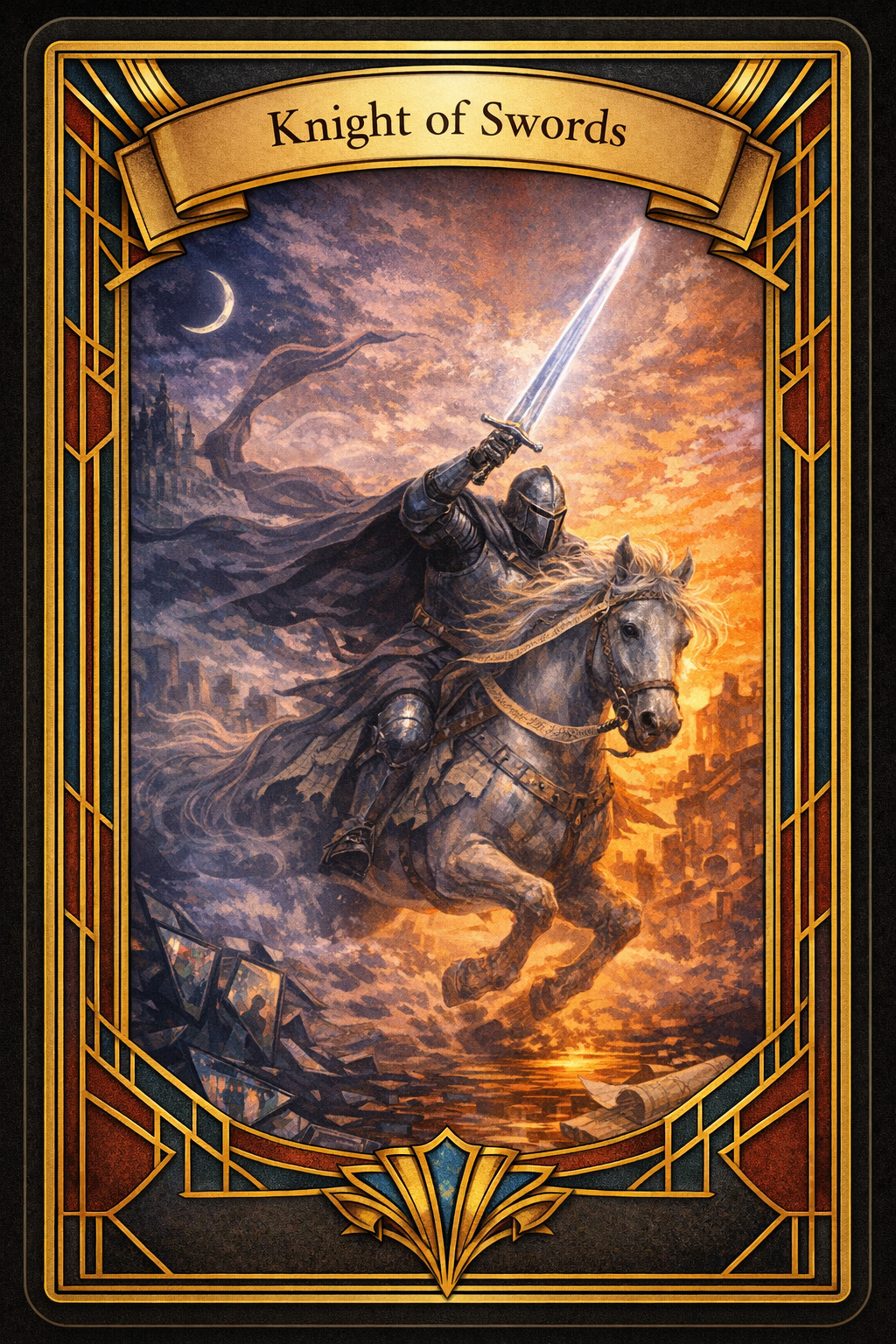
The Knight of Swords is said to have been born in the thin hour before dawn, when the sky is neither night nor day and every boundary is undecided. In the oldest telling, he was not raised by a house or a heraldry, but by a question that would not let the world sleep. That question took the shape of a wind that worried at shutters and candleflames, and it followed him as a boy follows a drum—down alleys of rumor, across fields of half-truth, into courts where silence was sold as wisdom.
His sword was not forged in fire, but in argument. The smith who made it is unnamed, because the tale insists the blade was hammered from syllables: every blow a premise, every quench a doubt. When the sword was finished it made no music when drawn, only a clean, bright absence—as if it cut away the air that might have carried excuses. Those who have held the card close claim they can hear it anyway, not as a sound, but as the sudden clarity that arrives when a lie has nowhere left to stand.
He rides a horse the color of stormlight, a creature that does not rear but leans forward, always. The bridle is a strip of parchment inked with vows, and the saddle is stitched from maps of places he has not yet been. In some versions the horse is called Rhetoric, in others Momentum; either way it is sworn to outrun hesitation. The Knight’s armor is plain—no crest, no ornament—because he does not want to be remembered for anything but the direction he chose.
They say he first earned his name in the City of Mirrors, where every citizen spoke in reflections: you heard not what was true, but what you wanted to believe. The Knight rode in at noon and asked a single question aloud. The question is never quoted, because it changes with the listener, but its effect is always the same: the mirrors fog, the façades crack, and the city’s language becomes suddenly expensive. The people begged him to stay and govern, to make their speech honest by force. He refused, because the myth warns that truth imposed becomes another kind of lie. Instead, he left them with a rule: “Let your words be sharp enough to cut, and your hands gentle enough to bind.”
His greatest enemy is not a tyrant or a dragon, but the Fog-Queen—an old power that feeds on delay. She does not attack; she suggests. She lays soft alternatives in the road like quilts: later, perhaps, what if, it’s complicated. Against her, the Knight’s charge is both medicine and hazard. He can scatter her veils with a sentence, but he can also wound the innocent with the same stroke if he forgets to look.
There is a parable bound to the card that every reader learns: the Knight once came upon a bridge guarded by a troll who demanded riddles and tolls. The Knight did not bargain. He did not fight. He simply named the troll’s hunger—fear dressed as cleverness—and the creature shrank, exposed by being understood. The bridge held. The lesson is that some obstacles are maintained only by the belief that they cannot be crossed.
Yet the mythos does not paint him as saint. In the Book of Splintered Oaths, he rides into a village where a mother weeps for her missing child. The Knight deduces, swiftly and correctly, that the child ran away—no kidnapping, no curse, only a choice. He speaks the truth with the speed of a thrown knife, and the mother’s grief changes shape into anger. The village turns cold. In that telling, the Knight learns the darker edge of his gift: accuracy is not mercy, and certainty does not absolve cruelty. He leaves his cloak behind as penance, and the villagers use it to wrap their lanterns, so their light will be less harsh.
Because of this, the card carries two names in the oldest decks: The Rider Who Cuts and The Rider Who Clears. To draw him is to invite a force that hates stagnation and loves the clean line of decision. He arrives when a mind has been circling the same thought until it becomes a cage, when a truth is waiting to be spoken, when a choice must be made before time makes it for you.
In the final legend, the Knight rides at the end of the world to meet a door made of ice. Behind it, they say, is the last unanswered question. He raises his sword, but does not strike. Instead he presses the flat of the blade to the frozen surface and listens—because even the swiftest mind must sometimes pause to hear what it is about to change. The door melts, not from violence, but from understanding. And the Knight rides through, not to conquer what lies beyond, but to name it—so it can no longer hide.