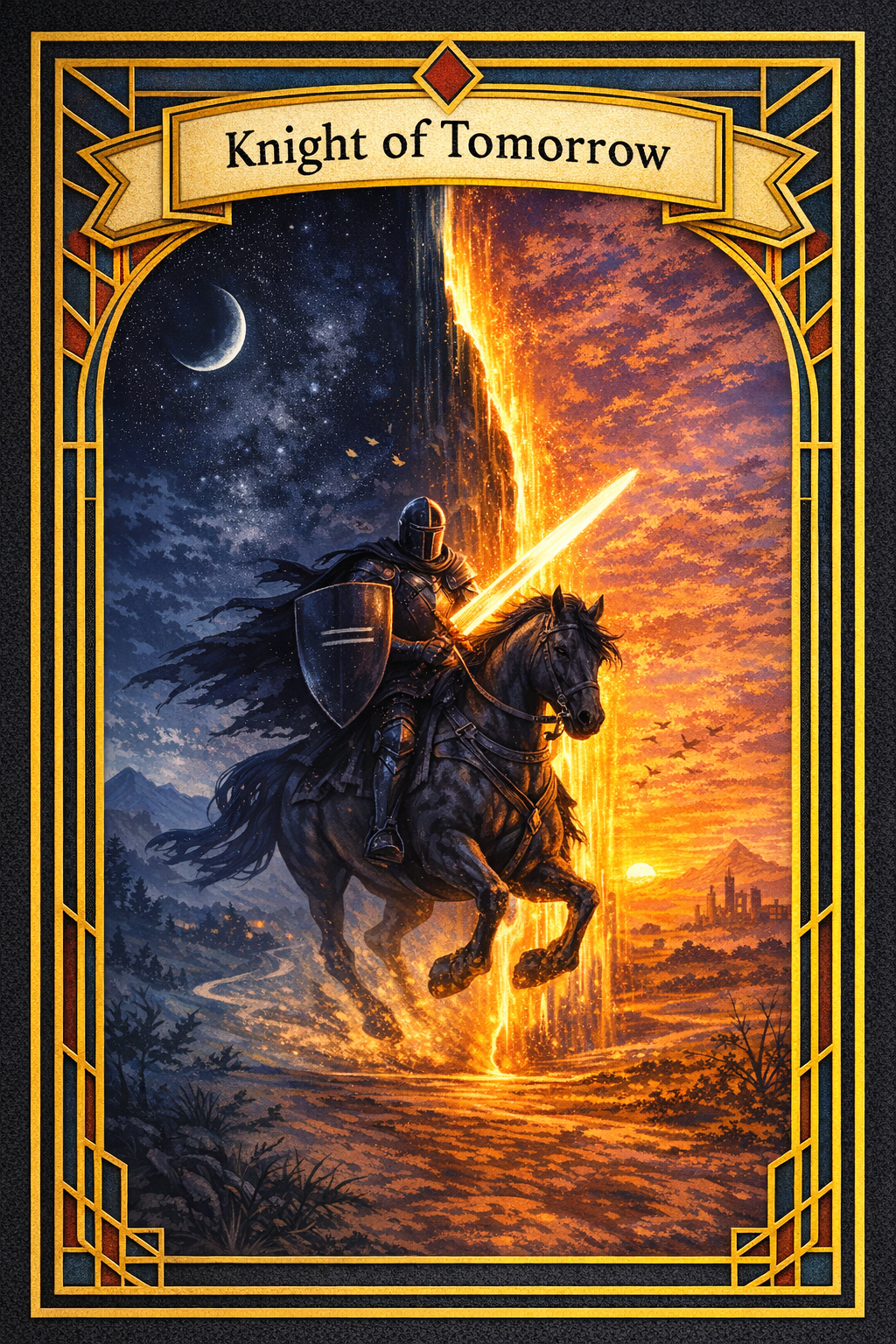
Knight of Tomorrow — Mythos
They say the first dawn was not born of sun or flame, but of a vow made in the dark.
In the age when the world still argued with itself about what it would become, the roads did not run straight. Paths doubled back, bridges led to rivers that had not yet decided where to flow, and towns woke to find their names changed overnight. In those unsettled days, people learned to live by omens and to bargain with chance—until a rider appeared on the horizon wearing armor that caught no light, as if it were forged from the pause between seconds.
No one saw the Knight of Tomorrow arrive. They only noticed what followed: the sound of hooves where there had been silence, the scent of rain before clouds formed, the sudden certainty that a door could be opened even if it had never been built.
The Knight carried no banner of any kingdom. His crest was a simple mark—two parallel lines that never met—etched into his shield like an unfinished equation. He spoke rarely, and when he did, his words felt like instructions remembered rather than advice given. He asked not for coin or shelter, but for promises: a farmer’s promise to plant again after blight, a widow’s promise to laugh once more, a child’s promise to learn the true name of fear and still walk forward.
Those who tried to follow him found the road strangely altered. Behind his horse, ruts became grooves, grooves became tracks, and tracks became something like a map. It was said the Knight did not predict the future—he trained it. He rode through villages where people awaited miracles and left them instead with tools, plans, and the uncomfortable gift of responsibility. He would set a broken wheel upright, then place the hammer in another’s hand. He would point to the horizon, then make the traveler take the first step.
Yet the Knight’s greatest power was not in making new things, but in refusing old endings.
When warlords sought to trap him with prophecies—“You will fall at the third gate,” “You will drown under a sky without stars”—the Knight answered by changing the meaning of the gate and teaching the river to run elsewhere. Seers hated him for this. Priests feared him. Kings tried to recruit him and failed, for he would not pledge to crowns that demanded the future as tribute. He served only what had not arrived.
The most enduring tale tells of the City of Lasts, a walled metropolis built around a clock that never advanced. Its people believed they had conquered uncertainty by imprisoning time. They ate the same meals, told the same stories, and buried their dead in graves that bore no dates. When the Knight came to their gates, the sentries laughed—no one entered the City of Lasts, and nothing new was allowed inside.
The Knight dismounted, pressed his ear to the stone, and listened as if the wall were a sleeping animal. Then he drew his sword.
It was not a blade of steel but of bright, thin morning—light shaped into an edge. He did not strike the wall. He struck the air beside it, carving a seam in the day itself. The seam widened into a doorway, and through it poured wind carrying unfamiliar scents: distant oceans, forests that had not yet been planted, smoke from fires not yet lit. The city’s clock shuddered, coughed, and ticked once—its first movement in generations.
Panic spread like spilled ink. Some citizens fled deeper into their routines, desperate to preserve the stillness. Others stepped through the seam and were never seen again, though travelers later spoke of strangers with the City’s careful manners building homes in places that used to be blank on maps.
The Knight did not conquer the city. He simply made it possible for the city to change.
Afterward, the seam closed. The Knight sheathed the morning and rode away as though nothing monumental had occurred. The clock continued to tick. The people began to argue about what came next. For the first time, their arguments mattered.
In the oldest decks, the Knight of Tomorrow is depicted with a visor down, not to hide his face, but to keep his eyes from being distracted by the present. His horse is often drawn mid-stride, never fully touching the ground, because he belongs to motion more than to place. Behind him, artists paint a sky split into two colors: one side night, one side dawn, as if he rides the boundary where decisions become days.
Those who claim to have met him describe the same sensation: not being judged, not being comforted, but being recognized—seen as someone capable of becoming. They say he leaves no blessing except a question that lingers like a bell’s last note:
“What will you do with the hour that has not happened yet?”
And if you listen carefully on a road that seems to lead nowhere, you may hear distant hooves approaching—not from ahead, but from the direction your life has not taken yet.