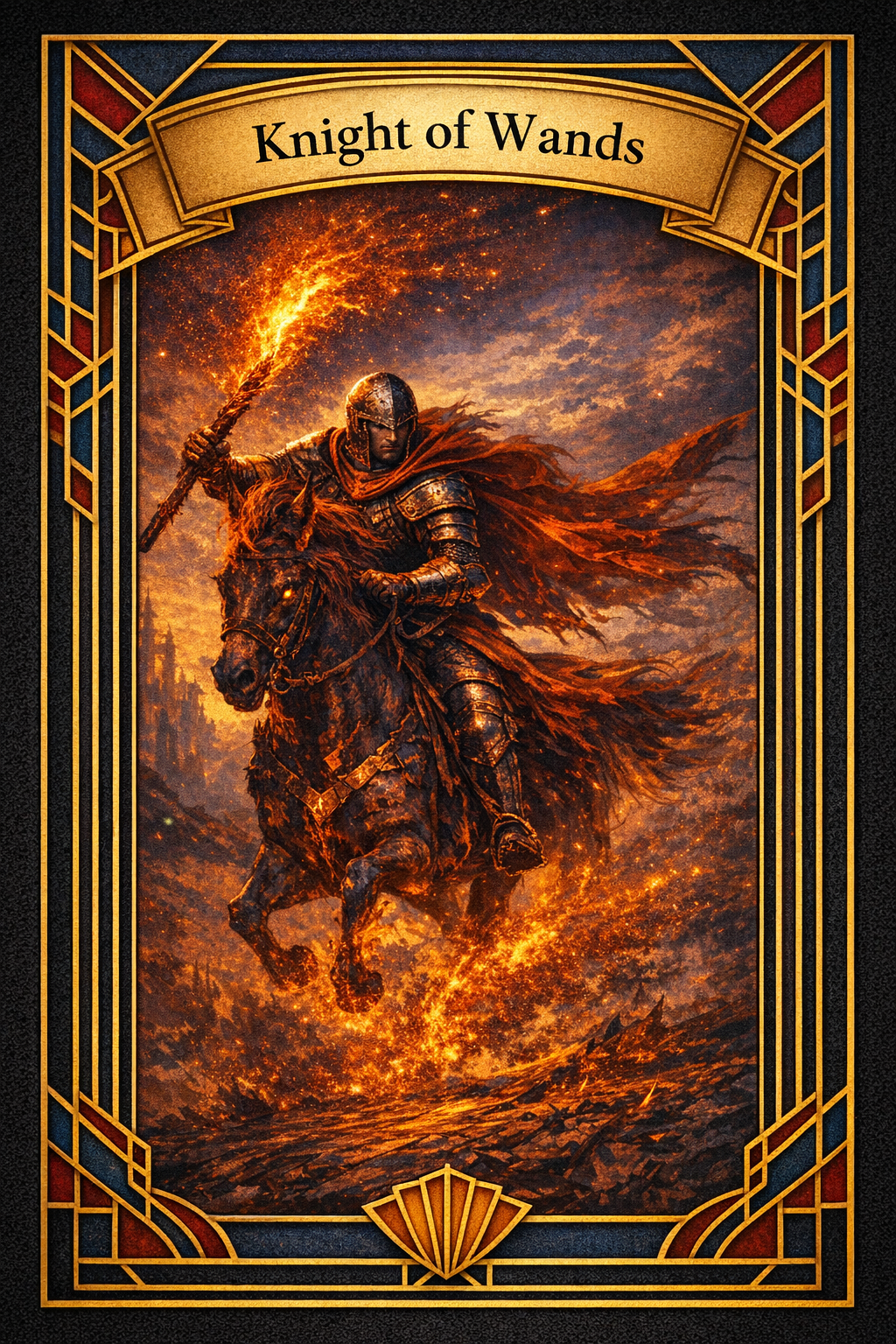
The Knight of Wands was not born so much as sparked.
In the oldest telling, the first fire did not come from lightning or sun, but from a vow spoken too loudly in a world that still preferred whispering. The vow struck the dry bones of the earth and flared—brief, ravenous, beautiful. From that flare rose a rider in ash-colored mail, his helm open to the wind, his eyes reflecting whatever horizon he faced. He carried no banner, because he was the banner: motion made visible.
They say the Knight of Wands is the younger sibling of every revolution and the elder sibling of every regret.
He appears in the myth-cities at the moment their gates begin to rust shut. He comes when councils argue in circles, when artisans repeat themselves, when lovers stop daring each other, when prayers become polite. He does not knock. He arrives like a thrown torch—sudden, undeniable—and something that has been waiting in the dark remembers it can burn.
His wand is cut from the Heartwood of the First Tree, the one that grew before roots understood the concept of staying. The wand is not a staff of rule but a splinter of origin, still hot with the memory of sap becoming flame. Along its length are carved the names of roads that do not exist until someone walks them. When the Knight grips it, those names glow like embers under skin. When he lowers it, the ground itself seems to lean forward.
The horse beneath him is called Cinder, though it is not always a horse. In some regions it is a stag with antlers like branching sparks; in others a lean hound made of smoke; in desert stories it is simply heat given hooves. Whatever shape it takes, it never tires, because it feeds on the same thing the Knight does: the hunger to begin.
The Knight’s armor is a contradiction—bright plates over scorched leather, polished edges over soot-stained seams. It is said each mark upon it is a lesson he refused to let become a cage. He does not seek purity; he seeks ignition. His cloak is the color of late afternoon, that hour when shadows lengthen but the light still insists on being warm.
He is not a hero in the way statues demand. He is reckless in the way matches are. In the mythos he is blamed for wars and thanked for rescues, accused of seducing the innocent into adventure and praised for waking the brave from sleep. He can be found in the stories of saints who ran away to do good improperly, of inventors who dismantled their own machines to build something stranger, of messengers who crossed mountains because the message could not wait for spring.
There is a caution woven through his legend: the Knight does not stay to tend what he sets alight.
In one tale, a village prays for deliverance from winter. The Knight rides in and teaches them to burn their old fences for warmth, to dance until blood remembers it is hot, to break the ice on the river and drink like animals. By morning the village is alive again—laughing, hungry, loud. By the third night, their stores are gone and their tempers flare. They curse him for leaving them with fire and no patience. The elders learn, too late, that flame is not a plan. Yet the children grow up with bright eyes, and when spring comes they build new fences—stronger, and theirs.
In another telling, the Knight meets the Queen of Wands at the edge of a battlefield that has not yet begun. She stands amid the tents and the anxious prayers of generals, holding a lantern that does not flicker. She asks him what he serves. He answers, “The next step.” She asks what he protects. He answers, “The first breath.” The Queen does not command him; she simply watches. It is said that when the Knight rides under her gaze, his fire becomes purpose instead of wildfire. When he rides without it, he becomes a beautiful accident.
The Knight is also bound to a rival: the Knight of Cups, who dreams before acting, and the Knight of Swords, who acts as if thought is a weapon. In the oldest epics the three meet at a crossroads that appears only once each century. The Cups Knight offers a map drawn in moonlight. The Swords Knight offers a route cut clean through the forest. The Wands Knight laughs, strikes his wand against the stone, and a fourth road appears—unmarked, smoking at the edges. He is the one who makes new doors, even when walls are still standing.
Those who consult the card are told the mythic rule: you do not summon the Knight of Wands; you recognize his hoofbeats already in your chest.
When he rides upright in the reading, the story says he is blessing you with heat—courage, appetite, the nerve to begin, the audacity to be seen. He brings invitations that feel like dares. He brings journeys that start before you have packed. He brings the kind of confidence that is not certainty, but refusal to be small. He asks only one offering: that you move.
When he rides reversed, the myth turns sharp. His fire becomes impatience. His courage becomes provocation. The road he makes becomes a rut of constant starting. He tempts you to burn bridges you still need, to mistake intensity for truth, to call destruction “freedom” because it feels like wind. In the reversed legends, the Knight is not an enemy—he is a lesson that speed without direction is still a kind of prison.
There is a final, quieter tale that few readers speak aloud. It says that one day the Knight of Wands will reach the end of all roads and find a door that does not open outward. He will dismount. He will press his wand to the threshold and wait—not for permission, but for the moment his own fire learns to become a hearth. On that day, the card will change, and the Knight will no longer be a spark seeking tinder.
Until then, the mythos insists: when you see him, something in you is ready to run.
And something in you must decide what, exactly, you are willing to set alight.