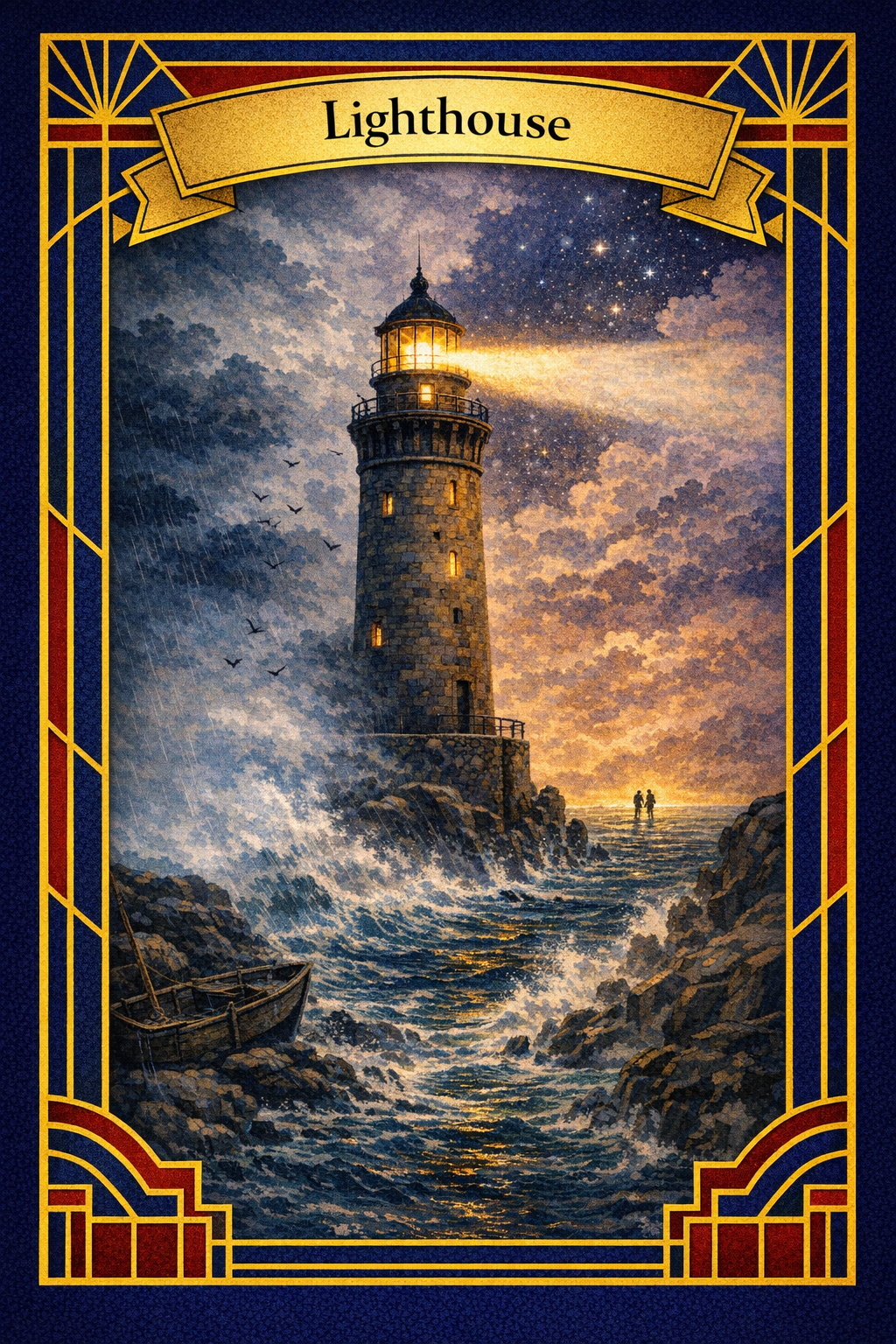
Lighthouse
In the old coastal kingdoms, where maps ended in blank parchment and sailors stitched prayers into their sleeves, there stood a lighthouse with no recorded builder. Its stones were the color of stormclouds, its iron ribs salted white, and its lantern never went dark—not in summer’s gentle haze, not in winter’s teeth of sleet. The locals called it the Far-Signal, because it seemed to shine not only across water, but across whatever distance kept hearts from finding one another.
The myth says the light was first kindled on a night when the sea swallowed the horizon. Two travelers—strangers by name, familiar by longing—set out from opposite shores at the same hour, each believing the other lost to time. Fog pressed down like wool over mouth and mast, turning every wave into a wall and every sound into doubt. Yet when the world became nothing but grey, a single beam cut through it: steady, patient, uninterested in haste. It did not promise safe passage. It promised direction.
The keeper of the Lighthouse is never described the same way twice. Some say it is a widow who never sleeps, turning the lens with hands worn smooth by waiting. Some say it is a child who died before learning fear, and so cannot imagine giving up. Others insist there is no keeper at all—that the tower responds to the ache of distance the way a bell responds to a struck note. What remains constant in every telling is the rhythm: the light does not flare and vanish like hope born of panic. It returns. It returns. It returns.
Sailors learned to trust it not as a rescue, but as a vow. When the crossing took longer than promised, when currents pulled them sideways, when the fog made even their own thoughts unfamiliar, the beam continued to sweep the dark with the same deliberate certainty. It taught them that being delayed was not the same as being denied. The Lighthouse does not shorten the sea; it makes the sea navigable.
There is a final detail in the oldest version of the tale: the two travelers never meet at the base of the tower. They meet beyond it, on a shore neither had seen before. The Lighthouse, then, is not the destination—it is the thread through the labyrinth, the signal that keeps two paths from forgetting they were meant to converge. It is the quiet force that says: Keep going. You are not alone in the fog. The light is still there, and so is the other.