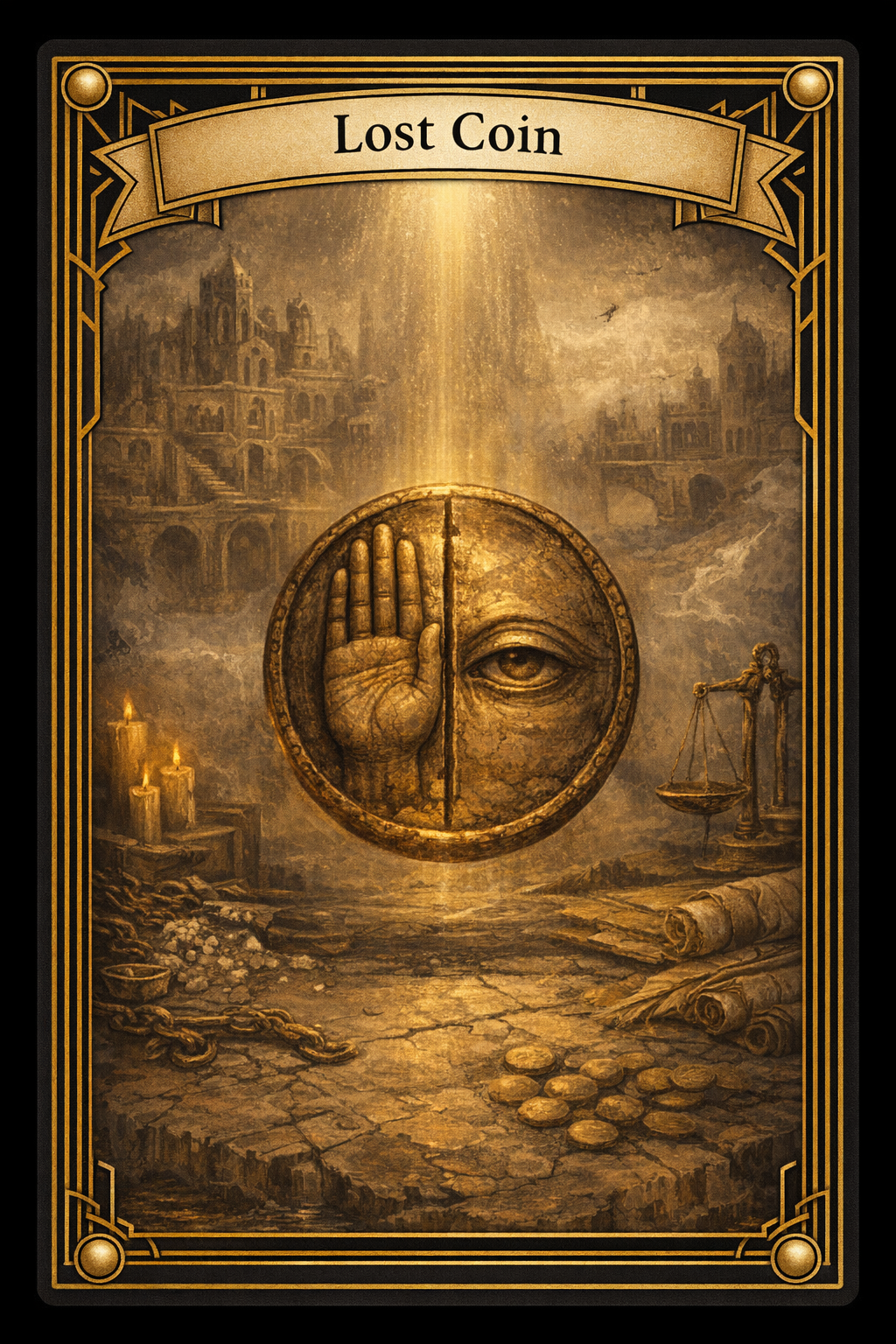
The Lost Coin is said to have been minted in a city that never agreed on its own name. Some called it a port, others a shrine, others a marketplace built atop an older marketplace, and all of them were correct. Its streets were laid like a labyrinth with no center, because the founders believed a true treasure should never be reached by walking straight toward it. In the first year of the city’s founding, an unknown artisan—neither priest nor banker, neither thief nor judge—cast a single coin from an alloy no ledger could account for. It bore no monarch’s face. One side showed an open hand; the other, an eye that was neither awake nor asleep.
The coin was not made to purchase. It was made to measure. The artisan claimed that every life carries two weights: what is held, and what is owed. Ordinary coinage counts only what is held. The Lost Coin, when placed on the tongue or pressed to the heart, was said to count what is owed—promises made in childhood and forgotten, kindness received and never returned, truths swallowed to keep peace, harms done by accident and excused by time. To touch it was to feel the invisible arithmetic of one’s days.
Because it could not be spent, it became a relic. Because it could not be owned, it became a temptation.
The first keeper of the coin was a widow who ran a stall of salt and dried figs. She found it in her apron one morning, though she had not handled money in days. When she tried to give it away, it returned to her palm like a thought returning to the mind. That night, she dreamed of a staircase descending through her own ribs, each step etched with a name she had once spoken with love. At the bottom sat a small child counting pebbles—each pebble a moment she had been too busy to notice. She woke with the taste of metal and wept until her stall opened, and then she went to the river and placed the coin beneath a stone. By midday it was back in her apron, dry as bone.
The city’s clerics declared it a moral instrument: a mercy, because it revealed debts before they became chains. The bankers declared it a threat: a currency that audited the soul could topple empires built on forgetting. The thieves declared it a joke: if it could not be sold, it could still be stolen, if only to deny it to another. The judges declared it evidence: if guilt could be weighed, perhaps punishment could be made clean and exact. Each faction tried to claim it, and each failed in the same way. The coin would vanish from locked chests, sealed reliquaries, even from clenched fists, and reappear where it was least convenient: in the hem of a liar’s robe, beneath the pillow of a tyrant, in the mouth of a poet who had not spoken honestly in years.
The oldest tale says it finally chose a keeper: a young accountant tasked with tallying taxes for a war he did not believe in. He discovered the coin in his ink jar, blackened and shining. When he held it, he felt every number he had written become a footprint leading to a single door in his mind—a door he had always kept barred. Behind it were the faces of those who would starve if he continued his work unquestioned. He tried to throw the coin into the sea. It returned, cold and patient, to the pocket over his heart. He tried to bury it in the city’s cemetery. It returned, smelling of earth, to the fold of his collar. At last he did the only thing that changed its behavior: he paid a debt that could not be recorded. He resigned, confessed what he had helped to build, and used his skill to expose the hidden routes of stolen grain. The coin did not disappear. It simply became lighter, as if some of its weight had been released.
From this, the mythos teaches that the Lost Coin is not truly lost; it is unclaimed. It travels until someone recognizes that what they seek is not always what they are missing. It is drawn to those who confuse possession with proof, who hoard in order to feel safe, who tally affection like interest, who treat apologies as cheap currency. When it appears in a spread, readers say it has two voices.
The first voice is the Open Hand: what you have withheld—time, gratitude, rest, tenderness, truth. It asks what you are afraid will happen if you let it go.
The second voice is the Half-Waking Eye: what you have refused to see—your quiet complicity, your inherited patterns, the bargain you made long ago to survive. It asks what you are afraid will happen if you look.
Yet the card’s power is not accusation. The Lost Coin is a myth of return. It promises that what is misplaced can be found, but not always in the form you expect. Sometimes what returns is not the object, but the capacity to live without it. Sometimes the debt is not repaid by suffering, but by repair. Sometimes the treasure is not recovered, but relinquished.
In the oldest deck that includes it, the Lost Coin is unnumbered. The legend says it refused a place in sequence, because it arrives outside of time: before you are ready, after you have delayed, exactly when the story requires a reckoning. Its border is drawn with an incomplete circle, a ring that will not close until the querent names what they have been calling “gone” when they mean “avoided.”
Those who have carried the coin in the stories never keep it forever. It leaves the moment it has done its work, slipping away as quietly as a resolved grief. And in every telling, the final image is the same: a palm opening, an eye softening, and a single piece of metal catching the light—not as payment, not as prize, but as a reminder that the truest wealth is the courage to account for oneself.