Tarot's Landing / Cosmos / Readings
Love card art

Card Page

Love

Love is the first pact and the last trial, the card that refuses to be owned. In the oldest telling, it was not painted by any hand but appeared as a blank rectangle of vellum in the pocket of a widow who had forgotten her own name. She tried to burn it, and the fire took everything except the space where it lay. She tried to drown it, and the river ran around it as if ashamed. When she finally held it up to the light, the card drank her shadow and returned it softened, as though it had been forgiven.

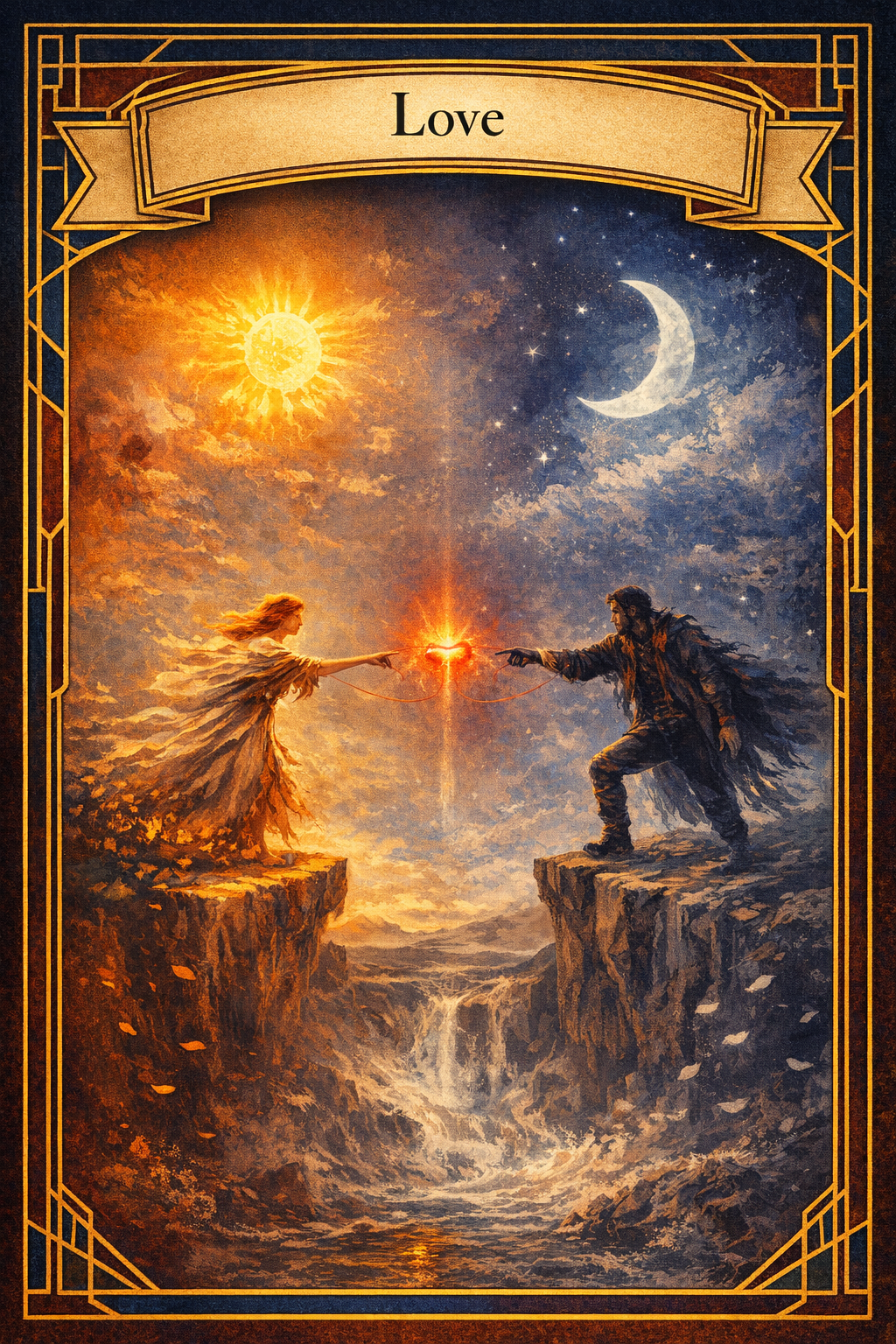
The Love card is said to have been born when the world was still deciding whether it would be made of hunger or of vow. Two beings met at the seam where the first day stitched itself to the first night. They were not lovers; they were opposites that had never before had a reason to stay. One carried the instinct to survive, sharp as a bone needle. The other carried the instinct to give, warm as breath. They looked at each other and understood that if either won completely, the world would become a single note—either a scream or a lullaby, endless and empty. So they did the only thing no law could compel: they chose a third way. They made a promise with no witness but the horizon, and from the tension of that promise a new force condensed, visible at last as a card.

Those who claim to have seen the card’s true image do not agree on what it shows. Some swear it depicts two figures standing on opposite cliffs, reaching, not touching, their hands separated by a thread of red. Others insist it is a single figure with two faces, one laughing and one weeping, both turned toward the same unseen door. A few say the card is nothing but a mirror that reflects you with someone else’s eyes. The only consistent detail is this: there is always a small wound somewhere in the picture, and it is always already healing.

In the mythos of the old readers, Love was once kept in a sealed box because it behaved like a living thing. It would slip into spreads uninvited, replacing cards that spoke too cleanly of victory or ruin. It would turn swords into cups, or cups into coins, not by changing fate but by changing what the seeker could bear to do with it. The box was buried beneath a chapel whose stones were mortared with salt and honey, the two substances that preserve and sweeten. Yet the card still found its way into hands that needed it, as if it could smell a fracture in the soul the way wolves smell blood.

There is a story of a king who demanded Love to secure an heir. He summoned every diviner, every monk, every charlatan, and ordered them to draw the card for him. They did, again and again, and always the card that rose was Duty, or Desire, or Dominion—never Love. Furious, the king jailed them all and went himself at midnight to the buried box. He opened it and found only a plain card, blank as bone. He cut his palm and pressed it to the surface, offering what he believed was the proper tribute. The card remained empty. Only when he returned to his chambers and found the queen awake, sitting beside the cradle they had prepared for a child that did not come, did the vellum change. Not with his blood, but with his silence. It showed two hands unarmed, palms open, and a crown set down on the floor. In the morning he freed the prisoners and dismantled the laws that treated lineage as a leash. The kingdom did not get an heir, but it got a future.

Because of this, Love is not considered a blessing in the simplistic sense. It is a consecration. It sanctifies what you touch, and sanctification is dangerous: it makes the ordinary matter. It makes promises audible. It makes harm count. In the old catechisms of cartomancy, Love is called the Weightless Weight, the Rope of Silk, the Knife That Cuts Chains. When it appears, it does not ask what you want. It asks what you are willing to become so that another may remain whole—and whether you will still choose yourself in that becoming.

There are three taboos associated with the card. The first: never draw Love to prove someone’s feelings, for the card will answer with your own fear and call it truth. The second: never draw Love in anger, for it will show you the shape of the wound you are about to make and you will not be able to unsee it. The third: never sell Love for coin, because it will spend you instead. Those who ignore these taboos are said to find the card stuck to their skin like a second tongue, speaking vows they did not mean until their lives become a tangle of half-kept oaths.

Yet the mythos insists Love is not merely romance, nor even affection. Love is the force that makes separation survivable. It is the bridge between self and other, built from attention, repaired with apology, reinforced with boundaries, and lit by the willingness to be changed. In some temples it is invoked at weddings; in others, at funerals. In a few, it is placed in the hands of the dying so they may remember that to release is also to hold.

The final legend says Love will be the last card left when the deck has been scattered by catastrophe and time. When the last reader—who will not know they are a reader—finds it, the card will not show two figures or one, not thread or mirror, not wound or crown. It will show a doorway standing in an empty field. On one side will be everything that was lost. On the other, everything that could still be made. And the seeker will understand, without instruction, that Love is not the door itself, but the courage to walk through it together, even when the hands do not touch.
Interpretation

Love — Interpretation

  • Core theme: Love appears as a consecration rather than a comfort. It makes what is happening matter—your choices, your promises, your harm, your care—and asks you to meet that gravity with honesty.
  • The pact and the trial: You are being invited into a “third way” between opposing instincts (self-preservation and self-giving, desire and duty, freedom and commitment). The path forward is not victory over the other side, but a vow that holds both without erasing either.
  • Healing wound: There is a tender place already in recovery. This card highlights repair in motion: apology that lands, trust being rebuilt, grief being integrated, or a boundary being honored. The wound may not vanish, but it no longer needs to rule you.
  • Choice with open hands: Love asks for consent, clarity, and mutuality—hands unarmed, palms open. It favors what is freely given over what is extracted, proven, or coerced. If you are trying to secure certainty, it redirects you toward presence.
  • Sanctifying the ordinary: Small actions become sacred under this card—how you speak, how you listen, how you keep time, how you handle conflict. Love’s message is: treat the everyday as the place where devotion is demonstrated.
  • Boundaries as devotion: Love strengthens the bridge between self and other by reinforcing edges. Saying “no,” asking for space, naming needs, and refusing to barter your integrity are not failures of love here; they are its architecture.
  • What you are willing to become: The question is not “What do you want?” but “Who must you be to keep yourself and another whole?” This may mean changing a habit, relinquishing control, choosing accountability, or allowing yourself to be seen without armor.
  • Release as a form of holding: Love can indicate staying, reconciling, committing—or letting go with dignity. It supports endings that preserve tenderness and beginnings that do not require self-abandonment.
  • Practical guidance:
  • Speak the vow you can actually keep.
  • Repair what you broke or name what broke you.
  • Choose actions that reduce harm, not appearances that increase certainty.
  • Let love be measured by care, not by intensity.
  • Likely outcome if followed: A future shaped by mutual courage—relationship, community, or self-relationship becoming more livable, more truthful, and more free, even if it is not the outcome your fear would have chosen.

Reversed Interpretation

Love — Reversed Interpretation

  • Core theme: Love turns into a distortion of devotion—either diluted into avoidance or weaponized into control. What should consecrate the ordinary instead makes it feel negotiable, performative, or unsafe.
  • The pact breaks into extremes: The “third way” collapses into polarities: self-sacrifice vs. self-protection, clinging vs. fleeing, duty vs. desire. One side tries to win, and the relationship (with another or with yourself) becomes a battleground instead of a bridge.
  • The wound that won’t heal (or is denied): Repair is stalled. Apologies don’t land, accountability is partial, or grief is bypassed. The tender place may be re-opened by repetition—same conflict, same trigger, same silence—because the real issue is not being named.
  • Closed hands, hidden terms: Consent and clarity blur. Love is treated like something to secure, prove, or extract. You may be bargaining for reassurance, testing loyalty, or offering care with unspoken conditions—and resenting the other for not reading them.
  • Boundaries collapse or harden: Either you overextend (people-pleasing, rescuing, merging) or you fortify (withholding, punishing distance, emotional shutdown). In either case, the architecture that makes closeness safe is missing.
  • Sanctification becomes pressure: The ordinary turns heavy in the wrong way—every small moment feels like a referendum on worth, commitment, or abandonment. Instead of “care makes this matter,” it becomes “this must go perfectly or it means nothing.”
  • Misreading fear as truth (taboo in motion): Anxiety, jealousy, or suspicion is mistaken for intuition. You may be seeking a verdict on feelings rather than building a practice of trust, communication, and repair.
  • Anger drives the spread: Love reversed can signal acting from hurt—saying the cutting thing, making the preemptive exit, keeping score, or turning vulnerability into leverage. You may see the wound you’re about to make and still feel unable to stop.
  • Selling yourself (or another) for certainty: Love is traded for approval, status, security, or an outcome. You may be spending your integrity—overpromising, self-abandoning, or staying in a dynamic that costs you more than it gives.
  • Practical guidance:
  • Name the real need beneath the strategy (reassurance, autonomy, respect, safety).
  • Replace tests with requests; replace mind-reading with agreements.
  • Set (or soften) boundaries so closeness is chosen, not coerced.
  • Stop offering vows you can’t keep—choose smaller, truer commitments.
  • If repair is impossible, choose a clean ending that reduces harm.
  • Likely outcome if unaddressed: A tangle of half-kept oaths—attachment without mutuality, intimacy without safety, or independence that is actually avoidance—until a clearer choice is made.

Story Beats

Vignette 1

The Card That Wouldn’t Burn

Dialog: I tried fire, I tried river—nothing takes it. Look… it drank my shadow. And gave it back softer. Like it forgave me.

Scene: A dim, soot-stained cottage interior at dusk. An elderly widow with weathered hands and simple mourning clothes stands near a small hearth; ash and half-burned kindling glow orange. In her palm is a blank rectangle of pale vellum that remains pristine while everything around it shows smoke and scorch marks. A candle or window beam cuts through dust motes, and the card subtly absorbs the woman’s shadow, then returns it faintly softened on the floor—like a gentler silhouette. Mood is mystical and intimate, high detail, cinematic lighting, shallow depth of field, warm firelight contrasted with cool twilight.

Vignette 2

The Seam of First Day and First Night

Dialog: If I win, the world becomes hunger. If you win, it becomes only vow. So choose with me—something neither law can force.

Scene: A surreal landscape at the horizon where day and night meet like stitched fabric: one half golden sunrise, the other deep indigo with early stars. Two archetypal beings face each other on a flat, empty plain: one sharp-edged and lean, clothed in bone-needle motifs and survival imagery; the other warm and luminous, breath-like mist curling from their mouth, hands open in offering. Between them, tension is visible as a faint, forming tarot card shape in the air—an unpainted vellum rectangle condensing from the space between their outstretched hands. The environment is minimal, symbolic, and mythic, with a clear seam line across the sky and ground.

Vignette 3

The King Sets Down the Crown

Dialog: My blood won’t wake it. But my silence did. I can’t command love—only lay down the crown and open my hands.

Scene: A candlelit royal bedchamber at midnight. A weary king in a dark robe stands beside an empty cradle draped in fine cloth; the queen sits awake nearby, calm and sorrowful, hands folded. The king’s palm shows a small cut, but the focus is on a blank vellum card in his other hand that now reveals an image: two unarmed open palms and a crown placed on the floor. The crown is shown in the scene as well—set down on the stone or wooden floorboards near his feet, slightly out of place, emphasizing humility. Lighting is soft and dramatic with long shadows; the mood is tender, heavy, and transformative.