Money Flow
In the first counting-house of the world, before ledgers learned to lie and before coins learned to sleep in coffers, there was only Flow—a bright current that moved through hands the way wind moves through reeds. It was neither gold nor debt, neither gift nor theft, but a living passage between need and plenty. The old stories say Flow came from the same source as breath: it was meant to circulate, to warm the body of a village, to carry seed to soil and bread to mouth, to make work visible and gratitude tangible.
When people began to fear winter more than they trusted one another, they tried to trap Flow. They hammered it into discs, carved it into bars, pressed it into paper, and wrote promises upon it until the promises looked like truth. They built vaults like stone lungs and called the hoarding “security.” But Flow, being born of motion, grew sick in stillness. It soured into Stagnation, and Stagnation birthed two pale siblings: Scarcity, who whispered that there would never be enough, and Greed, who insisted that enough was an insult.
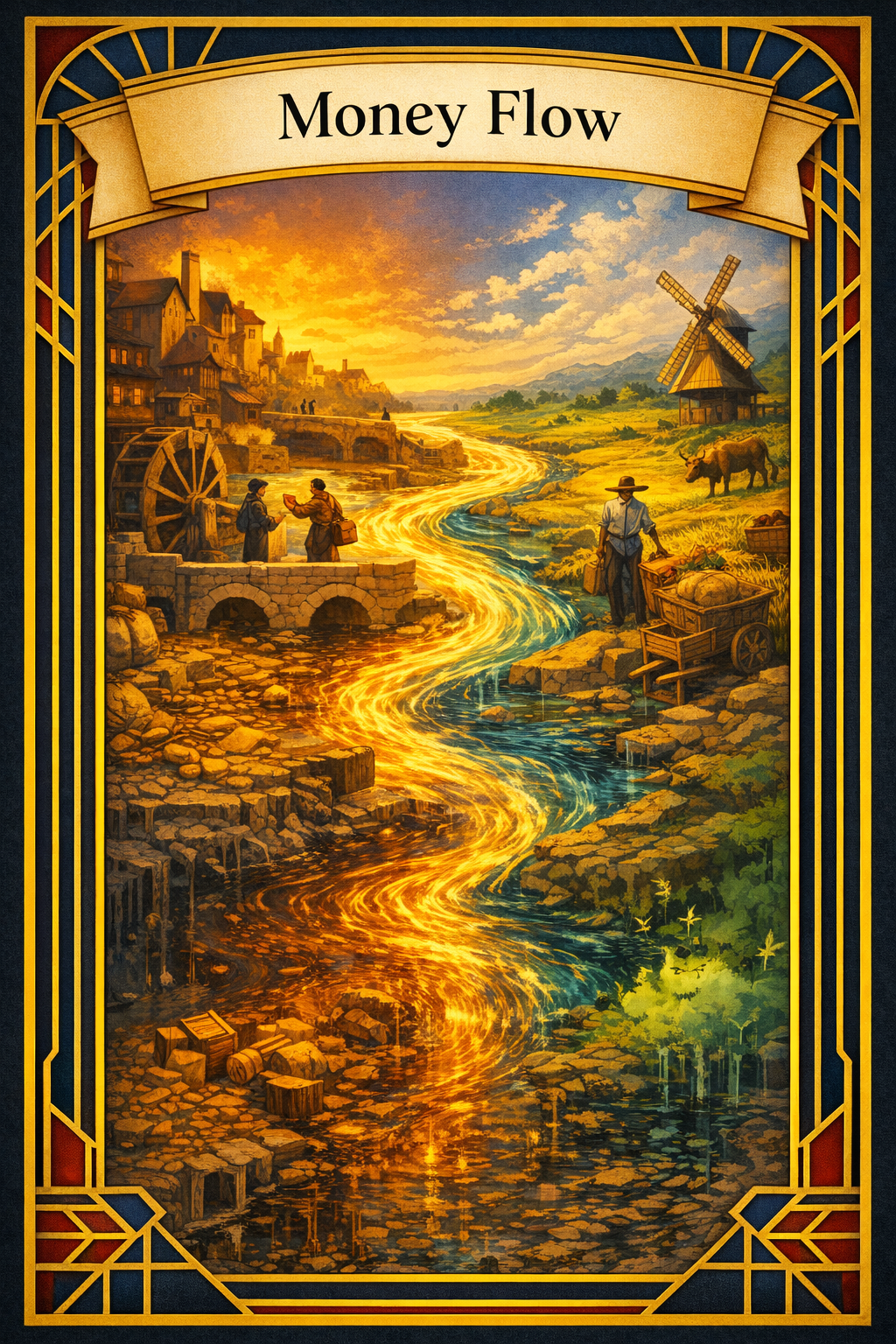
Seeing this, the Weaver of Measures—an unnamed spirit who keeps the weight of things honest—took pity on the world and made a card to remind mortals what money truly was: not a treasure, but a river. The card was painted with a channel running through a city and a field at once, passing under bridges of labor and over stones of risk. Where the water moved, wheels turned: mills ground grain, looms sang, lamps stayed lit. Where the water pooled, it turned dark and thick, and the air above it filled with gnats shaped like excuses.
The myth says the card does not appear when someone is poor or rich, but when someone has forgotten the difference between holding and having. It comes to the merchant who counts profits yet cannot name a single person helped by their trade. It comes to the healer who undercharges until their hands tremble with exhaustion. It comes to the gambler who mistakes speed for circulation, and to the miser who mistakes stillness for safety. In each case, the card arrives like a soft knock at the door of the mind, asking a simple question: Where does your river go?
Those who heed it learn the old law: Flow must be guided, not dammed. They begin to build channels—budgets, boundaries, wages, savings—that keep the current clean without stopping it. They pay debts that have become stones in the stream. They refuse bargains that poison the water. They give where giving creates more giving, and they charge where charging keeps the well from running dry. They discover that generosity is not leaking, and prudence is not hoarding; both are forms of stewardship.
Those who ignore the card often dream of drowning in coins that clang like hail, or of trying to drink from a fist closed so tight it bruises itself. In the harshest telling, the Weaver of Measures returns and turns their vault into a pond, their pond into a swamp, until even their wealth cannot breathe.
But in the gentler telling—the one whispered to apprentices and children—the card’s river never stops entirely. Even in drought, it remembers its route. Even in flood, it seeks its banks. Money Flow is the myth of a world that survives by circulation: the promise that what moves with purpose can nourish, and what is hoarded without love will, in time, rot into silence.