Tarot's Landing / Cosmos / Readings
Moonwell card art

Card Page

Moonwell

Moonwell is the card of the hidden water—an oracle that does not speak in words, but in reflection, ripple, and return. It is said to have first appeared not in any deck, but in a pond that had no bottom, where the night sky leaned down to drink. Those who looked into it did not see their faces. They saw their lives as the moon sees them: silvered, softened, half-concealed, and truer for what was missing.

In the oldest telling, the Moonwell was dug by three sisters who could not agree on what was real. The first believed only in what could be held; she carried stones and built walls. The second believed only in what could be proven; she measured the wind and named the stars. The third believed only in what could be felt; she listened until the dark had a pulse. When their quarrel grew too loud, the earth opened a seam between them, and from that seam rose water that remembered every argument ever spoken over it. They lowered their faces to the surface and, for the first time, saw not one truth but three—each bending the other, each incomplete alone. They sealed the well with a ring of pale rock and swore never to draw from it in daylight, for sunlight makes the water honest in the wrong way: it shows only what is there, not what is becoming.

The Moonwell belongs to no single suit, because it is not an instrument but a threshold. In some regions it is called the Thirteenth Mirror, in others the Bride of the Tide. Its image is consistent across traditions: a circular well of white stone, filled to the brim with black water that holds a moon which is not in the sky. Sometimes a single cup sits beside it, overturned. Sometimes a key rests on the rim, too cold to touch. Always there is a suggestion of something just beneath the surface—hair drifting like weed, a pale hand, a fish with human eyes, a coin that refuses to sink.

The myth says the well is fed by all the uncried tears of the living and all the unspoken names of the dead. That is why it shimmers even when no wind moves. The water is not wetness; it is memory in liquid form. To drink from it is to swallow a dream that has been waiting for you since before you were born. To lower a vessel into it is to ask a question that will be answered in symbols, coincidences, and the sudden return of what you thought you had outgrown.

There are wardens of the Moonwell, though they rarely call themselves such. They are midwives, undertakers, lighthouse keepers, and those who wake before dawn without knowing why. They tend the rim, clear the leaves, and speak to the water as if it were a tired animal. They warn that the Moonwell does not grant wishes; it exchanges them. If you ask to be shown your path, it may take your certainty. If you ask to be spared grief, it may take your capacity for love. The well is generous, but it is never free.

The card’s origin in the tarot is attributed to an unnamed cartomancer who found a blank card in a sealed pack—no number, no title, only a faint crescent stain as if pressed by a wet thumb. She placed it on her table under moonlight, and by morning the illustration had risen on it like frost: stone, water, moon, and a shadow that could not be inked. She tried to burn the card. It would not catch. She tried to tear it. The fibers reknit. She tried to throw it away. It returned to the deck, always between the cards she feared most. When she finally read with it, every querent left changed, as if they had remembered something they were not meant to remember and decided, quietly, to live anyway.

Moonwell’s myth is bound to a single law: what is seen in it is never the whole truth, yet it is never a lie. The well shows the self as it exists in the realm of night—where desire and dread share a face, where instincts wear the masks of omens, where the past is not behind you but beneath you, pressing upward. Those who gaze too long may confuse reflection with revelation and drown in their own interpretations. Those who look briefly, then turn away, may carry the moon’s pale guidance for years without realizing it.

There is a final story told in whispers: that the Moonwell is not a place at all, but a wound in the world where the sky once fell in love with the earth. The moon, unable to descend, poured its light into the hollow until it became water. That is why the surface shines and why the depths are dark. That is why the well calls to wanderers, mourners, and the nearly awakened. It is the meeting point of above and below, of what you show and what you hide, of the life you live and the life that watches you living it.

To draw Moonwell is to be invited to kneel at the rim of yourself. Not to judge what you find there, nor to name it too quickly, but to listen for the soft, tidal sound beneath your thoughts—the ancient pull that brings lost things back, not as they were, but as they must now be.
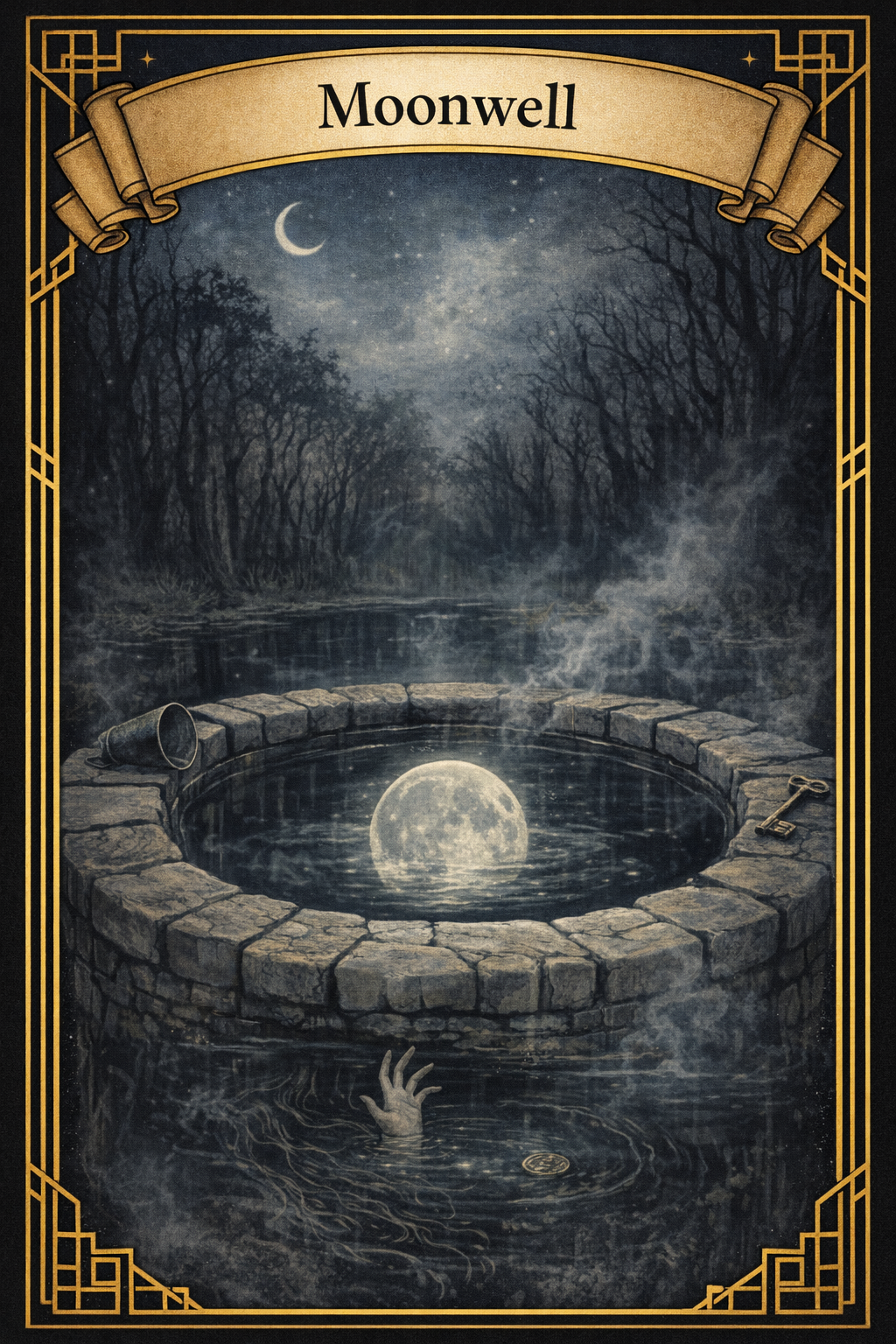
Interpretation

Moonwell — Interpretation

  • Core message: A threshold of inner knowing. What you seek cannot be forced into plain answers; it arrives as reflection, symbol, and return. The truest guidance now is indirect.
  • Themes: Hidden memory • intuition over proof • emotional tides • the half-seen truth • becoming rather than being • exchanges and costs • the past rising from below.
  • When Moonwell appears:
  • You are being asked to pause before naming reality too quickly. Something is forming beneath the surface—an insight, a grief, a desire, a calling—and it will reveal itself through patterns: recurring thoughts, synchronicities, dreams, chance encounters, old names resurfacing.

  • Invitation:
  • Kneel at the rim of yourself. Listen more than you decide. Let ambiguity teach you. Allow what is unfinished to be unfinished a little longer, so it can become honest in the right way.

  • Guidance:
  • Trust what you feel without demanding immediate certainty.
  • Ask better questions: What am I avoiding feeling? What keeps returning? What truth am I ready to hold gently?
  • Record dreams, symbols, and emotional spikes; the message is in the repetition.
  • Seek quiet counsel—therapy, ritual, water, night walks, journaling—spaces where the psyche speaks in images.
  • Love & relationships:
  • Feelings run deep and may be older than the current situation. Attraction, longing, and fear can share a face. This card favors tenderness, slow disclosure, and emotional honesty that doesn’t demand final answers. Pay attention to what is mirrored back to you—especially what you resist seeing.

  • Work & purpose:
  • A path is emerging, but it won’t be mapped by logic alone. Follow the pull of meaning: the work that feels alive, even if it is not yet explainable. Consider what you are willing to trade—time, comfort, identity—for a truer direction.

  • Money & resources:
  • Watch for choices driven by emotional undertow (scarcity panic, proving, soothing). Make decisions after the tide settles. Invest in what restores you; avoid bargains that cost your peace.

  • Spirituality & inner growth:
  • Heightened intuition, liminal perception, ancestral or subconscious material surfacing. The Moonwell teaches discernment: not everything that appears is literal, but it is meaningful. Approach with reverence, boundaries, and grounded practices.

  • Caution:
  • Don’t drown in interpretation. Obsession, projection, and chasing certainty can distort the message. The Moonwell is accurate, but partial—take what resonates, then return to life and let it unfold.

  • Likely outcome:
  • A quiet shift: you remember something essential, reclaim a buried truth, or release an old story. Guidance arrives not as a command, but as a steady lunar pull toward what you can no longer ignore.

Reversed Interpretation

Moonwell — Reversed Interpretation

  • Core message: The reflection is distorted. Intuition is blocked or misused—either ignored entirely or treated as absolute. What should be a gentle, symbolic guidance becomes confusion, fixation, or avoidance.
  • Themes: Emotional repression • projection • self-deception • compulsive meaning-making • fear of feeling • numbness • false certainty • drowning in the past.
  • When Moonwell appears reversed:
  • You may be forcing clarity too soon or refusing it altogether. Signs, dreams, and memories are present, but you’re either dismissing them (“it means nothing”) or clinging to them (“it must mean everything”). The surface is busy—ripples from anxiety, denial, or outside noise—making it hard to see what’s true.

  • Invitation:
  • Come back to the body. Before interpretation, feel what’s actually happening: grief, longing, anger, tenderness. Let the emotion be real without turning it into a story.

  • Guidance:
  • Reduce inputs: less divination/asking, less reassurance-seeking, fewer opinions.
  • Name one plain truth you can verify today (a boundary, a need, a next step).
  • If patterns repeat, ask: What am I protecting myself from feeling? What payoff do I get from staying uncertain?
  • Ground intuition with structure: therapy, sleep, hydration, routine, movement, time in daylight.
  • Love & relationships:
  • Mixed signals may be self-generated or amplified by fear. Idealization, suspicion, or “testing” replaces direct communication. This favors slowing down, clarifying intentions, and checking projections: are you relating to the person—or to an old wound wearing their face?

  • Work & purpose:
  • Drifting, second-guessing, or chasing a “sign” instead of making choices. Alternatively, rigid overconfidence blocks learning. Return to fundamentals: define success, set a timeline, take one measurable action, then reassess.

  • Money & resources:
  • Emotional spending, scarcity spirals, or avoidance of numbers. Don’t make financial decisions in a tidal state. Create a simple plan, automate what you can, and separate comfort-seeking from actual needs.

  • Spirituality & inner growth:
  • Psychic noise, porous boundaries, or using spirituality to bypass pain. Clean the channel: protection practices, rest, fewer readings, and discernment. Not every message is yours; not every feeling is prophecy.

  • Caution:
  • Obsession, rumination, and confirmation bias. The danger isn’t that nothing is true—it’s that you’ll mistake intensity for accuracy.

  • Likely outcome:
  • Clarity returns when you stop trying to extract a final answer from the dark. By grounding, setting boundaries, and feeling what’s been avoided, the water settles—and what’s real becomes visible again.

Story Beats

Vignette 1

The Three Sisters at the Seam

Dialog: First Sister: “Truth is what I can hold.” Second: “Truth is what I can prove.” Third: “Truth is what I can feel.”

Scene: Nighttime in an ancient clearing. Three sisters kneel at the rim of a newly formed circular well made of pale white stone. The ground around it is cracked like a fresh seam in the earth, as if it opened mid-argument. The well is filled to the brim with black, mirror-smooth water holding a bright moon that is not in the sky. The sisters are distinct: one with rough hands and a satchel of stones, one with measuring tools and star charts, one with closed eyes and a listening posture. Their faces are lit by cold moonlight reflected from the water. Subtle ripples distort the moon’s reflection into three overlapping crescents. Cinematic, high-contrast, mystical realism, shallow mist hugging the ground.

Vignette 2

The Warden’s Warning

Dialog: Warden: “It doesn’t grant wishes—it exchanges them. Ask for your path, and it may take your certainty.”

Scene: A solitary lighthouse keeper at pre-dawn, standing beside the Moonwell on a windless cliff. The well’s white stone ring is damp and clean, freshly tended, with a few leaves swept aside. A brass key rests on the rim, rimed with frost, looking too cold to touch. The keeper wears a heavy coat and holds a lantern low, but the lantern’s warm light is swallowed by the well’s black water, which glows with a moonlike sheen. The ocean is suggested in the distance as a dark band; the sky is deep indigo, just beginning to pale at the horizon. The keeper’s expression is calm but grave, as if speaking to someone just off-frame. In the water, a faint suggestion of something beneath the surface—hair drifting like weed—barely visible.

Vignette 3

The Blank Card That Wouldn’t Burn

Dialog: Cartomancer: “I burned it. I tore it. I threw it away.” (whispering) “By morning, the moon had drawn itself back.”

Scene: Interior, a small candlelit room with a wooden table scattered with tarot cards. At the center lies a single card: unnumbered, untitled, its illustration forming like frost—white stone well, black water, a moon reflection, and a shadowy shape that cannot be fully inked. A woman cartomancer with ink-stained fingers holds the card above a shallow dish of ash and charred paper scraps, implying failed attempts to burn it. The candle flames lean slightly, but the card remains pristine, fibers subtly reknitting at a torn corner. Moonlight streams through a nearby window, pooling on the table and making the card’s surface shimmer. The surrounding cards are arranged as if the Moonwell card has slid itself between the ones she fears most. Mood: uncanny, intimate, magical realism, fine detail, cool moonlight contrasted with warm candlelight.