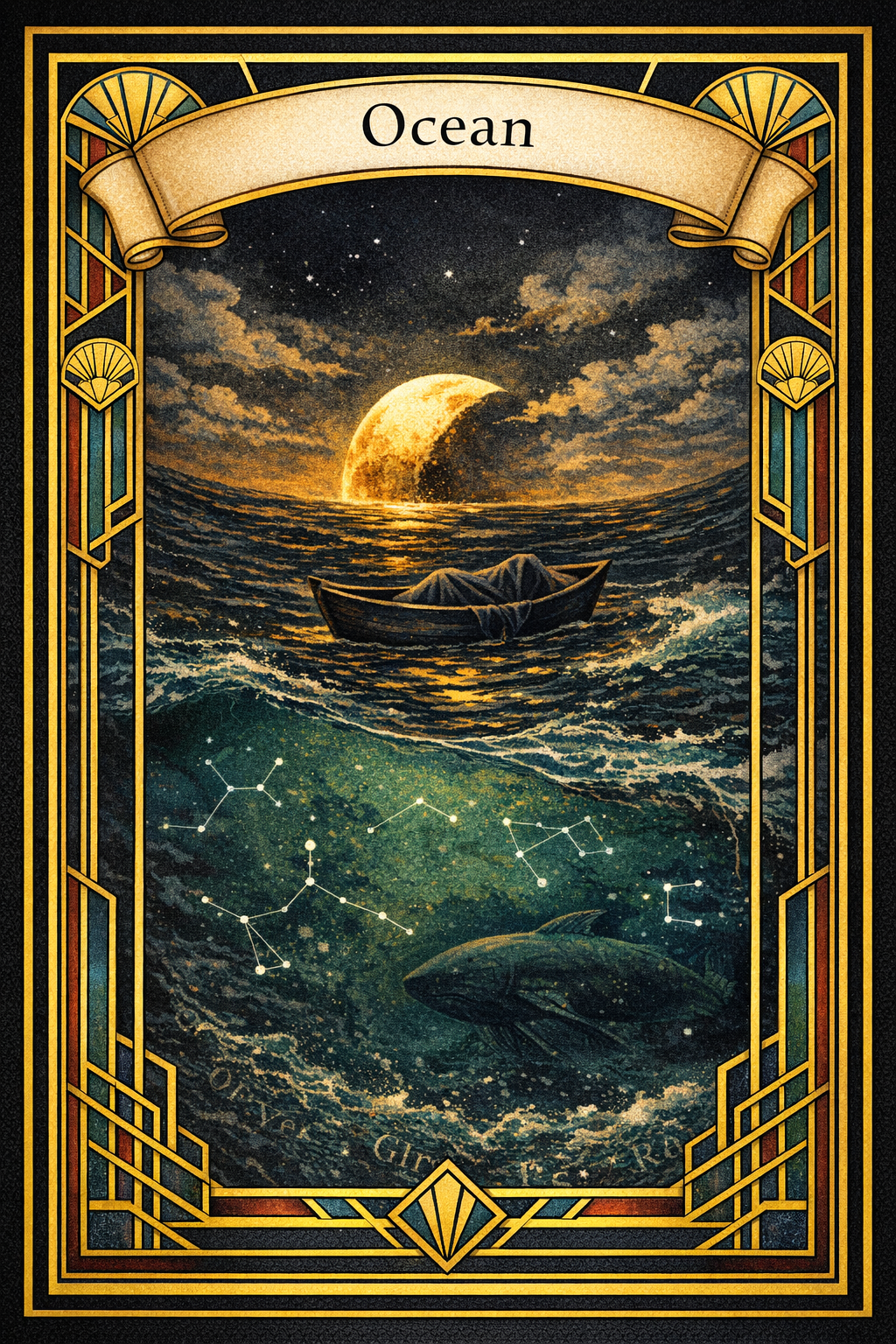
The Mythos of the Tarot Card: Ocean
In the oldest decks—those said to have been inked with ground pearls and bound in sealskin—there is a card that does not belong to any suit and refuses the numbering of the Major Arcana. It is simply called Ocean. Some readers insist it is a lost trump; others swear it is a living card that appears only when a question is too small for the truth behind it.
They say you do not draw Ocean. Ocean draws you.
Origin: The First Mirror
Before the world learned its shapes—before mountains had names and rivers knew where to go—there was only a single surface: a vast, dark water that held the sky like a secret. In that water, the first gods looked down to learn what they were. But the Ocean did not reflect them as they wished. It reflected them as they were: immense, unfinished, and frightened of their own depth.
Angered, the gods tried to break the mirror. They struck it with lightning, with stone, with fire. Each blow only made more Ocean. What shattered was not the water, but the certainty of the gods. From that fracture came change, time, hunger, love, grief—everything that moves.
So the Ocean became the first teacher: not a giver of answers, but a keeper of the questions that cannot be outrun.
The Card’s Image (as described in the myth)
Most depictions of Ocean share the same impossible elements:
- A horizon that is not straight, but subtly curved like the edge of an eye.
- A moon half-submerged, as if the sea is drinking it.
- A small boat with no oars, carrying either a sleeping figure or an empty cloak.
- Beneath the surface: a second sky, with constellations that do not exist above.
- In the foam: the suggestion of letters—names that vanish when spoken.
The oldest versions include a detail many overlook: the water is not blue, but black-green, like ink diluted with memory.
The Three Tides
The mythos of Ocean is taught through “tides,” because Ocean is not a single meaning—its truth arrives in movements.
#### 1) The Tide of Return Ocean governs what comes back: old feelings, forgotten vows, ancestral patterns, unfinished stories. Not as punishment, but as gravity. The sea does not judge what falls into it; it simply refuses to let anything be lost.
In the monasteries of the Salt Archivists, novices were warned: > “What you throw into Ocean is not gone. It is changed.”
#### 2) The Tide of Dissolution Where other cards build—Tower, Emperor, Chariot—Ocean unbuilds. It dissolves the hard edges of identity. It blurs the border between what you chose and what chose you. In readings, Ocean is said to arrive when the querent is clinging to a shape that no longer fits: a role, a certainty, a story about themselves.
The fishermen-priests of the western reefs taught that Ocean is mercy disguised as drowning: it takes what is rigid so something truer can float to the surface.
#### 3) The Tide of Revelation Ocean is also the keeper of the deep. In myth, the sea floor is a library made of pressure and bone, where truths are stored until the mind is ready to bear them. When Ocean rises in the third tide, it does not whisper—it shows.
But revelation is never clean. It comes with salt in the eyes. It comes with the ache of realizing you already knew.
The Leviathan Oath
A central legend tells of the first tarot-reader, Mara of the Shoals, who tried to bind Ocean into a predictable symbol. She carved a circle of iron nails on the beach and read the cards inside it, demanding the sea obey the spread.
The Ocean answered by sending a leviathan—not to devour her, but to speak.
The leviathan offered an oath:
- “If you read me to control, I will give you storms.”
- “If you read me to escape, I will give you undertow.”
- “If you read me to listen, I will give you currents.”
Mara broke her nails, stepped into the surf, and learned the first rule of the card: Ocean cannot be mastered. It can only be entered.
Place in the Tarot Cosmology
Ocean is often called:
- The Hidden Major
- The Thirtieth Card
- The Card Between Cards
It is said to appear when the spread reaches a threshold—when the question is really about surrender, grief, longing, intuition, or the vast, wordless truth beneath a tidy narrative.
Some traditions place Ocean as the shadow-pair to The Star:
- The Star is hope you can see.
- Ocean is hope you cannot yet name.
Others pair it with The Moon:
- The Moon is illusion and instinct.
- Ocean is the source from which those tides rise.
How Ocean “Behaves” in a Reading (in legend)
Readers who honor the old stories treat Ocean as a ritual event. If it appears:
- The room often feels colder, as if a window has opened.
- The reader is advised to ask fewer questions, not more.
- Silence is considered part of the interpretation.
The myth says Ocean is not there to predict. It is there to re-orient—to turn the querent toward what is real even when it is not comfortable.
The Gift and the Cost
Ocean’s gift is depth: intuition, emotional truth, spiritual initiation, the ability to feel what others deny.
Ocean’s cost is the end of pretending. It brings the awareness that some things cannot be fixed by willpower alone—only met, grieved, and allowed to move through.
Closing Saying
Among coastal readers, there is a phrase spoken when Ocean appears, half warning and half blessing:
> “Do not ask the sea for a map. > Ask it for the courage to be carried.”
If you’d like, I can also write Ocean’s upright/reversed meanings, keywords, and a few example interpretations in spreads (love, career, spiritual path), keeping the same mythic tone.