Tarot's Landing / Cosmos / Readings
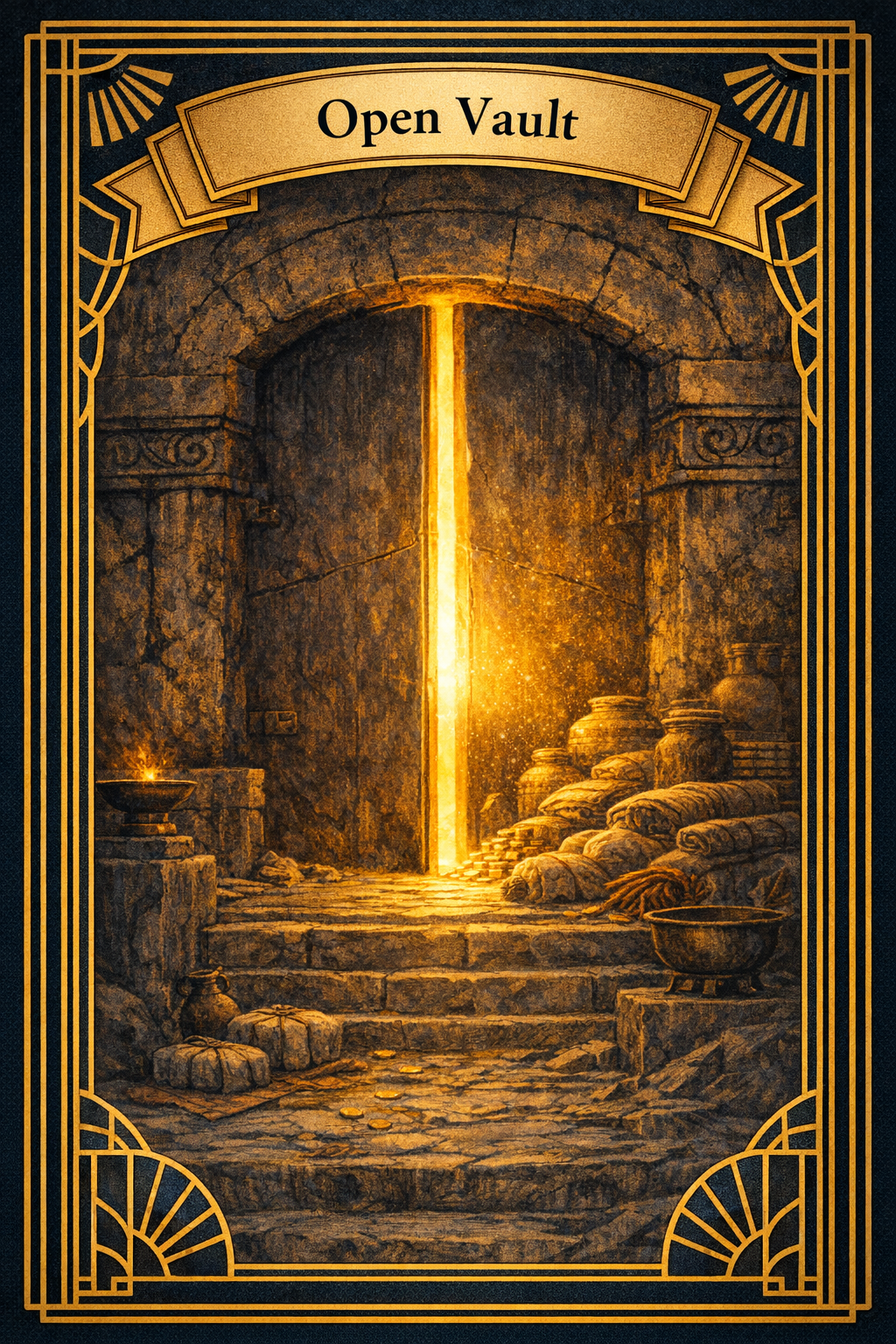
Open Vault card art

Card Page

Open Vault

Open Vault

In the old cities beneath the mountains, where the stone remembers every oath spoken above it, there is said to be a door with no handle and no keyhole—only a single, unbroken seam of metal set into bedrock. The seam does not rust. It does not yield to tools. It waits.

The Vault was not built to hoard. It was built to hold.

In the earliest days, when communities still measured wealth by what could be carried in two hands—grain, salt, lamp oil, seeds—there came a season of too much and then, as seasons do, a season of too little. People learned quickly that abundance is not only a gift; it is also a test. The wise ones gathered what could be spared and sealed it away with ritual and restraint, not from fear of others, but from fear of their own future hunger.

They called this place the Vault of Deferred Good—where surplus was stored until the world was ready to receive it without ruin.

To close the Vault, they did not use locks. They used vows. The sealing was done by speaking aloud the terms of release: when the famine ends, when the exile returns, when the debt is forgiven, when the hands that stored this are no longer clenched in fear. The words sank into the metal like breath into cold glass. The seam became a promise made physical.

And so the Vault remained shut across generations. Stories of it grew distorted. Some claimed it was a treasure hoard, a king’s greed entombed. Others insisted it was a trap, a curse, a lure for thieves. But those who listened closely to the oldest songs heard a different refrain: It will open when you are meant to have it. Not when you want it. Not when you demand it.

The myth says the Vault opens in silence, without spectacle. No grinding gears. No cracking stone. One moment there is only the seam; the next, the door stands slightly ajar, as if it has always been that way and the world simply forgot to notice.

Inside is not merely gold—though there is gold, luminous and warm as dawn. There are stores of every kind: sealed jars of grain that smell like harvest, bundles of cloth that hold the memory of skilled hands, ingots stamped with forgotten sigils, and small offerings wrapped in linen—tokens of gratitude placed there by those who once received and later returned their share. Yet the truest wealth is the light itself: a sacred radiance that does not blind, but clarifies. It shines into the corners of the heart where scarcity has nested.

Those who step into the Vault do not feel the fever of taking. They feel the relief of permission. The abundance is not stolen; it is released. It comes with the weight of rightful access—like an inheritance finally delivered, like wages long delayed, like a blessing that had to ripen in darkness before it could be carried in daylight.

The keepers of the myth warn of one thing: the Vault does not open for grasping hands. It opens for hands that can hold without clenching. It opens for those who understand that stored abundance is a covenant between past and future selves. To take more than is needed is to reseal the door from the inside; to take what is needed and leave gratitude behind is to keep the seam soft in the world.

When Open Vault appears in a reading, it is said the querent stands at the threshold of delayed prosperity—resources, support, or recognition that has been held back not as punishment, but as timing. The card speaks of stores that were gathered in an earlier chapter—by you, by your lineage, by your unseen allies—and are now ready to be brought into the open. It is the moment when the sealed becomes accessible, when the withheld becomes given, when the long-waiting door finally admits light.

Not the thrill of getting rich.

The quiet, holy relief of being allowed to receive.
Interpretation

Open Vault — Interpretation

Core Message

A long-deferred blessing becomes available. What was held back wasn’t denial—it was ripening, protection, and timing. The threshold you’re facing is not about taking; it’s about being cleared to receive.

Themes

  • Released abundance; rightful access
  • Support arriving “at the appointed time”
  • Inheritance, backpay, restitution, delayed recognition
  • Permission, relief, and sustainable prosperity
  • Stewardship: taking what’s needed without clenching

In a Reading

Open Vault signals that resources—money, help, opportunity, housing, tools, information, allies—are ready to come out of storage. This may be something you prepared for long ago, something your past self set in motion, or something held by family, community, or institutions that is finally unlocked. The emphasis is on clean access: you don’t have to fight, prove, or force. You have to accept.

What It Asks of You

  • Receive without guilt; let “enough” be enough.
  • Claim what’s yours through clear terms, paperwork, conversations, or agreements.
  • Use what comes in for stability and continuity, not spectacle.
  • Leave gratitude in your wake: acknowledge helpers, pay forward, restore trust.

Likely Outcomes

  • A door opens quietly: approval, funding, a job offer, a settlement, a long-awaited yes.
  • Stored effort pays off: earlier work, savings, training, or reputation converts into tangible support.
  • Scarcity thinking loosens; you make choices from sufficiency rather than fear.

Guidance

Approach the opening with steady hands. Take what is needed, allocate it wisely, and let the rest remain unspoiled—so the flow stays open. The gift is not just what’s inside the Vault; it’s the shift from grasping to right relationship with abundance.

Reversed Interpretation

Open Vault — Reversed Interpretation

Core Message

The Vault stays shut—or opens in a way that doesn’t help—because the relationship with receiving is tangled. What’s available cannot be integrated yet due to fear, grasping, shame, poor timing, or unclear terms.

Themes

  • Withheld support; delays; “not yet” timing
  • Scarcity mentality; hoarding; clenching
  • Entitlement or guilt around receiving
  • Access blocked by missing documentation, unclear agreements, or distrust
  • Misuse of resources; spending to soothe instead of stabilize
  • Taking too much / taking too fast; resealing from the inside

In a Reading

Open Vault reversed suggests a benefit exists, but access is stalled or compromised. You may be pushing for release before conditions are met, or refusing what’s offered because it feels unsafe, undeserved, or indebted. Sometimes it indicates resources arriving with strings attached, or a “windfall” that becomes a leak through mismanagement, secrecy, or lack of planning.

What It Asks of You

  • Identify the real lock: fear, shame, control, distrust, or avoidance.
  • Get the terms clean: budgets, boundaries, contracts, timelines, receipts, accountability.
  • Practice receiving in proportion—take what’s needed, not what anxiety demands.
  • Stop proving and start stewarding: choose sustainability over spectacle.
  • If the offer is coercive or unclear, renegotiate—or decline.

Likely Outcomes

  • Delayed approval, postponed payout, stalled opportunity, or a “yes” that keeps moving.
  • Resource drain: unexpected expenses, impulse spending, or support that evaporates.
  • Conflict over inheritance/shared assets; resentment about who “deserves” what.
  • A lesson in sufficiency: learning to hold without clenching, or to ask without grasping.

Guidance

Do not force the seam. Build capacity first: stabilize basics, clarify agreements, and repair trust—especially with yourself. When your hands can hold without tightening, the opening becomes clean, and what’s stored can finally become sustaining.

Story Beats

Vignette 1

The Seam That Waits

Dialog: No handle. No keyhole. Just a seam. Stop pushing—listen. It opens when your hands unclench.

Scene: Deep beneath a mountain city, an ancient corridor carved from dark stone leads to a massive metal door set flush into bedrock. The door has no visible mechanism—only a single, perfectly straight seam that catches faint torchlight. A weary traveler in a dust-stained cloak stands close, palms hovering near the seam but not touching, fingers slowly relaxing. Beside them, an older guide holds a dim lantern low, watching the traveler’s hands rather than the door. The air is still, with fine mineral dust suspended like mist; carved oath-marks and faded runes line the surrounding stone, suggesting vows embedded in the architecture. Mood: tense hush turning to calm restraint.

Vignette 2

Vows as Locks

Dialog: We didn’t seal it with iron. We sealed it with promises: when famine ends, when exile returns, when debt is forgiven.

Scene: A ritual scene in an early-era stone chamber: several community elders and workers stand in a semicircle before the same seamless vault door, their faces lit by bowls of oil flame. One elder speaks aloud, hand over heart, while others hold symbolic offerings—grain in a clay jar, a bundle of cloth, a small sack of salt. The metal seam appears to drink in the spoken words, subtly reflecting their breath in the cold air. The floor is strewn with chalk lines and simple ceremonial markings. Clothing is practical and worn, suggesting scarcity and discipline rather than opulence. Mood: solemn, communal, restrained hope.

Vignette 3

Permission to Receive

Dialog: It’s open… not with thunder. Just—ajar. Take what you need. Leave thanks, or you’ll lock yourself inside your hunger.

Scene: The vault door stands slightly ajar in complete silence, revealing a warm, clarifying radiance spilling into the dark corridor. Inside, shelves and niches hold sealed jars of grain, folded textiles, stamped ingots, and small linen-wrapped tokens arranged with care. A person steps forward cautiously, eyes softened by relief rather than greed, holding a small bundle as if measuring need. Another figure kneels at the threshold placing a simple gratitude offering—perhaps a tied ribbon or a small carved token—on the stone floor. The light is golden and gentle, illuminating dust motes and the edges of the traveler’s hands, which are open and relaxed. Mood: quiet holiness, release, and rightful access.