Tarot's Landing / Cosmos / Readings
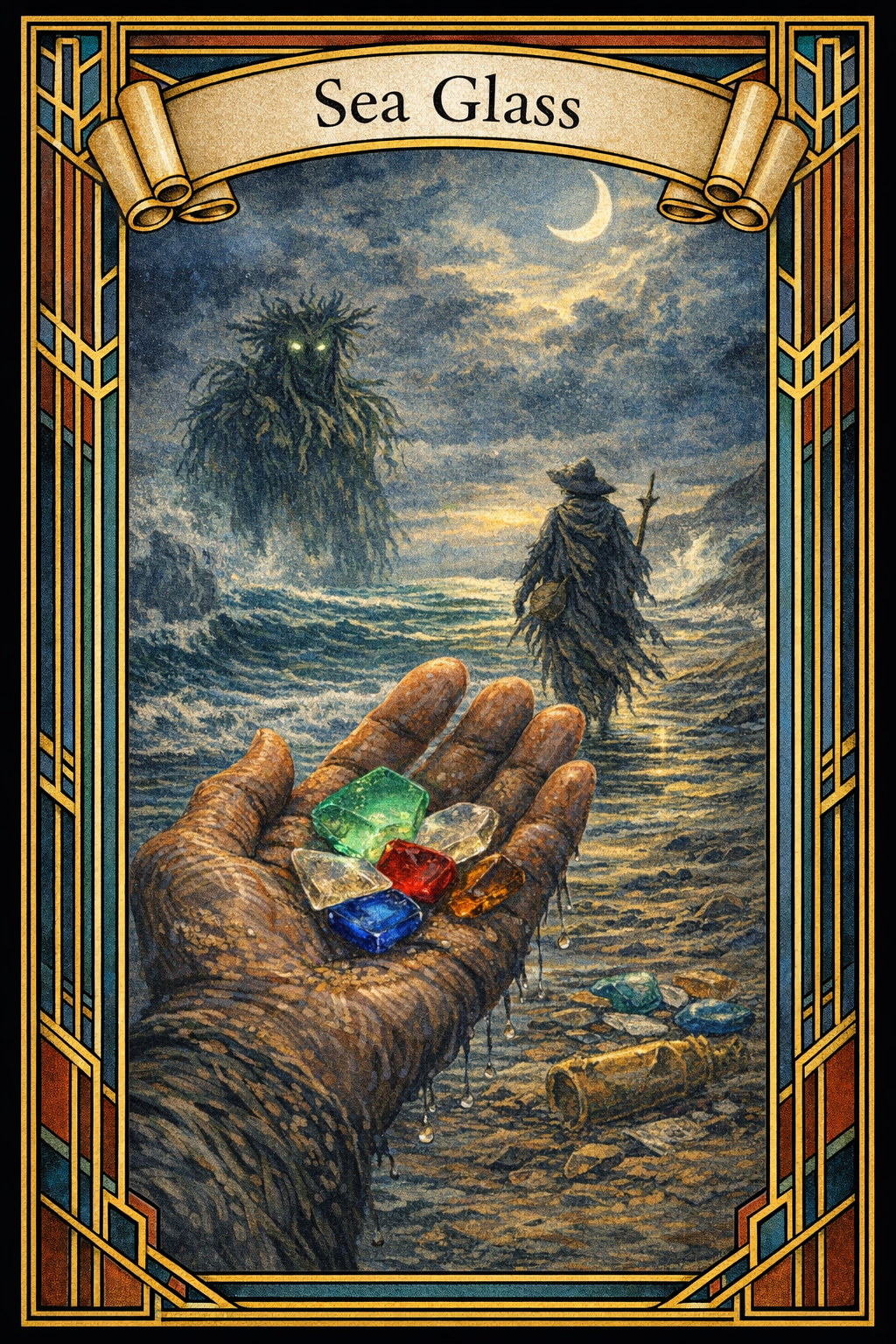
Sea Glass card art

Card Page

Sea Glass

The Mythos of Sea Glass

In the oldest coastal towns—those that keep their graveyards facing the water and their doors painted the color of storms—there is a saying: the sea does not destroy; it revises. What it cannot keep, it returns altered. What it cannot forgive, it wears smooth.

Sea Glass is the card that rose from that belief.

Origin: The Bottle and the Tide

The myth begins with a green bottle thrown from a ship in a year no one records. Some say it carried a love letter. Others insist it held a curse, sealed with wax and spit. A few claim it contained nothing at all—only the arrogance of making trash and calling it travel.

The bottle broke on a reef during a night of black weather. Its shards should have been a hazard, a punishment, an ending. Instead, the ocean took them into its long labor: tumbling them through sand, salt, and time until every sharp intention was softened. The sea did not erase the glass’s history; it made it touchable.

That is the first doctrine of the card: harm can be transformed without being denied.

The Finder: The One Who Walks After Storms

Centuries later, a person known only as the Beachcomber appears in the mythos—sometimes an old woman with a basket, sometimes a child with pockets full of stones, sometimes a sailor who cannot sleep on land. They walk the shoreline after storms, when the ocean is most honest about what it has taken and what it is willing to give back.

The Beachcomber finds a piece of sea glass unlike the rest: not merely smoothed, but faintly luminous, as if it remembers moonlight. When held to the ear, it does not “sound like the sea.” It sounds like a room you once lived in—distant voices, a door closing, the hush after an argument, the soft clink of a glass set down carefully. It is the noise of a life becoming memory.

The Beachcomber keeps it, and in keeping it becomes the card’s second doctrine: what is found is not always meant to be owned; sometimes it is meant to be witnessed.

The Guardian: The Tide’s Quiet Bargain

In some tellings, the ocean notices the theft. Not in anger—more like recognition. The sea is not a god, but it behaves like one: patient, total, uninterested in excuses.

The Beachcomber dreams of a figure made of kelp and foam, crowned with driftwood and barnacles, eyes like polished stones. This is the Undertow, the card’s guardian. It offers a bargain:

  • Keep what I have softened, it says, but do not pretend you made it gentle.
  • Carry it as proof that time can change the edges of a thing.
  • And when you are ready, return something of your own—something sharp.

So the Beachcomber returns a secret, a grudge, a name they have bitten down on for years. The sea takes it without ceremony. In exchange, the sea glass becomes a talisman: not protection from pain, but protection from becoming pain.

This is the third doctrine: healing is an exchange.

What the Card Represents in the World

In the tarot’s internal mythology, Sea Glass is said to be the ocean’s answer to the Tower. Where the Tower is sudden fracture, Sea Glass is the slow, tidal aftermath—the patient reshaping of what remains.

Readers in port cities claim the card was added to decks by sailors who wanted a symbol for the kind of survival no one celebrates: living through something and being changed by it in ways you can’t explain without sounding like superstition.

It is associated with:

  • Recovered fragments (of self, of history, of love)
  • Softened truths (honesty without cruelty)
  • Time’s craftsmanship
  • Beauty born from accident
  • The ethics of keeping (what you take from the past, what you return)

The Hidden Story: The Colors and Their Meanings

Not all sea glass is equal in the mythos. Each color is treated as a different “chapter” of the same lesson:

  • Green: the common miracle—everyday endurance, the kind anyone can find if they keep walking.
  • Brown: the bitter medicine—accepting what was ordinary and still hurt.
  • Clear: the hardest to recognize—pain that looks like “nothing happened,” yet changed everything.
  • Blue (rare): joy that survived—something bright that the world tried to break.
  • Red (legendary): a wound made holy—transformation so complete it becomes purpose.

Some decks depict Sea Glass as a single shard; others show a handful, suggesting that a person is never healed in one piece.

The Warning: Smooth Is Not the Same as Safe

The card’s darker myth is whispered among readers who have watched people use “healing” as a mask.

Sea glass is smooth, yes—but it is still glass.

If you clutch it too tightly, it can still cut. If you make it your identity, you may start seeking storms just to feel the drama of finding yourself again. The Undertow’s voice returns in those readings:

Do not confuse being softened with being harmless. Do not confuse being broken with being honest.

The Card’s Place in a Spread

When Sea Glass appears, it is said to mean:

  • The worst edges of an experience are being worn down by time.
  • You are ready to hold what happened without bleeding.
  • Something once discarded—by you or by others—has returned with new value.
  • A reconciliation is possible, but only if you accept what cannot be unbroken.
  • You are being asked what you will give back to the sea: what bitterness, what pride, what insistence on staying sharp.

Closing Line of the Myth

In the final telling, the Beachcomber grows old and returns to the same shore with the same piece of sea glass. They do not throw it away. They place it gently in the tide as though setting a cup on a table.

The ocean takes it—not greedily, but as if completing a sentence.

And the shore, in the morning, is scattered with new fragments made gentle.

So the myth concludes:

Sea Glass is the card of aftermath made beautiful—proof that time can polish even ruin into something you can hold, provided you remember who did the polishing, and what it cost.
Interpretation

Sea Glass — Interpretation

Core Message

Time is reshaping what hurt you. You are moving from raw fracture to workable truth—still real, still part of your story, but no longer able to draw blood every time you touch it.

Themes

  • Aftermath, integration, and slow healing
  • Beauty and meaning recovered from what was discarded
  • Softened honesty: clarity without cruelty
  • The ethics of keeping: what you hold onto vs. what you return
  • Exchange: release as the price of relief

What This Card Signals Now

  • A past rupture is settling into perspective; the sharpest edges are wearing down.
  • You are ready to handle a memory, relationship, or truth with steadier hands.
  • Something you thought was “ruined” can become useful again—not by undoing the break, but by changing how it’s carried.
  • A return is occurring: an old feeling, person, or lesson resurfaces, altered by time and distance.

Invitation / Guidance

  • Let time do its craft, but participate: choose gentleness as a practice, not a mood.
  • Hold the past with respect, not ownership—witness it without making it your identity.
  • Make the bargain: offer the sea something sharp you’ve been gripping (a grudge, a secret, a rehearsed story of harm, the need to be right) so you can keep what’s been softened.
  • Seek repair that honors reality: reconciliation is possible when both sides stop pretending nothing broke.

Caution

Smooth is not the same as safe. Don’t romanticize damage or chase storms to feel transformed. What’s been polished can still cut if clutched too tightly.

In Relationships

A chance to speak with tempered truth. Old wounds can be addressed without escalation. Connection improves when you release the need to punish, prove, or relive the break—and instead name what remains, what changed, and what you can hold now.

In Work / Creativity

Salvage and refinement. A discarded draft, failed attempt, or past skill returns with new value. Progress comes through patient iteration, editing, and letting experience sand down perfectionism into craft.

In Spiritual / Inner Work

Integration over erasure. You’re learning to carry your history without bleeding into everyone else. The work is not to become unbreakable, but to become less dangerous to yourself and others.

Reversed Interpretation

Sea Glass — Reversed Interpretation

Core Message

The past is being handled too soon—or held too tightly. What should be slowly integrated is being forced into meaning, weaponized, or used as an identity. The edges may look smooth, but they still cut.

Themes

  • Stalled or performative healing
  • Clinging to fragments; making the aftermath a home
  • “Softened truths” becoming avoidance, vagueness, or denial
  • Possessiveness over what should be witnessed and released
  • Refusing the exchange: keeping the talisman without giving up what’s sharp

What This Card Signals Now

  • You’re reopening an old break by gripping it, retelling it, or testing it for pain.
  • A memory or relationship is being romanticized as proof of depth rather than processed as reality.
  • Something returned from the past is not a gift yet—it’s unfinished business asking for boundaries.
  • You may be mistaking numbness for peace, or silence for resolution.
  • The “bargain” is overdue: relief is being sought without relinquishing the grudge, the secret, the pride, or the need to be right.

Invitation / Guidance

  • Stop polishing the story; tend to the wound. Choose one honest, concrete step over symbolic gestures.
  • Loosen your grip: you can honor what happened without carrying it everywhere.
  • Name what still has an edge—then decide how you will handle it safely (support, distance, structure, time).
  • Return something sharp on purpose: a rehearsed narrative, a revenge fantasy, a private vow to never trust again.
  • Let “integration” include limits: some things are understood best from afar.

Caution

Smooth is not safe. If you clutch the softened fragment as identity, it will keep drawing blood—quietly, repeatedly, and in ways that look like “just being honest.”

In Relationships

Old wounds are being used as leverage, armor, or a test. Conversations may circle without repair—too gentle to be truthful, or too “truthful” to be kind. Reconciliation is blocked by scorekeeping, avoidance, or insisting the break never mattered.

In Work / Creativity

You’re stuck in salvage mode: endlessly revising, rescuing, or reworking what should be released or rebuilt. Perfectionism disguises itself as refinement. Progress returns when you stop trying to make the broken draft prove your worth.

In Spiritual / Inner Work

Avoidance dressed as wisdom. You may be bypassing grief with aesthetics, metaphors, or “acceptance” that is actually resignation. The task is to feel what’s still jagged—and to practice containment so your history doesn’t become harm.

Story Beats

Vignette 1

The First Return

Dialog: What the sea gives back has already been changed by time. Take it gently, and let the edges teach you patience.

Scene: At dawn, smooth shards of sea glass shine among wet sand, shells, and foam on a quiet shoreline after the tide has receded.

Vignette 2

Tidepool Witness

Dialog: Reflection does not always arrive in a mirror. Sometimes it waits in shallow water until you are calm enough to see through it.

Scene: A moonlit tidepool holds luminous sea glass, shells, and reflected stars while calm water gathers around dark coastal stones.

Vignette 3

Keeper of Fragments

Dialog: A life can be rebuilt from fragments when each piece is turned until it catches the light. What survives you may yet become beautiful.

Scene: Inside a small lamplit room near the sea, jars of sea glass and shells rest on a weathered wooden table beside an open window facing calm water.