Tarot's Landing / Cosmos / Readings
Spring Flowers card art

Card Page

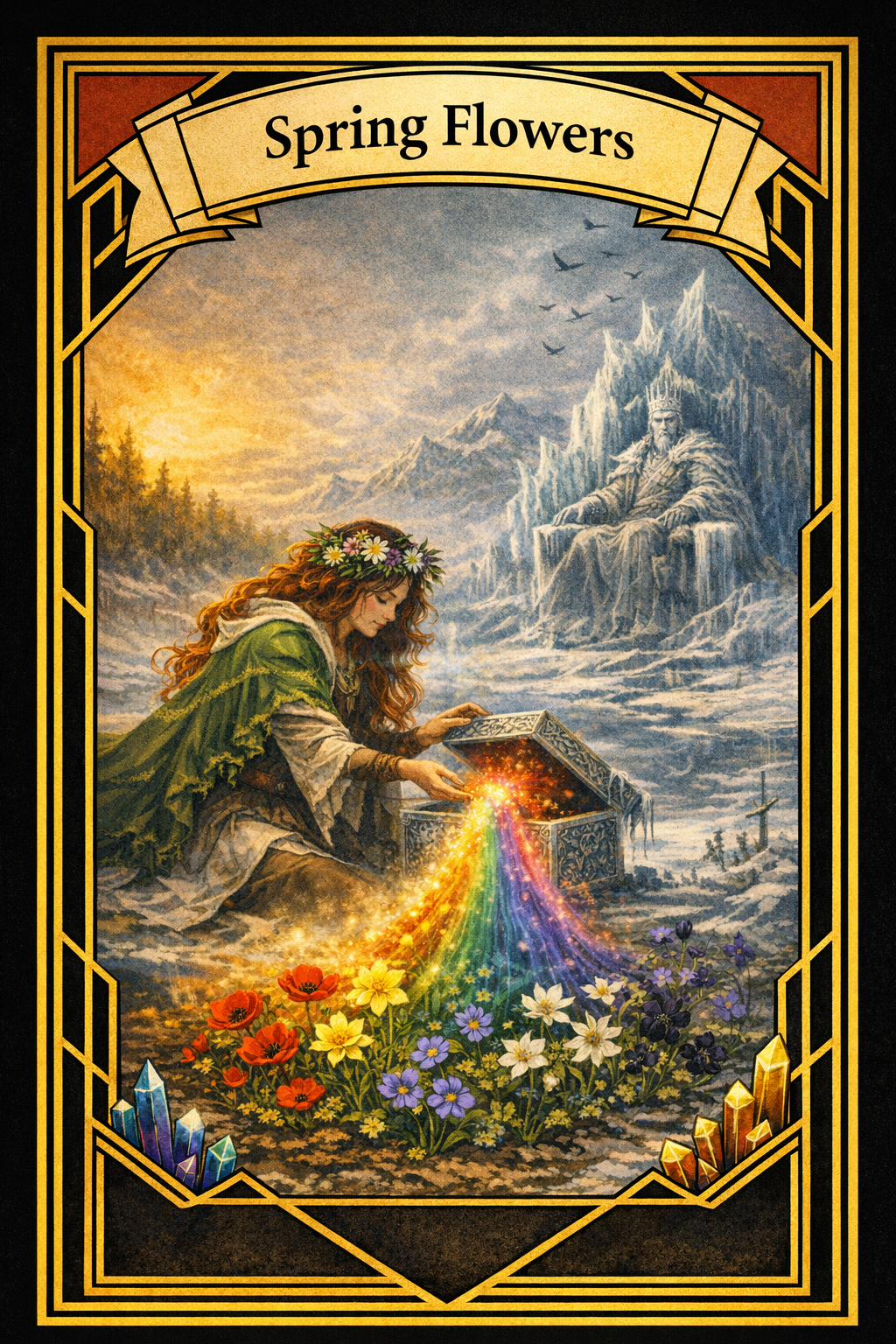
Spring Flowers

They say the first spring did not arrive by warmth alone, but by a bargain struck in the grey season between endings and beginnings. When the world was still rinsed in winter’s ash, a wanderer-goddess named Vernalis walked the sleeping fields and found the colors of creation locked away in a buried casket of frost. The casket belonged to the Pale King of Stillness, who hoarded every hue so nothing could change and nothing could be lost.

Vernalis did not fight him. Instead she offered a gentler theft: she would return each color at the end of the year, willingly, if the King allowed her to lend them to the world for one turning of the sun. The King agreed, believing that mortals would squander such gifts. Vernalis then opened the casket and, with a breath that tasted of rain, scattered the colors into the soil like seeds.

Where each color landed, a different flower rose—scarlet for courage that survives sorrow, gold for laughter that refuses to be shamed, violet for the mysteries that keep faith alive, blue for truth spoken softly, green for forgiveness, white for beginnings, black for the fertile dark beneath grief, and every shade between for the countless names of love. The flowers were not merely decoration; they were the world’s first promises made visible. To pick one was to borrow its vow—briefly—and to plant the stem afterward was to return the vow to the earth.

The myth warns that those who hoard spring’s blossoms, pressing them into books and locking them in drawers, begin to fade in color themselves. Their voices grow thin, their dreams lose saturation, and their days become a long winter of sameness. But those who let the flowers pass through their hands—gifted, replanted, or simply admired—find that the world answers in kind. New paths open. Old wounds soften. Even the Pale King, watching from his ice-throne, cannot help but tilt his head as if listening to a song he almost remembers.

Thus the card of Spring Flowers is said to appear when the casket has been opened again in your life: when the heart is ready to risk brightness, when change is no longer an enemy but a necessary bloom. It carries the old agreement in its petals—take what you need, but do not imprison it. Color is meant to move.
Interpretation

Spring Flowers — Interpretation

  • Core message: A season of renewal is opening. Beauty, hope, and momentum return when you allow change to move through you rather than trying to control it.
  • Theme: Borrow the vow, don’t hoard the bloom. Take what nourishes you now—joy, courage, tenderness, truth—but keep it circulating through action, sharing, and release.
  • In your life now: Opportunities appear in small, vivid ways: a new connection, a fresh idea, a softened heart, a second chance. What was “grey season” begins to color in. Follow what feels alive.
  • Guidance:
  • Choose one bright, simple step and do it today.
  • Let gifts be used, not preserved: speak the kind word, make the apology, start the project, accept the invitation.
  • Return something to the world—replant what you receive through generosity, mentorship, creativity, or care.
  • Shadow to watch: Possessiveness, perfectionism, nostalgia, or trying to freeze a moment so it won’t end. When you clutch the beautiful thing too tightly, it loses its power and you lose your own color.
  • Relationships: Affection grows through shared experiences and small rituals. Offer appreciation freely; allow bonds to evolve. A gentle truth can restore warmth more than dramatic declarations.
  • Work & creativity: Inspiration is fertile and varied. Experiment, iterate, collaborate. Don’t wait to “save” your best ideas—put them into circulation and they will multiply.
  • Spiritual/inner meaning: Your heart is ready to risk brightness again. Healing is not the absence of winter, but the willingness to bloom after it.
  • Practical prompt: Ask: What am I trying to preserve that wants to be lived? Then choose one way to let it move—gift it, use it, share it, or begin it.

Reversed Interpretation

Spring Flowers — Reversed Interpretation

  • Core message: Renewal is stalled or resisted. Color is available, but you may be withholding it—fearing change, loss, or the messiness of living things in motion.
  • Theme: Hoard the bloom, lose the vow. Clinging to what’s beautiful (or to how things used to be) drains it of power and drains you of vitality.
  • In your life now: The “grey season” lingers because you’re waiting for certainty before you begin, or because you’re trying to preserve a moment, a relationship, or an identity exactly as it was. Small opportunities for warmth appear, but you may dismiss them as “not enough” or “not safe.”
  • Guidance:
  • Stop treating joy as something to earn later—take one imperfect step toward what feels alive now.
  • Practice circulation: share the idea, say the kind thing, make the offer, ship the draft, accept help.
  • Choose release over preservation: delete the script of how it must go; let the season be new.
  • Shadow to watch: Possessiveness, perfectionism, scarcity thinking, nostalgia, or fear of disappointment. Pressing life “flat” to keep it from changing can turn tenderness into control.
  • Relationships: Affection may feel conditional or tightly managed. Overthinking, testing, or holding back warmth can create distance. A gentle, honest conversation—without trying to dictate the outcome—restores movement.
  • Work & creativity: Inspiration is present but blocked by comparison, over-curation, or waiting for the “right” version. Iteration is the medicine: publish, prototype, collaborate, and let feedback be compost.
  • Spiritual/inner meaning: You may be protecting yourself from grief by refusing brightness. Healing asks for a risk: to let beauty pass through you even if it cannot be kept.
  • Practical prompt: Where am I trying to freeze what wants to grow? Identify one place to loosen your grip today—share, begin, forgive, or let something end cleanly.

Story Beats

Vignette 1

The Bargain in the Grey Season

Dialog: Vernalis: “Lend me your colors for one turning.” Pale King: “And you’ll return them—willingly?” Vernalis: “Every year. Let the world change.”

Scene: A bleak late-winter field under a slate-grey sky, snow reduced to ash-like crust. In the foreground, Vernalis—a wanderer-goddess in a rain-damp cloak with hints of green and pale gold—stands calmly before an ice-throne formed from jagged frost and frozen reeds. Seated on it is the Pale King of Stillness, tall and severe, skin like porcelain ice, crown of hoarfrost, expression unreadable. Between them: a half-buried casket of translucent frost with faint trapped colors glowing inside like stained glass under ice. The mood is tense but quiet, like a negotiation rather than a battle; breath fog hangs in the air, and the only warmth is the subtle, prismatic light leaking from the casket’s seams.

Vignette 2

Colors Scattered Like Seeds

Dialog: Vernalis: “Scarlet—courage. Gold—laughter. Violet—mystery.” A child whispers: “If I pick one… do I keep it?” Vernalis: “Only long enough to live it.”

Scene: A close, intimate spring awakening: Vernalis kneels in dark, thawing soil, one hand opened as if releasing something. From her palm, flecks of luminous color drift downward like seeds—scarlet, gold, violet, blue, green—each spark touching ground and instantly sprouting delicate shoots. A small child in simple village clothing stands nearby, wide-eyed, holding an unpicked bud. Around them, the first flowers rise in distinct patches, each color visibly different in shape and aura: red blooms like small flames, gold like sunbursts, violet like velvety bells, blue like calm stars. The background still shows remnants of winter—bare trees and melting snowbanks—while the foreground is alive with fresh growth and soft rain-mist.

Vignette 3

The Hoarder Fades

Dialog: Hoarder: “I’ll keep them perfect—pressed, preserved.” Vernalis: “Then you’ll lose your own color.” Hoarder: “My dreams… why are they turning grey?” Vernalis: “Because you imprisoned spring.”

Scene: An interior scene lit by cold window light: a small room with shelves of drawers and old books. On a desk lies an open book filled with pressed flowers—flattened petals like faded confetti—beside a locked wooden drawer with a tarnished key. A person sits hunched over, clutching a brittle bloom; their skin looks desaturated and pale, lips nearly colorless, eyes tired, as if the vibrancy is draining from them. In contrast, through the window, a garden outside glows with living spring color—bright blossoms moving in a breeze—yet the room feels airless and muted. A faint, spectral presence of Vernalis is suggested near the doorway: a soft silhouette with rain-scented light and a few drifting petals, emphasizing warning rather than judgment.