Tarot's Landing / Cosmos / Readings
Sunrise card art

Card Page

Sunrise

Sunrise

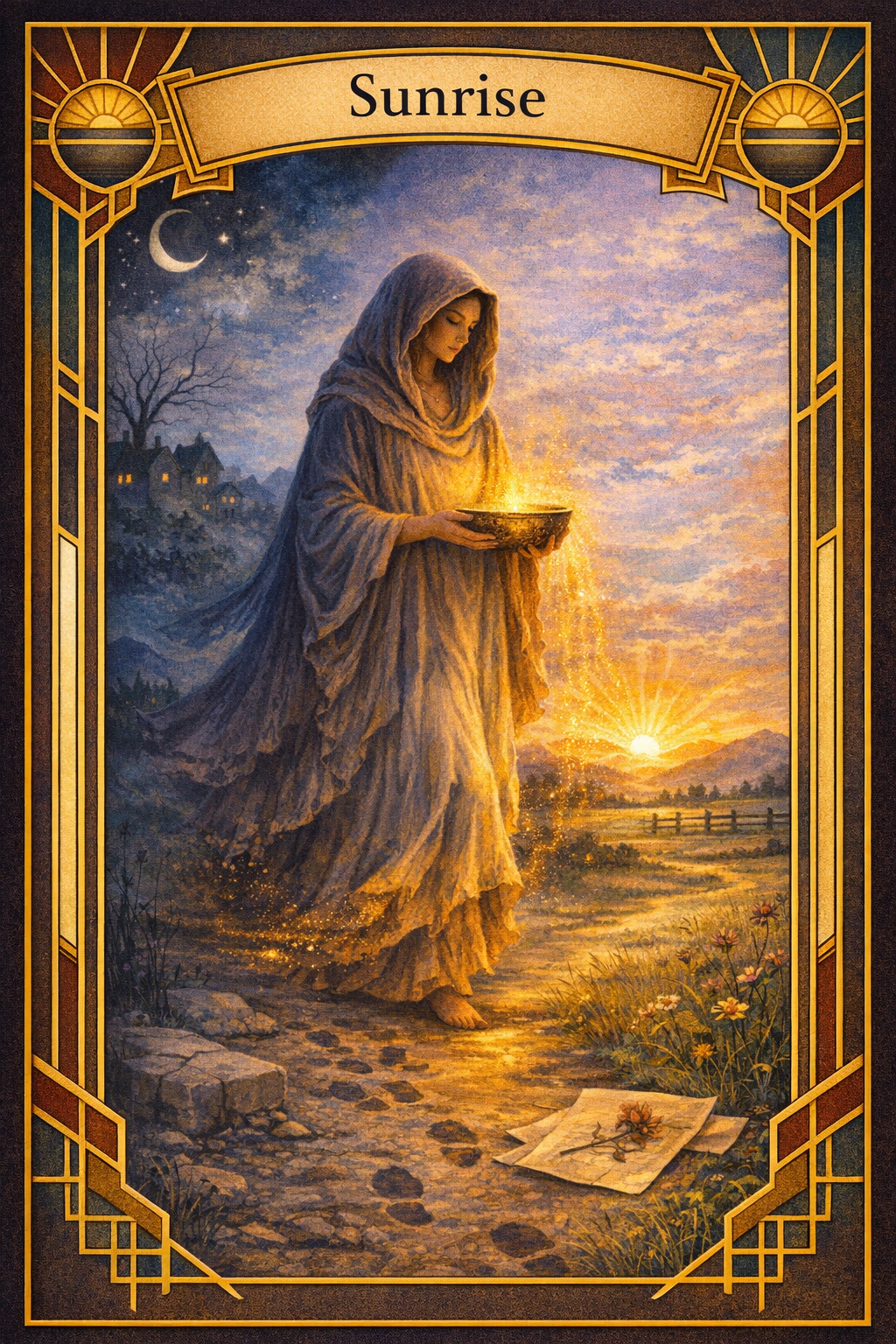
They say the Sun does not rise; it is invited.

In the oldest stories, the world endured a night that would not end. Not the ordinary turning of hours, but a long, patient darkness that seeped into people’s speech and made even truth feel like a risk. In that night, lamps were plentiful—clever lights, flattering lights, lights that could be aimed away from whatever hurt to look at. Whole lives were arranged by their glow. Promises were made in it because no one could clearly see the cost.

When the first honest light finally came, it did not arrive like victory. It arrived like accuracy.

The myth names that light Sunrise, and it is not a blazing god nor a conquering flame, but a quiet figure who walks the rim of the world carrying a bowl of pale gold. With each step, the bowl tips slightly, and the light spills in thin bands across roofs, across fields, across faces turned away. It does not accuse. It does not console. It simply reveals: the footprints at the threshold, the hairline cracks in the foundation, the letter left unsent, the tenderness that survived despite everything.

Sunrise is said to be the child of two stubborn forces: Night, who keeps secrets by nature, and Time, who keeps none by necessity. Night hoarded what it could—misunderstandings, bargains, bruised intentions—while Time waited, unhurried, for the moment when concealment would become too heavy to carry. Their union produced a light that cannot be bribed. It shows what is there, not what is wished.

In the myth, those who feared exposure tried to stop it. They built higher walls. They painted their windows black. They filled the air with smoke and sweet perfume, hoping to blur the edges of what they had done. But Sunrise did not fight them. It only kept coming—slowly, steadily—until even their defenses became visible for what they were: evidence of fear.

The turning point of the tale is always the same: a person steps outside at the first hint of dawn. They are not rewarded with certainty. They are given something rarer—the right timing. Not too early, when action would have been futile, and not too late, when damage would have hardened into fate. The myth insists that certain truths cannot be forced into readiness; they must ripen. Sunrise is the moment ripeness becomes obvious.

Under this card’s light, hidden things do not necessarily become easy—but they become simple. The tangled can be seen as separate threads. The unnamed can finally be named. The path that was guessed at in darkness becomes visible enough to walk.

And so Sunrise is kept in the deck as a reminder: after the long night, clarity is not a thunderclap. It is a gradual unveiling, honest and inevitable—an arrival that asks only one thing of you:

Look.
Interpretation

Sunrise — Interpretation

Core message: Clarity arrives in its own time. What is true becomes visible, and you are asked to meet it without flinching.

Themes: honest revelation • timing that’s finally right • simplicity after confusion • seeing consequences • gentle inevitability • naming what was unnamed

In a reading: Sunrise indicates a gradual unveiling—facts, motives, and feelings separating into distinct threads. Something you sensed in the dark is now confirmable. This is not dramatic rescue; it’s accurate light. Expect the situation to become easier to navigate because it becomes easier to see. Denial, ambiguity, and “maybe later” lose their power.

What it may point to:

  • A truth surfacing naturally (a conversation, a document, a realization, a pattern you can no longer unsee).
  • The end of a period of self-protective fog: rationalizations, half-promises, or convenient narratives.
  • The right window to act—conditions have ripened enough that a step taken now will matter.
  • Quiet proof: small details revealing the real state of things (cracks, footprints, inconsistencies, or enduring tenderness).

Guidance: Step outside. Look directly at what is present rather than what is preferred. Name the threads: what happened, what it cost, what you want, what you can do. Choose actions that align with what the light shows, not what the night allowed. If you’ve been waiting for certainty, accept “clear enough” and move.

Likely outcome: A simpler path forward—possibly not painless, but unmistakable. Decisions become cleaner, boundaries more obvious, and the next step visible.

Reversed Interpretation

Sunrise — Reversed Interpretation

Core message: Clarity is resisted, delayed, or distorted. The light is present, but you may be turning away from what it shows—or mistaking glare for truth.

Themes: avoidance • denial and rationalization • premature conclusions • half-revelations • selective seeing • fear of consequences • “not yet” timing

In a reading: Reversed Sunrise suggests an unwillingness (yours or someone else’s) to face what’s becoming obvious. Information may be withheld, minimized, or presented in a way that creates more fog than clarity. Alternatively, you may be pushing for certainty too soon—forcing an answer before it has ripened—resulting in misread signals, harsh overexposure, or decisions made from anxiety rather than accuracy.

What it may point to:

  • Selective illumination: focusing on the details that support a preferred story while ignoring the rest.
  • Obscuring tactics: excuses, distractions, “sweet perfume” narratives, or performative transparency that avoids the real issue.
  • Fear-driven delay: avoiding a conversation, a decision, or a truth because it would require change or accountability.
  • False dawn: a promising sign that isn’t stable yet; clarity that flickers, then recedes.
  • Glare and oversimplification: mistaking intensity, urgency, or outrage for truth; reducing a complex situation into a single convenient conclusion.

Guidance: Stop negotiating with the fog. Ask: What am I not wanting to see? What would I have to do if I admitted it? Seek corroboration, not reassurance. Slow down if you’re forcing resolution; speed up if you’re stalling out of fear. Choose one honest action that makes denial harder—name a fact, request specifics, set a boundary, document what’s real.

Likely outcome: Clarity still arrives, but later—and often at a higher cost—unless you cooperate with it now. The path forward becomes simple only after the avoidance ends.

Story Beats

Vignette 1

Bowl of Pale Gold

Dialog: Don’t flinch. It isn’t judgment—just light. See the cracks, the footprints, the unsent letter. Now you know what’s real.

Scene: Cinematic dawn at the edge of a quiet town. A calm, androgynous figure in a simple cloak walks along a rooftop ridge at the horizon line, carrying a shallow bowl that glows with pale gold. Thin bands of sunrise spill from the tipped bowl across shingles, a small garden, and a front doorstep where muddy footprints are clearly revealed. In a nearby window, a hand holds an unopened, slightly crumpled letter. The light is gentle but precise, emphasizing hairline cracks in a foundation and a single resilient flower. Color palette: cool night blues transitioning into soft gold; high detail, realistic, shallow depth of field.

Vignette 2

Windows Painted Black

Dialog: You can paint the windows black, build the walls higher, burn perfume into smoke—Sunrise won’t argue. It will only arrive.

Scene: Early morning street scene with stark contrast: a tall, imposing house with windows painted matte black and fresh boards nailed over some panes. A high stone wall casts long shadows. Wisps of gray smoke and a faint haze suggest incense or sweet perfume drifting from within. Beyond the wall, the first sunlight creeps in, revealing the wall’s texture, soot stains, and the anxious effort of concealment. In the foreground, a figure stands half-hidden behind the wall, tense posture, clutching a paintbrush or rag. The sunrise glow outlines everything with unforgiving clarity—no violence, just revelation. Mood: quiet, uneasy, inevitable; realistic lighting, detailed masonry and smoke.

Vignette 3

The Right Timing

Dialog: Not too early. Not too late. Step outside—now. The truth has ripened. You don’t get certainty, only the timing to act.

Scene: A solitary person opens a door and steps onto a porch at first light. The world is still, dew on grass, faint mist over a field, and the sky shifting from indigo to peach. The person’s face is lit by a narrow, advancing band of sunrise that reaches their feet like a threshold. Behind them, the interior is dim with warm lamplight—suggesting the long night of comforting illusions. Ahead, a clear path becomes visible: a dirt trail through tall grass, previously hidden, now distinct. Subtle details in the light: separated threads of a tangled rope on the porch rail, a name visible on an envelope, and a repaired-but-scarred fence. Mood: quiet resolve, clarity without triumph; cinematic realism, soft fog, crisp highlights.