Tarot's Landing / Cosmos / Readings
The Fool card art

Card Page

The Fool

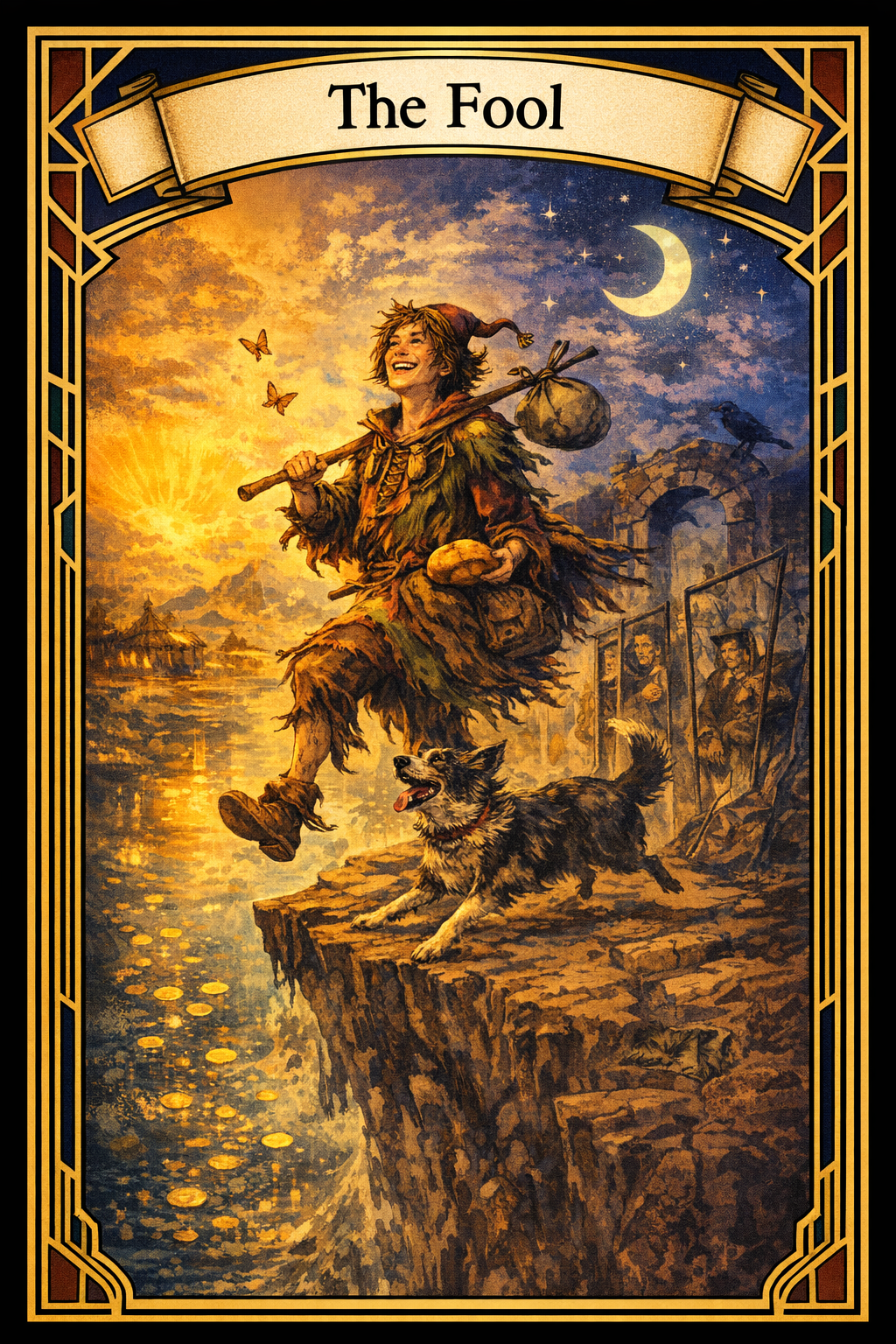
The Fool is the first footfall and the last echo: the wanderer who steps beyond the edge because the edge was only ever a story. In the oldest telling, before kings named their borders and priests weighed sins on brass scales, there was a nameless one who carried nothing but a laugh and a loaf of bread that never went stale. They walked into villages unannounced, sat at the poorest tables as if invited, and spoke to dogs as if they were judges. Wherever The Fool passed, locked doors forgot how to be closed.

It is said The Fool was born from a wager between Dawn and Dusk. Dawn promised that beginnings were sacred and must be guarded; Dusk insisted that endings were merciful and should be welcomed. Neither could prove their claim, so they fashioned a child from their argument—bright-eyed, unarmored, unafraid—and set them on a road that had no map. “Find the place where beginning and ending are the same,” Dawn said. “Find the place where nothing can be lost,” Dusk replied. The Fool nodded, not because they understood, but because they did not need to.

They traveled with a small companion—some call it a dog, some a wolf, some the shadow of hunger itself. It nipped at their heels to remind them of consequence, to keep them from mistaking innocence for invincibility. The Fool never struck it. When it bit, The Fool laughed; when it whined, The Fool fed it; when it ran ahead, The Fool followed. Thus the companion became both warning and blessing: the world’s teeth made gentle by refusal to fear.

In one myth, The Fool came upon a bridge guarded by a giant who demanded a toll of certainty. “Name your destination,” the giant rumbled, “or you do not pass.” The Fool looked at the river beneath, bright as spilled coins, and answered, “I am going to where I am going.” The giant, who had eaten philosophers and spat out their proofs, was so baffled by a truth that could not be argued with that it stepped aside. The bridge creaked under the weight of unclaimed possibility, and The Fool crossed as if crossing were the most ordinary miracle.

In another telling, The Fool entered the Hall of Mirrors where every reflection showed a different life: beggar, saint, murderer, monarch, child, corpse. Those who entered the hall usually fled, broken by the sight of what they might become. The Fool bowed to each reflection as to a stranger on the road. “Thank you for showing me,” they said, and walked on without choosing. The mirrors cracked—not from violence, but from irrelevance. Fate, confronted with someone who would not bargain, found itself suddenly unemployed.

The Fool’s greatest deed is also their smallest: they once gave away the last coin in their purse to a thief who had tried to steal it. “You needed it more than I did,” The Fool said, and the thief wept so hard that the coin rusted in their palm. That rust became the first seed of remorse, and from it grew the thorned hedge that now surrounds every heart that wants to change but fears pain. When The Fool appears, the hedge parts without being cut, because it recognizes its own origin.

There is a darker strand, whispered by those who distrust laughter. They claim The Fool is the mask worn by the Void when it wishes to walk among the living without being recognized. They say The Fool’s empty hands are not generosity but appetite, and that every leap is a sacrifice offered to nothingness. Yet even this accusation bends into paradox: if the Void must disguise itself as innocence to be endured, then innocence has already conquered it.

The mythos agrees on one thing: The Fool cannot be owned. Kings have tried to crown them, lovers to bind them, prophets to recruit them as proof. Each time, The Fool slips free—not by force, but by failing to understand the terms of captivity. Chains require agreement. The Fool offers none.

When The Fool is drawn, the old stories say the road has noticed you. A threshold is near, and the world is about to test whether you can step forward without demanding guarantees. The Fool does not promise safety. The Fool promises motion: the holy irresponsibility of beginning, the brave stupidity of trust, the strange wisdom of walking with nothing to protect except your own willingness to learn.

And when the journey ends—when the last card is laid down and the last question has been asked—The Fool is said to return to the cliff’s edge, look back at every life they have lived in a single breath, and grin. Not because it was easy. Because it was real. Then they step again, not into death, but into the next story, carrying nothing, needing nothing, and making room in the universe for whatever comes after certainty.
Interpretation

Interpretation — The Fool

  • Core message: A threshold is opening. Step forward without demanding guarantees. Trust motion over certainty, and let the road teach you what planning cannot.
  • Essence: Holy irresponsibility, beginner’s mind, willingness to look unguarded, freedom from contracts you never agreed to.
  • What’s arriving: A new path, an unclaimed possibility, an invitation that won’t come with proof. The right choice may be the one that feels light enough to carry.
  • How to meet it: Bring less. Say yes to experience before you fully understand it. Follow curiosity, not fear; learn by doing; allow yourself to be surprised.
  • Gift: Doors unlock. Old roles loosen. You become harder to control because you stop negotiating with expectations. You recover the ability to start again.
  • Warning within the blessing: Innocence is not invincibility. Consequences still nip at your heels—listen to them without surrendering to them. Keep your laugh, but watch your footing.
  • Relationships: A fresh beginning, a meeting without scripts, a bond that thrives on openness and shared discovery. Let connection be real rather than defined.
  • Work / money: A leap into a new role, venture, or study. Progress comes from experimentation. Give strategically, but don’t cling—resources move when you do.
  • Inner work: You are not required to choose a single reflection of yourself. Honor every possible self, then walk on. Identity can be a road, not a cage.
  • Guiding question: What would you do if you didn’t need certainty to deserve a beginning?

Reversed Interpretation

Reversed Interpretation — The Fool

  • Core message: The threshold is still there, but you’re either refusing the step or taking it with your eyes closed. Motion without awareness becomes drift; caution without movement becomes a cage.
  • Essence (reversed): Naivety, avoidance, impulsivity, “freedom” used as an excuse, fear of commitment disguised as spontaneity.
  • What’s arriving: A false start, a tempting detour, an invitation that flatters your appetite for escape more than your growth. Or: a real new beginning that you keep postponing until it expires.
  • How to meet it: Slow down. Ask one honest question before you leap. Name the risk, set a boundary, check the facts, then choose—deliberately.
  • Shadow pattern: You keep “starting over” to avoid being seen finishing. You mistake not choosing for staying pure, when it’s really staying untested.
  • Warning within the warning: Consequences aren’t just nipping—they’re trying to get your attention. Ignoring them turns the companion into a predator. Don’t confuse optimism with immunity.
  • Relationships: Charm without accountability; flirting with possibility while dodging clarity. Mixed signals, ghosting, idealization, or a fear of being defined that prevents anything real from forming.
  • Work / money: Risky leaps, poor planning, scattered effort, or gambling dressed up as courage. Watch for “opportunities” that require you to ignore numbers, timelines, or basic due diligence.
  • Inner work: Identity becomes a hall of mirrors you can’t leave—endless self-reinvention, comparison, or refusal to integrate your contradictions. Choose one small, real next step and let it teach you.
  • Guiding question: Where am I calling it freedom when it’s actually fear—of consequence, of commitment, or of being ordinary long enough to grow?

Story Beats

Vignette 1

Toll of Certainty

Dialog: GIANT: Name your destination, or you do not pass. FOOL: I’m going to where I’m going. GIANT: That’s not an answer. FOOL: It’s the only one I have.

Scene: A wide, ancient stone bridge spans a bright river that glitters like spilled coins. A towering giant blocks the center of the bridge, looming and stern, holding a crude spear like a gatekeeper. The Fool stands barefoot at the threshold, unarmored, with a small satchel and a simple loaf of bread tucked under one arm; their expression is calm, almost amused. A small dog/wolf-like companion hovers at the Fool’s heels, teeth visible but not attacking—more warning than threat. Morning and evening light mingle unnaturally in the sky, suggesting Dawn and Dusk’s wager. The atmosphere feels mythic and timeless, with wind tugging at the Fool’s clothing and the bridge stones worn smooth by countless forgotten crossings.

Vignette 2

Hall of Mirrors

Dialog: REFLECTIONS (overlapping): Beggar. Saint. Murderer. Monarch. FOOL: Thank you for showing me. REFLECTION: Choose. FOOL: Not today.

Scene: An endless hall lined with tall, ornate mirrors, each mirror reflecting a different version of the Fool: one crowned, one bloodstained, one in rags, one as a child, one as a corpse—each vivid and distinct. The real Fool walks down the center, relaxed posture, head slightly bowed in polite acknowledgment, hands open and empty. The companion (dog/wolf/shadow) pads alongside, alert, ears pricked, casting a long, strange shadow that doesn’t match the lighting. Several mirrors show hairline cracks forming—not from impact, but as if the glass is losing interest in holding the images. The lighting is cool and silvery, with reflections multiplying into infinity, creating a surreal, fate-haunted atmosphere.

Vignette 3

The Last Coin

Dialog: THIEF: Hand it over. FOOL: It’s my last coin. THIEF: Then you’ll miss it. FOOL: You need it more than I do—take it. THIEF (breaking): Why would you do that?

Scene: A narrow alley beside a poor village table scene: rough wooden walls, a dim lantern glow, and distant warm light from a humble home. The Fool stands close to a ragged thief with trembling hands; the Fool gently presses a single coin into the thief’s palm. The coin shows a faint bloom of rust beginning where tears have fallen, symbolizing the first seed of remorse. Around the thief’s chest and shoulders, an abstract thorn-hedge motif appears—like a shadowy, symbolic barrier—parting slightly as the exchange happens. The Fool’s expression is kind and unguarded, almost laughing softly; the companion watches from the side, calm but vigilant. The mood is intimate and transformative, with gritty realism in the alley and subtle mythic symbolism in the rust and thorns.