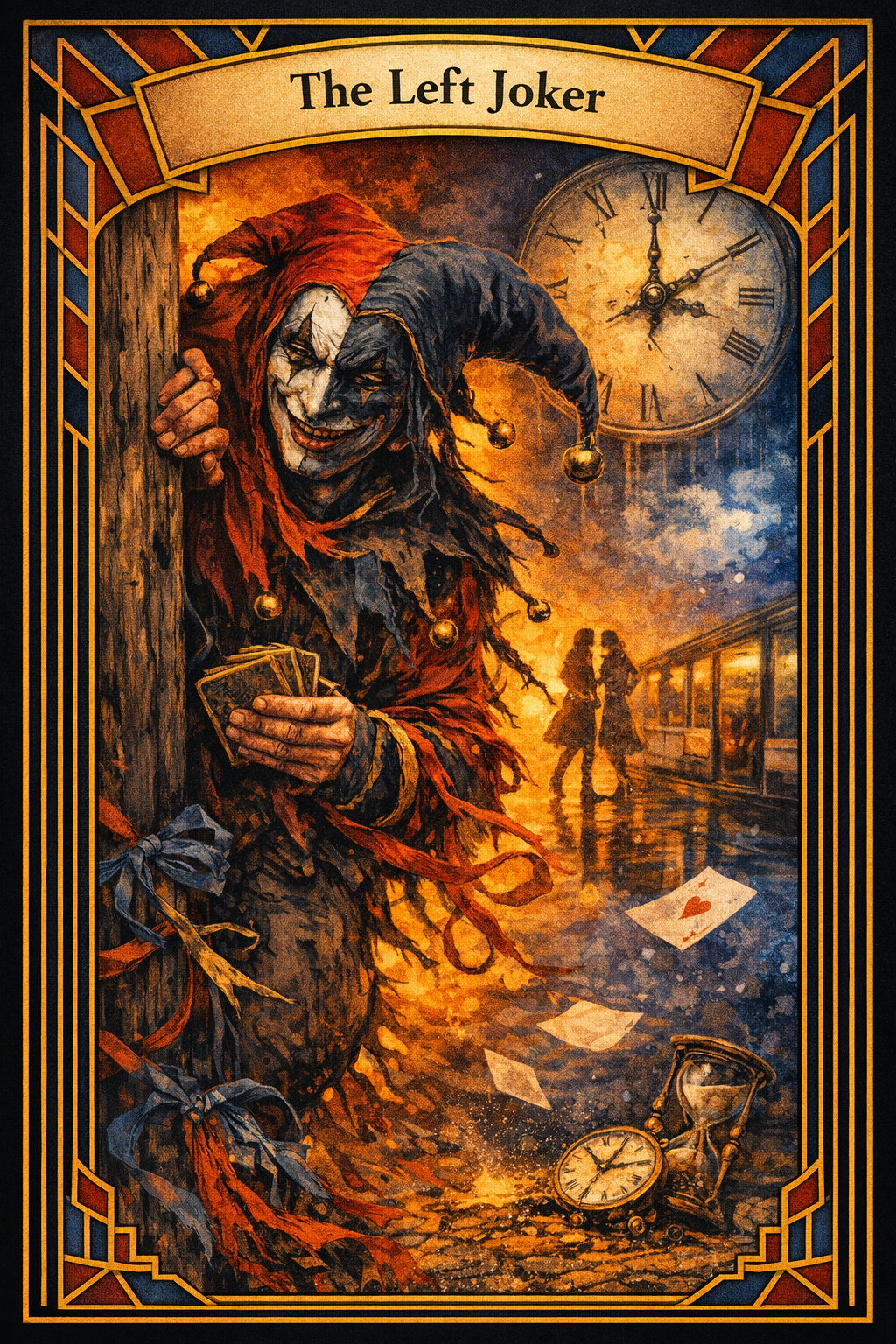
The Left Joker — Mythos
They say the Left Joker was never meant to be printed.
In the first decks, there were only the ordered powers: Kings who ruled, Lovers who chose, Wheels that turned when they were supposed to. But in the margins of the woodcuts—where the ink bled, where the carver’s hand hesitated—someone kept appearing: a figure leaning the wrong way, smiling as if at a private joke, stepping out of the frame instead of into it. Not the Fool, who begins with innocence, but something older and more irritating: a mischief with memory.
The Left Joker is the patron of timing that almost happens.
He arrives when two lives are aligned in meaning but not in sequence—when the meeting is fated, but the hour is cursed; when the message is written, but the send button fails; when the train doors close at the exact moment a name is finally recognized. He does not sever bonds. He simply rearranges the order of events until the heart cannot tell whether it is being protected or punished.
In the oldest telling, the Left Joker was the twin shadow of the Right Joker, a jester assigned to keep the cosmic procession from becoming too smooth. The Right Joker made surprises that felt like gifts: sudden luck, chance encounters, perfect accidents. The Left Joker was given the opposite task—introducing the wrong kind of chance, the kind that teaches by delay. He was placed at the left hand of Time, where all things are slightly behind, slightly off, slightly late.
His mask is half-laugh and half-grimace, because he cannot decide if he is saving you from a disaster you have not seen or stealing from you a joy you have earned. Around his ankles trail ribbons tied in knots—appointments rescheduled, plans rewritten, beginnings restarted. He carries a deck with one card missing, and when he flicks his thumb along the edge, you can hear it: the soft stutter of a story trying to start.
The Left Joker’s road is marked by false starts.
A door opens to a hallway instead of a room. A confession turns into a joke. A kiss lands on the cheek because the angle was wrong. Two people keep arriving at the same place on different days, like magnets that pull hard but never quite click. The Left Joker watches these near-misses with a strange tenderness, as if he is testing the strength of a thread by tugging it—not to break it, but to see whether it is real.
Those who have met him describe the same sensation: the world tilts a fraction to the left, and everything becomes slightly misregistered. Words land a beat late. Signals cross. The universe feels like a song played in the wrong key—recognizable, but unsettling. And yet, beneath the irritation, there is a pulse of meaning: this still matters. The Left Joker does not appear for trivialities. He appears when the outcome is important enough to withstand chaos.
There is a superstition among readers: if the Left Joker turns up in a spread, do not force the next step. Do not chase the sequence back into place with clenched hands. Because he feeds on insistence. The more you demand the proper order, the more he shuffles.
Instead, the myth advises a different offering: patience without passivity, attention without obsession. Let the misalignment show you what it is protecting. Let the delay reveal what is unready. Let the interruption expose what is brittle.
For the Left Joker’s secret is this: he is not the enemy of connection—he is the examiner of it.
If two people are meant to meet, he will make them miss each other until their desire becomes clear enough to survive disappointment. If two people are not meant to bind, he will keep the timing wrong until the spell of inevitability breaks. He is the strange chaos that enters not to destroy the story, but to ask whether the story can still be told when the pages are out of order.
And in the final line of the oldest myth, carved so faintly it can be missed:
When you curse the Left Joker, listen closely.
Sometimes the laughter is yours, arriving late.