Time of Your Life
They say this card was first painted on the back of a broken clockface, pried from a tower that had stopped chiming the hour it was built to guard. The artist—no one agrees on their name—used ink mixed with ash from old calendars and the dust shaken loose from well-worn diaries. When the image dried, the hands on the ruined clock began to move again, but not forward, and not back: they moved inward, toward the center, as if time were something that could be gathered and held.
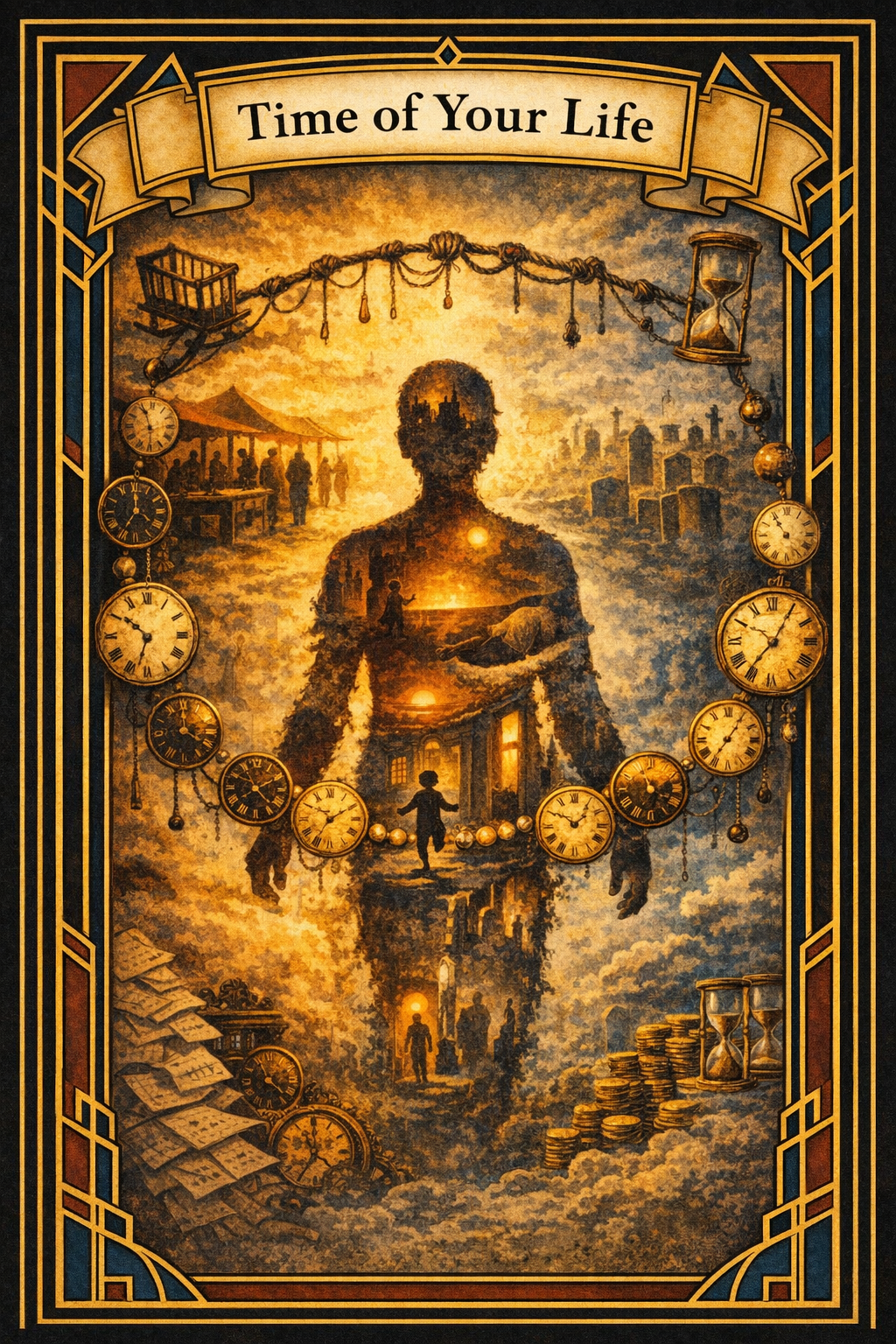
In the oldest telling, Time of Your Life does not depict a person at all, but a silhouette made of moments: a laugh caught mid-breath, a goodbye never finished, a door left half-open, a sunrise witnessed from a hospital window, a child’s hand slipping free to run ahead. Around this figure hangs a garland of hours like beads on a string—some polished bright, others cracked and dark with neglect. Above it, a thin thread runs from cradle to grave, but it is knotted in places where choices were made, and frayed where choices were avoided.
The mythos claims the card was never meant for fortune-telling. It was a warning left by those who learned too late that time is not a river you float upon, but a room you furnish. Every object you place inside it—work, love, fear, obligation, wonder—takes up space. What you refuse to place there does not vanish; it piles up outside the door, waiting to be faced when the room can no longer hold you.
Readers who draw Time of Your Life speak of a peculiar sensation: the faint sound of a metronome behind the ribs, a sudden awareness of the weight of a single day. Some report seeing, in the card’s background, a marketplace where merchants sell “later” by the hour, each purchase made with a coin stamped someday. Others swear the card’s edges are lined with tiny, moving scenes—people postponing joy, people choosing it, people mistaking motion for meaning.
There is a superstition that if you draw this card at night and leave it face-up, you will dream of a corridor lined with doors. Behind each door is a version of your life built from a different decision: one where you stayed, one where you left, one where you spoke, one where you swallowed your words. The dream ends the same way every time: a hand—yours, but older—places a small key in your palm and says, without accusation, You can only open so many.
In the myth, the card’s true power is not prophecy but clarity. It does not tell you how much time remains. It asks what you are doing with the time that is already yours. It reminds the seeker that the “time of your life” is not a single peak of happiness waiting somewhere ahead—it is the sum of lived attention, stitched together moment by moment, until the pattern becomes a life.
And the final line, written so small it is often missed, is said to change depending on who looks:
Spend it like it matters.