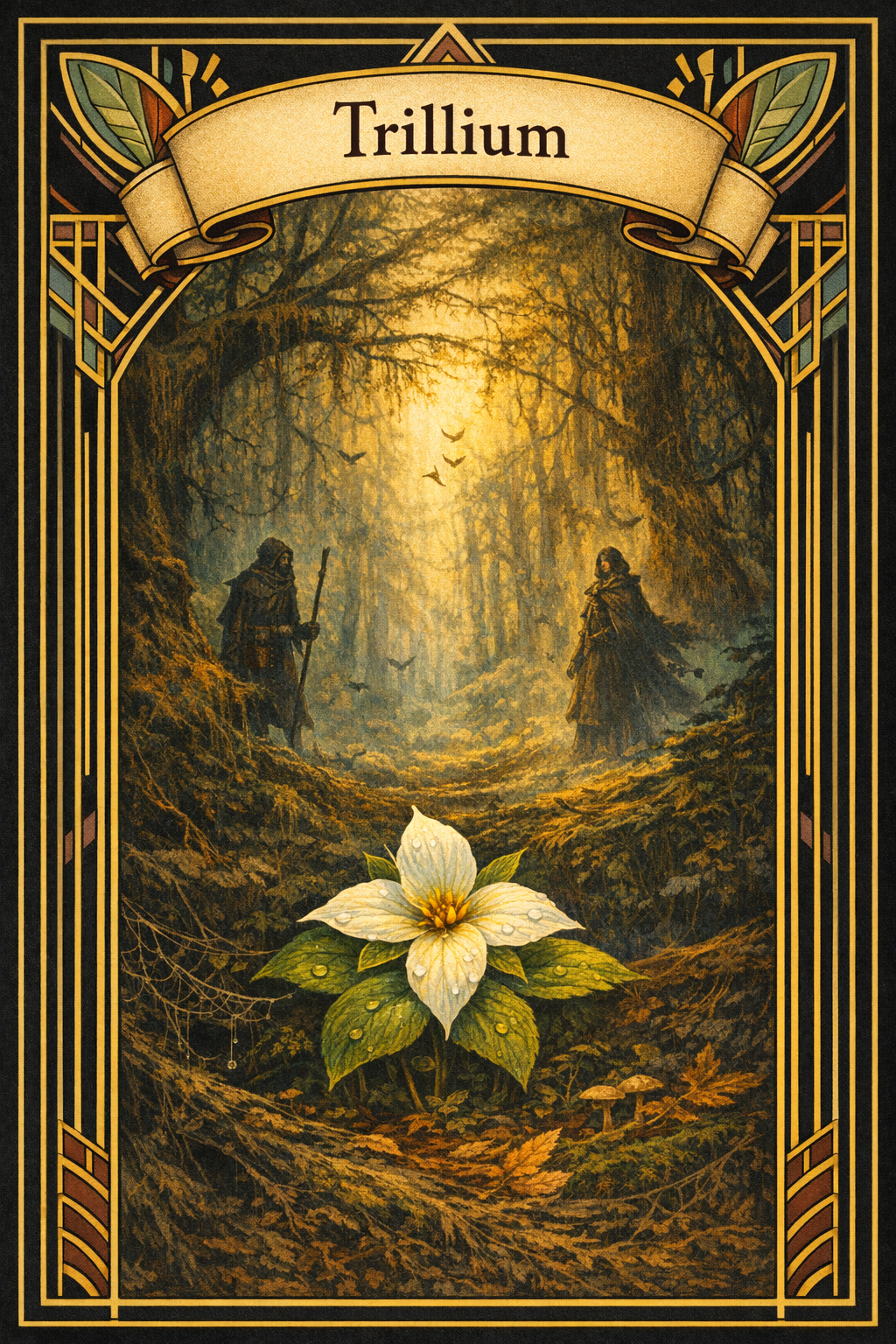
Trillium
In the oldest forests—where sunlight arrives in careful threads and the ground keeps its secrets under last year’s leaves—there is said to be a flower that refuses all command. The Trillium does not answer to longing, nor to vows, nor to the impatient counting of days. It belongs to a calendar written in sap and thaw, and it opens only when the wood itself agrees that the season is true.
Woodcutters once believed the Trillium was a lantern set low by the forest to guide lost lovers home. They would search for it when their hearts were raw with wanting, but the bloom would not appear for pleading hands. Those who hunted it out of hunger found only green silence. Those who walked without demand—who listened, who waited, who learned the slow language of returning birds—sometimes saw it at their feet, as if it had been there all along and only their eyes had finally arrived.
A tale is told of two people who met at the edge of winter and mistook the ache of recognition for readiness. They tried to name their devotion quickly, to bind it with promises before the earth had softened. Each time they went to the woods to seek the Trillium’s blessing, the forest offered only closed buds and cold soil. They argued, and their love became a fire fed by its own urgency—bright, consuming, brief.
Years later they returned separately, each carrying a quieter heart. They did not come to claim anything. They came to apologize to the season they had tried to steal. And in that gentler hour, the Trillium opened—three petals like a vow made in balance: not too soon, not too late, but precisely when it could be kept. The two saw it from different paths at the same time, and neither reached to pluck it. They simply understood: what is meant to live must be allowed to ripen.
So the Trillium card is kept for thresholds—when desire presses hard against the gates of time. It teaches that love is not proved by speed, nor by how tightly it is held, but by the patience to meet it in its proper season. Some hearts bloom only when the ground is ready. Some bonds are harmed by being harvested early. The Trillium does not deny love; it guards it—insisting that what is rare must be waited for, and what is true will open when it can endure.