Tarot's Landing / Cosmos / Readings
Twist of Fate card art

Card Page

Twist of Fate

Twist of Fate

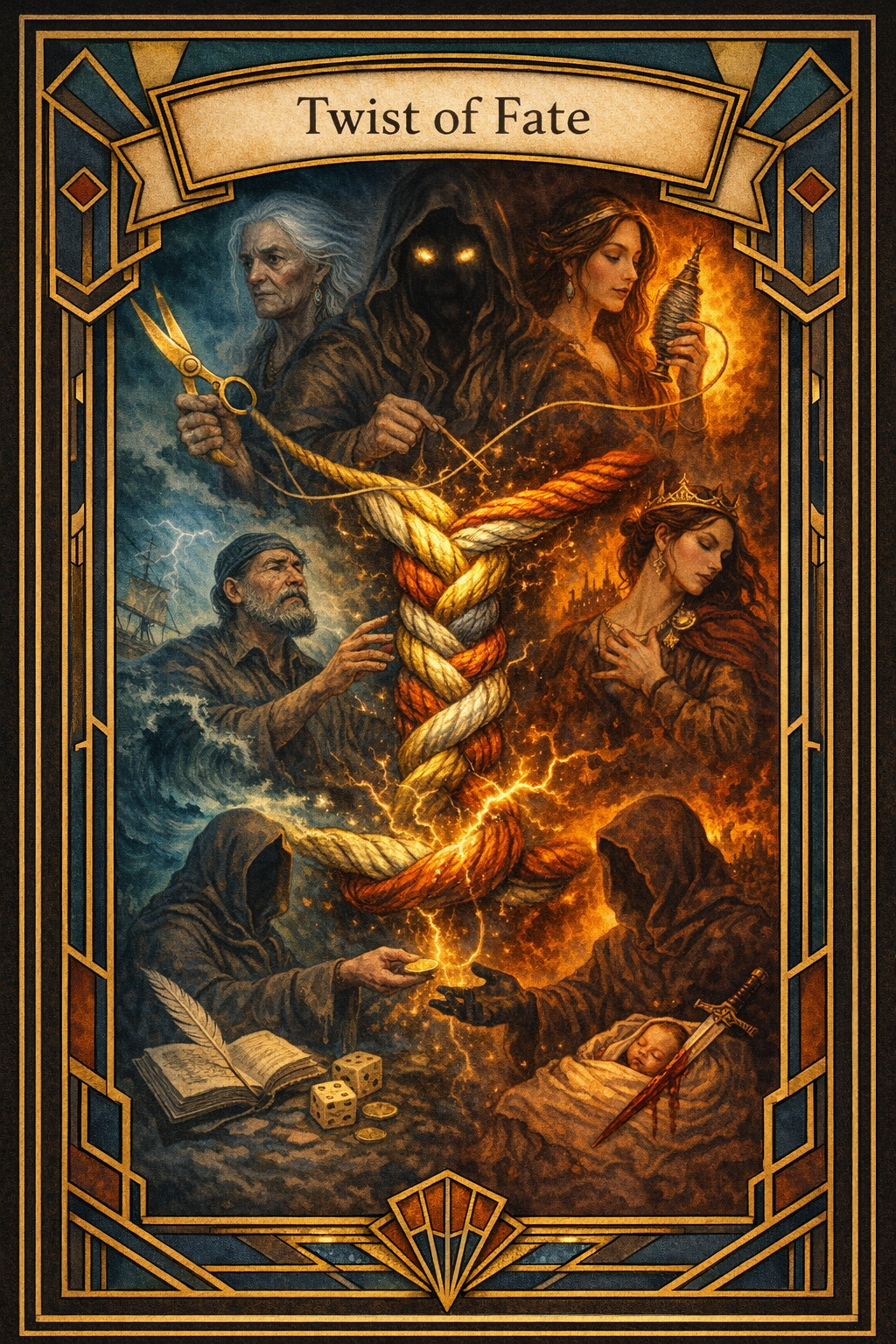
They say Fate is a thread, but the oldest storytellers insist it is a braid: three strands—choice, chance, and consequence—twined so tightly that no hand can pull one free without tugging the others. The Twist of Fate is the card that depicts the moment the braid tightens.

In the mythos of the deck, the card first appeared the night the Loom of Hours stuttered. A minor spirit, nameless and curious, crept into the Hall of Spindles where the Fates kept their work. It did not cut a thread—no, that would have been mercy. Instead, it pinched two lives between finger and thumb and turned them once, like twisting two cords into a knot. A sailor’s oath became a queen’s scandal. A midwife’s kindness became a warlord’s survival. The spirit fled laughing, believing it had made a prank of destiny.

But the Fates did not chase it. They only watched the knot settle and said, Now it will be seen.

From that night on, the world learned a new kind of turning—one that did not feel like a clean fork in the road, but like the road itself had rotated beneath your feet. The Twist of Fate is not the lightning strike, nor the collapse, nor the miracle. It is the subtle pivot that makes all three possible.

The card’s legend tells of those who tried to master it. A gambler-priest once carried the card into a city of ledgers and laws, certain he could “read the turn” before it came. He watched the dice, the markets, the lovers’ glances, the soot on a chimney—signs within signs—until he grew so skilled at prediction that he stopped living. When the twist finally arrived, it was not in the numbers. It was in him: he met a stranger, offered a coin without thinking, and in that uncalculated kindness unraveled the careful future he’d been hoarding. The city was saved from a famine he had never foreseen, and he could not explain why. The card had taught him its cruelest truth: the twist is often born where you are not looking.

In readings, the Twist of Fate is spoken of as the Knot, the Turn of the Wheel, the Hand on the Braid. It carries the mythic warning that destiny is not a straight line you can follow—only a tension you can feel. When it rises, it means the story is about to change shape: a coincidence that is not coincidence, an interruption that reveals a hidden track, an encounter that rearranges the past as much as the future.

And in the oldest margin-notes—those written in ink that seems to shift when you stare—there is a final line attributed to the Fates themselves:

“We do not twist to punish. We twist so the living remember they are holding the thread, too.”
Interpretation

Twist of Fate — Interpretation

  • Core message: A subtle pivot is tightening the braid of choice, chance, and consequence. What seemed separate is about to knot together, changing the shape of your story.
  • What’s happening now: Events are aligning in a way that feels like coincidence but carries meaning. A small interaction, offhand decision, or “random” interruption is the hinge—less a dramatic rupture than a quiet rotation of the road beneath you.
  • Guidance:
  • Stay responsive rather than controlling; you can’t force the turn, but you can meet it well.
  • Pay attention to what you normally dismiss: a passing invitation, an unexpected delay, a new name, a misplaced object, a sudden change of mood.
  • Choose the cleanest next action instead of the perfect plan; the knot tightens around what you do now.
  • Opportunity: The twist can reroute you toward a better outcome than your forecasts allow. Uncalculated kindness, honest curiosity, and flexible timing can open doors that strategy cannot.
  • Challenge: Over-reading signs or trying to predict every variable can freeze you into inaction. The card warns against living only in anticipation; the turn often arrives where you aren’t looking.
  • In relationships: A chance meeting, miscommunication, or unexpected confession reshapes the bond. Past events may be reinterpreted; a new context makes old choices look different. Stay open to dialogue that changes the narrative.
  • In work and material matters: A shift in timing, policy, market mood, or a single conversation alters the trajectory. What looks like a disruption may be the hidden track—follow the opening, renegotiate, adapt.
  • In inner life: You are being reminded that you’re not merely carried by fate—you’re holding part of the thread. Your next small choice has outsized weight; act with integrity and let the consequences teach you.
  • Timing/feel: Sudden but not always loud—often recognized only in hindsight. The moment is close when multiple threads begin to tug at once.
  • Key question: Where am I trying to control the braid, when I should be choosing my next strand with care?

Reversed Interpretation

Twist of Fate — Reversed Interpretation

  • Core message: The knot is tightening, but you’re resisting the turn—or trying to force it. The braid of choice, chance, and consequence is being pulled out of alignment, creating friction, delays, or a sense of being “stuck in the twist.”
  • What’s happening now: A near-miss, postponed change, or repeated pattern signals that the pivot is already in motion, but it’s being muted or misread. Coincidences feel irritating rather than meaningful; the road keeps rotating and you keep trying to stand where it used to be.
  • Guidance:
  • Stop wrestling the thread: release one point of control and see what immediately loosens.
  • Treat interruptions as information, not obstacles—ask what they’re redirecting you away from.
  • Make one small, honest correction (a message sent, an apology offered, a boundary set, a task finished). Reversed, the card responds to simple integrity more than grand strategy.
  • Opportunity: You can untie a developing knot before it hardens into fate-by-default. A modest change in habit, timing, or tone can restore flow and prevent a larger, messier turn later.
  • Challenge:
  • Over-attribution: seeing omens everywhere, paranoia, superstition, or spiraling “what if” thinking.
  • Under-attribution: dismissing clear signals, clinging to the plan, insisting nothing needs to change.
  • Attempts to “game” chance backfire; the more you grip, the more the braid bites.
  • In relationships: Miscommunication and reinterpretation run wild—old events get weaponized, motives are assumed, chance encounters create suspicion. The fix is clarity: name what’s true, ask what’s true, and don’t build a story from fragments.
  • In work and material matters: A disruption becomes costly when you refuse to adapt—missed timing, paperwork tangles, preventable setbacks, or a deal that keeps almost landing. Recheck assumptions, renegotiate terms, and prioritize what’s actionable over what’s ideal.
  • In inner life: Feeling fated, powerless, or singled out by bad luck may mask a neglected choice. Reversed, the card asks: where have you surrendered agency out of fear of consequences? Reclaim one thread—your next decision.
  • Timing/feel: The twist is delayed, dampened, or recurring—the same lesson arriving in different disguises until acknowledged. Often felt as mounting tension rather than sudden change.
  • Key question: What am I calling “bad luck” that is actually a choice I’m avoiding—or a change I’m refusing to let happen?

Story Beats

Vignette 1

In the Hall of Spindles

Dialog: Spirit: “I won’t cut it—too clean.” Fate: “Then twist it.” Spirit: “A sailor’s oath for a queen’s shame… done.” Fate: “Now it will be seen.”

Scene: A vast, dim, mythic chamber called the Hall of Spindles: towering wooden looms and spinning wheels recede into shadow. Three immense, veiled Fates stand motionless like statues, their hands hovering over a glowing braid of three strands—choice, chance, consequence—colored subtly (gold, silver, and deep red). In the foreground, a small nameless spirit—child-sized, half-smoke, half-starlight—pinches two luminous life-threads between finger and thumb and twists them into a tight knot. As the knot forms, faint ghostly vignettes flicker in the air: a storm-tossed sailor swearing an oath on a deck; a crowned queen turning away amid scandalous whispers. Lighting is dramatic and sacred, with thread-glow illuminating faces; dust motes drift; the mood is eerie, inevitable, and intimate.

Vignette 2

The Road Rotates

Dialog: Traveler: “I swear I was walking straight.” Companion: “You are—only the world turned.” Traveler: “Then this isn’t a fork… it’s a pivot.” Companion: “That’s the knot tightening.”

Scene: An old stone road at dusk in a windswept countryside. The scene captures an impossible, subtle rotation: the road appears to twist beneath the characters’ feet like a ribbon, without breaking—its cobbles slightly skewed as if the ground has turned. Two figures stand mid-step: a weary traveler with a cloak and satchel, and a calm companion who seems almost symbolic (face partly in shadow, eyes reflective). Around them, landmarks mismatch as if reality re-ordered—one side shows a familiar signpost pointing home, the other reveals an unexpected hidden track leading into misty woods. The air carries a faint spiral of leaves and dust that visually echoes a braid. Color palette: muted blues and grays with a warm amber rim light on the road’s edges, emphasizing the “pivot” feeling rather than disaster.

Vignette 3

The Gambler-Priest’s Uncalculated Coin

Dialog: Gambler-Priest: “The dice say famine.” Stranger: “Then why are you smiling?” Gambler-Priest: “I’m not. My hand moved first.” Stranger: “Kindness is a number you can’t count.”

Scene: A crowded city street in a “city of ledgers and laws,” rendered with tall brick buildings, iron balconies, and posted notices of taxes and grain quotas. In the foreground, a gambler-priest in worn ceremonial robes (subtle stitched symbols, a small charm of dice at his belt) extends a single coin toward a cloaked stranger. The priest’s other hand clutches a small notebook filled with calculations and market figures; a pair of dice rests on the open page. Behind them, hints of looming famine: an empty grain cart, anxious townsfolk near a ration line, shopkeepers tallying accounts on slate boards. Yet a soft, unexpected light falls on the exchanged coin, suggesting a turning point. The priest’s expression is startled—caught mid-realization—as if the true twist happened inside him. The atmosphere is tense but hopeful, with fine details like soot on chimneys and fluttering ledger papers to echo his obsessive watching of signs.