Tarot's Landing / Cosmos / Readings
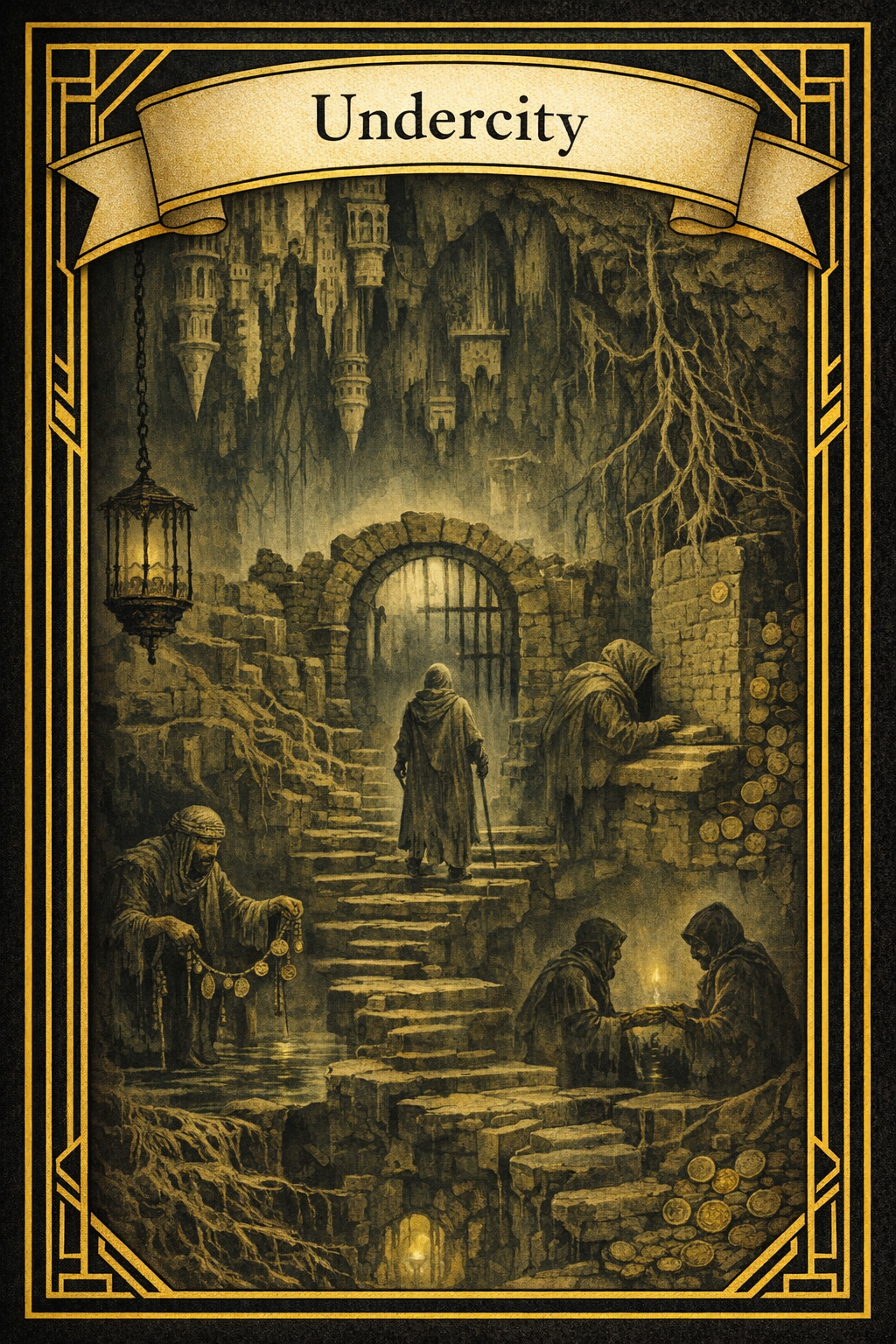
Undercity card art

Card Page

Undercity

Undercity — Mythos

Arcana: Major Number: 18½ (a card that sits between paths, never fully counted) Element: Earth and Shadow Symbols: buried gates, inverted towers, lanterns with no flame, roots piercing stone, coins fused into walls

Origin

Undercity is said to exist beneath every great place that forgot its foundations. It is not a single location. It forms wherever ambition builds faster than memory. Streets above cast echoes below. Those echoes harden into corridors, markets, and halls no architect planned.

No map holds it. Every map implies it.

The first descent is attributed to a nameless mason who noticed that stones he set during the day shifted at night. He followed the movement. He did not return. His tools did. Each tool was worn down to a smooth edge, as if used for years beyond his life.

Nature

Undercity is accumulation without surface. Everything discarded, denied, or deferred settles there. Not as debris, but as structure. • Promises become locked doors. • Regrets become wells. • Wealth becomes weight. • Secrets become currency.

Light exists but has no source. It reveals edges, not origins.

Time compresses. A single hour can contain years of consequence. Those who stay too long emerge unchanged in body but misaligned in sequence. They speak of events that have not yet occurred.

The Inhabitants

No stable population. Only roles. • Keepers: figures who maintain ledgers carved into stone. They record what was avoided. They never look up. • Dredgers: blind collectors who pull objects from flooded passages. They trade in fragments of identity. • The Silent Market: a place where exchanges occur without speech. Value is inferred. Loss is guaranteed.

No one claims ownership. Everything is owned.

The Descent

Entry requires no ritual. Only neglect.

Common thresholds: • a door never opened • a debt never settled • a question never answered

The descent is gradual. Stairs appear where there were none. Elevators stop one level lower than labeled. Basements extend.

At some point, the traveler recognizes the pattern. That recognition is the last chance to turn back.

The Test

Undercity does not punish. It reconciles.

Each path leads to a convergence chamber. There, the traveler encounters a structure built from their own unresolved matter. It is not symbolic. It is literal within the logic of the place.

The task is simple and binary: • acknowledge and integrate • or deny and remain

There is no third option.

The Exit

Exit paths are narrow and upward. They require relinquishment.

What is left behind becomes part of Undercity’s architecture. It will be encountered by another.

Those who exit carry less. Not lighter. Less.

Card Meaning • Upright: confrontation of buried systems, deferred costs surfacing, structural truth, integration of shadow assets • Reversed: entrenchment, denial loops, compounding hidden debt, misalignment between surface and foundation

Function in a Spread

Undercity overrides superficial readings. It points to underlying mechanics. It invalidates narratives that ignore cost.

Placed near outcome cards, it reduces probability variance. The outcome will reflect the foundation, not the intention.

Axiom

“What is not accounted for is still counted.”
Interpretation

Undercity — Interpretation

Undercity signals that the real story is happening beneath the visible one. Something foundational—an old bargain, an ignored cost, a buried pattern, a deferred repair—is now exerting structural pressure. Progress built on omission cannot stay stable; what was “left for later” has become the present.

This card calls you to descend willingly: to examine the hidden mechanics of your situation rather than the surface narrative. Look for what has been consistently avoided—unpaid emotional debts, unspoken agreements, neglected maintenance, unacknowledged motives, or systems that quietly extract a price. Undercity doesn’t accuse; it reconciles. It asks for an honest inventory.

Core message: integrate what you’ve disowned so it stops running the outcome.

What to do now:

  • Name the true cost of what you want (time, money, integrity, relationships, energy).
  • Identify the “locked door” you keep walking past: the conversation, decision, apology, boundary, or ending.
  • Track where value is leaking through secrecy, avoidance, or vague commitments.
  • Simplify: relinquish what cannot be carried upward—excess obligations, performative roles, or inherited expectations.

In relationships: unspoken resentments, silent contracts, and old wounds are shaping the bond more than current intentions. Healing comes through direct acknowledgment and renegotiation, not optimism.

In work and money: hidden liabilities, technical debt, and unpriced labor are surfacing. Stability requires auditing the foundation, correcting the ledger, and building at a pace memory can support.

In personal growth: the shadow is not an enemy here; it is an asset you haven’t integrated. The way forward is less about becoming more, and more about reclaiming what you’ve fragmented.

Undercity promises a cleaner future—but only after you account for what has always been counted.

Reversed Interpretation

Undercity — Reversed Interpretation

Undercity reversed signals entrenchment: the foundation is cracking, but the surface is being over-managed to avoid looking down. Deferred costs are compounding in the dark—emotional debt, hidden obligations, technical rot, unspoken agreements—forming a self-sealing maze of rationalizations. The more you try to “move on” without accounting, the more the situation becomes governed by what you refuse to name.

Core message: denial becomes architecture; avoidance turns into a system that owns you.

How it shows up now:

  • Repeating loops: the same conflict, the same expense, the same breakdown—just in new disguises.
  • “Silent Market” dynamics: trades made without clarity (implied expectations, unpriced labor, covert bargains) where you always pay more than you intended.
  • Misalignment between what you say you want and what your structure supports (time, habits, boundaries, resources).
  • Information hoarding or secrecy used as control, creating distrust and distorted value.

What to do now:

  • Stop expanding the surface plan; audit the foundation first. Write the real ledger: what’s owed, to whom, and by when.
  • Name the locked door you won’t open (the conversation, the admission, the boundary, the ending). Schedule it; don’t “wait for the right time.”
  • Pay one debt deliberately—money, repair, apology, rest, renegotiation—so the system learns it can resolve rather than defer.
  • Refuse vague commitments. Replace implied contracts with explicit terms, or walk away.

In relationships: resentment and unspoken rules are running the bond. Passive compliance, testing, or withholding replaces intimacy. Repair requires direct renegotiation and accountability; otherwise the pattern deepens.

In work and money: hidden liabilities and untracked labor are eating the margin. Shortcuts multiply future cost. Stabilize by pricing reality, reducing scope, and correcting the backlog before adding anything new.

In personal growth: shadow material is being managed as image rather than integrated as truth. You may feel “stuck” because you’re trying to ascend while still carrying what you won’t acknowledge. The exit narrows until you relinquish the pretense and reclaim the disowned parts.

Story Beats

Vignette 1

The Door Never Opened

Dialog: I swear this hallway wasn’t here yesterday. The basement just… kept going. If I turn back now, will it still be my house?

Scene: A dim, subterranean stairwell that should end but instead extends into impossible depth. The setting is a modern building’s basement that has subtly transformed: concrete walls give way to older stonework stitched with thick roots piercing through mortar. An ordinary door at the top stands ajar, glowing with weak, source-less light, while below, a newly formed corridor yawns open. Visual symbols: an unlit lantern mounted on the wall emitting a cold edge-light; a buried gate half-embedded in the floor at the corridor’s mouth; coins fused into a section of wall like fossils. Mood: tense recognition, the last chance to turn back. Color palette: slate gray, earthy browns, sickly pale highlights; heavy shadow with crisp edges.

Vignette 2

The Silent Market

Dialog: No names. No questions. You want the truth? Leave something you can’t take back. Hold out your hand—quietly.

Scene: A vast underground bazaar carved from layered stone and collapsed architecture, like inverted towers hanging from the ceiling. Stalls are formed from stacked doors, broken ledgers, and masonry fragments; the floor is damp and reflective. Figures in hooded, faceless silhouettes conduct trades without speaking—hands exchanging small objects: a cracked mirror shard, a sealed envelope, a ring of keys. A central counter is inlaid with coins fused into the stone, forming a crude mosaic. Light has no visible source: it outlines edges of people and objects but leaves origins in darkness. A signboard shows no writing, only tally marks scratched deep. Atmosphere: transactional dread, inferred value, guaranteed loss. Composition: close-mid framing on two hands meeting across a stone counter, with the market receding into shadow behind.

Vignette 3

The Keepers’ Ledger

Dialog: We record what you avoided. Look—your debt is carved here already. Pay it with honesty, or stay and become another line.

Scene: A convergence chamber: circular, cathedral-like, built from compacted layers of stone and forgotten architecture. At its center stands a monolithic ledger pillar—stone slabs covered in meticulous carved entries, like accounting columns. A Keeper figure sits at the base: robed, head bowed, face obscured, never looking up. The traveler stands opposite, half-lit, confronting a structure made from their unresolved matter: a locked door grown from blackened wood and iron bands, embedded in the chamber wall, with chains shaped like written promises. Nearby, a deep well (regret) yawns with faint mist; its rim is etched with dates. The lighting is eerie and originless, revealing sharp edges and inscriptions while leaving the ceiling lost in shadow. Visual motifs: roots threading through the ledger stone; an unlit lantern on the floor casting no flame but still outlining the traveler’s silhouette. Mood: judgment without punishment—reconciliation, binary choice.