Tarot's Landing / Cosmos / Readings
Underdark card art

Card Page

Underdark

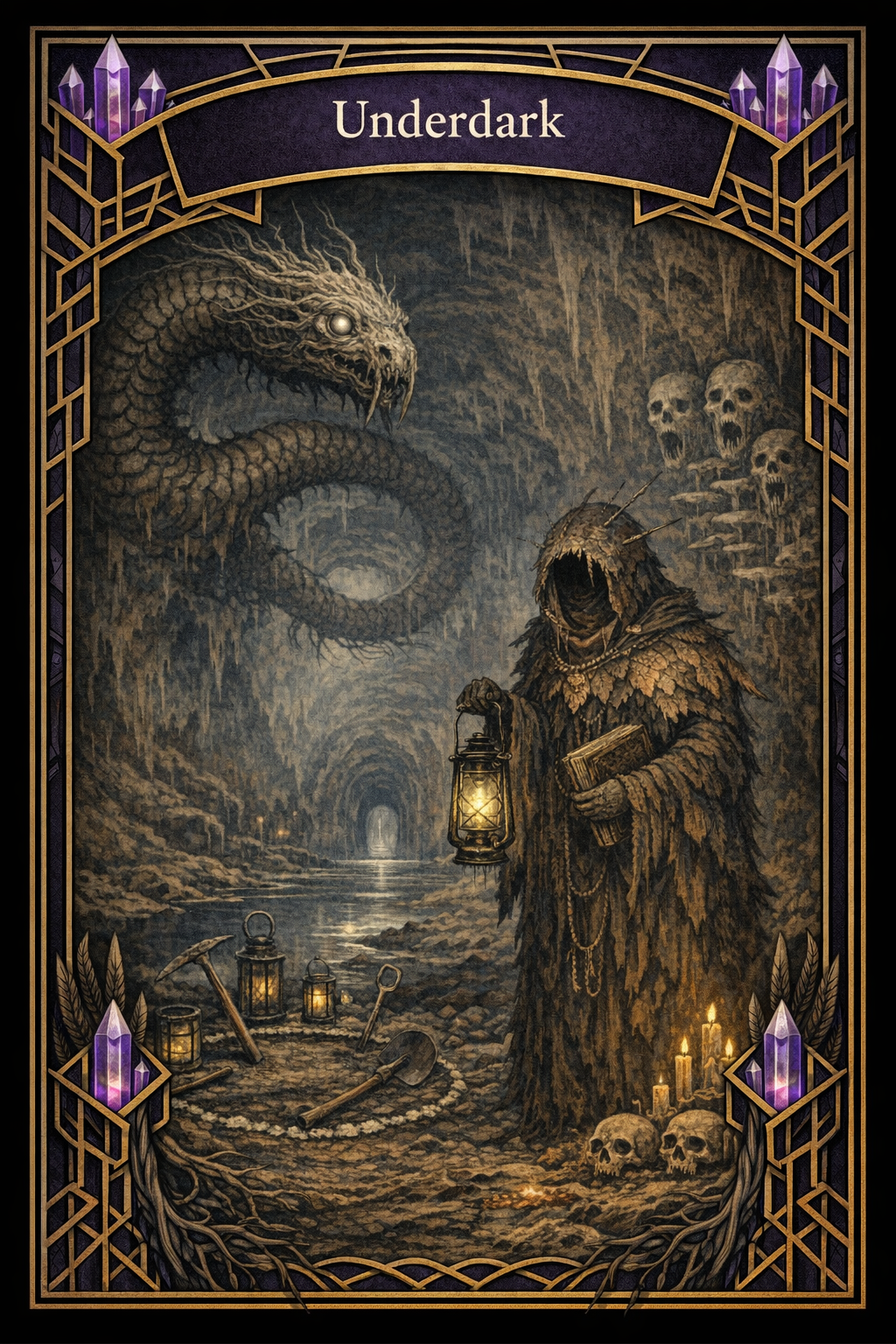
Underdark is the card of the world beneath the world: the hidden stratum where foundations are laid, debts are remembered, and truths grow teeth. It does not speak in omens of distant fate so much as in the pressure of what has already been buried—old vows compacted into stone, grief calcified into salt, desire turned to a blind, patient root. When Underdark appears, the seeker is being drawn downward not as punishment, but as necessity: you cannot build higher than your bedrock allows, and bedrock is made from what you refuse to name.

In the oldest telling, Underdark was not a place but a hunger in the earth, a hollow that learned to listen. The first miners who cut into it swore they heard their own thoughts echoed back, improved—sharper, crueler, truer. They fled, leaving tools behind. Those tools were later found arranged in circles, as if the dark had been practicing ritual. The elders called it the Below-Choir and forbade descent, but prohibition only gave it a second name: Invitation.

The myth says Underdark formed when the Sun first looked upon itself and blinked. That single moment of unseeing fell through the world like a seed. Where it landed, light became memory instead of presence, and the ground learned what it meant to be forgotten. From that seed grew a kingdom of absence: caverns like vast lungs, rivers that run with cold iron, fungi that bloom in the shape of lost faces. In Underdark, nothing is truly gone; it is merely stored in a different kind of time.

Those who enter without offering are met by the Pale Archivist, a figure stitched from moth-wings and old maps, carrying a lantern that gives off no light—only outlines. The Archivist does not bar the way. It simply asks for a name you have never spoken aloud. Refuse, and you will wander in tunnels that always return you to your own footprints. Answer, and the lantern will show you a door you have walked past your entire life.

Underdark is ruled by no monarch, yet it has laws. The first law is Weight: everything you avoid becomes heavier, and in that realm heaviness is gravity. The second law is Echo: every lie returns, not as punishment, but as architecture—you will live inside what you insisted was not there. The third law is Exchange: nothing can be taken without leaving something of equal intimacy behind. Coins are useless. The currency is confession, the collateral is tenderness, and the interest is always paid in sleep.

The saints of Underdark are not heroes but survivors. There is the Candle-Eater, who learned to swallow flame so others could see without being seen. There is the Bone-Singer, who taught the dead to hum so the living would remember where they came from. There is the Blind Cartographer, who drew the tunnels by touch and proved the dark has texture, not emptiness. Each of them bears the same lesson: descent is not defeat; it is apprenticeship.

The great beast of this mythos is the Root-Wyrm, a serpent older than trees, coiled around the world’s first secret. It does not hunt flesh. It hunts denial. When it catches you, it does not bite; it constricts until your ribs become a truth you can no longer ignore. Those who survive its embrace emerge changed—quieter, harder to deceive, and strangely capable of mercy toward themselves.

Underdark’s central paradox is that it is both prison and womb. It is where shame goes to ferment into power, where fear is stripped of its costumes and revealed as raw instinct, where the self meets its own shadow not as enemy but as abandoned kin. The card’s myth warns that if you descend only to conquer, the dark will crown you with a throne made of your own defenses. But if you descend to listen, the dark will give you a single, unbreakable gift: the sound of your true voice when no one is watching.

In the last story told about Underdark, a seeker returns to the surface carrying a stone that is warm as skin. They set it at the base of their home, and the house stops creaking in the night. Not because the world has grown safer, but because the foundation has finally been acknowledged. And somewhere below, the Pale Archivist closes a book that has been open for generations, as if a long-held breath has at last been released.
Interpretation

Underdark — Interpretation

Core Message

A necessary descent. You are being drawn toward what has been buried—old vows, unspoken names, inherited grief, quiet desires—because your next growth depends on the truth of your foundation. This card signals that what you avoid is already shaping your life; meeting it directly turns weight into stability.

Themes

  • Foundations, bedrock, and the hidden structure beneath your choices
  • Confession, naming, and the power of speaking what was never spoken
  • The architecture of denial: how avoidance becomes the room you live in
  • Shadow as abandoned kin: integration over conquest
  • Exchange: gaining clarity requires surrendering a defense, a story, or a comfort

What’s Happening Now

You may feel slowed, heavy, or pulled inward. The “pressure” you’re experiencing isn’t punishment—it’s gravity from unfinished inner business. Patterns repeat, you circle familiar tunnels, or you keep arriving at the same emotional footprint because something essential wants acknowledgement. The path forward is less about force and more about honesty.

Guidance

  • Name the unnamed. Identify the one truth you keep editing out—especially the one tied to shame, longing, or grief.
  • Offer an equal intimacy. To receive insight, leave behind a protective lie, a hardened stance, or a performative version of yourself.
  • Listen instead of conquer. If you descend to win, you’ll reinforce your defenses; if you descend to understand, you’ll recover your real voice.
  • Track the weight. Notice what feels disproportionately heavy—this is where the buried material is densest and most influential.
  • Choose small, real actions. One candid conversation, one boundary, one ritual of release, one act of self-mercy can reset the whole structure.

In Relationships

Underdark asks for truth beneath the script: the fear you don’t admit, the need you minimize, the resentment you’ve “handled” but haven’t expressed. Intimacy deepens through vulnerable specificity. If dynamics feel cyclical, the relationship is reflecting an unspoken contract—name it, renegotiate it, or release it.

In Work / Calling

This is about groundwork: hidden obligations, quiet debts, and the unseen cost of your ambition. You’re being asked to examine what your success is built on—overfunctioning, secrecy, self-erasure, or an old promise. Sustainable progress comes from restructuring the foundation, not stacking more on top.

In Spiritual / Inner Life

A threshold moment: shadow work, ancestry, memory, and the tender places you’ve exiled. The “dark” here is not evil—it’s storage. You’re retrieving a lost part of yourself and learning the texture of your own depths. The gift is a steadier self-trust and a voice that doesn’t require an audience.

Likely Outcome

If you accept the descent, you emerge quieter, clearer, and harder to deceive—especially by your own stories. The creaks in your life lessen not because the world changes, but because your foundation becomes acknowledged, reinforced, and true.

Reversed Interpretation

Underdark — Reversed Interpretation

Core Message

Avoidance becomes a labyrinth. The descent is resisted, rushed, or used as a performance—so what’s buried gains leverage. Reversed, Underdark signals denial hardening into structure: you may be living inside an old lie, circling the same emotional tunnels, or mistaking numbness for stability.

Themes

  • Refusal to name the unnamed; edited truths and withheld admissions
  • Stagnation, looping patterns, and “returning to your own footprints”
  • Over-identifying with shadow: brooding, obsession, or self-punishment
  • Unequal exchange: wanting clarity without surrendering a defense
  • Foundations built on secrecy, overfunctioning, or unspoken contracts

What’s Happening Now

Pressure increases because something essential is being postponed. You may feel heavy, stuck, or privately panicked—yet keep choosing familiar coping strategies (minimizing, rationalizing, controlling, disappearing). Alternatively, you may be digging compulsively, treating pain as proof of progress while skipping the integrating, stabilizing steps.

Guidance

  • Stop bargaining with the truth. Say the sentence you keep revising. Write it, speak it, or admit it to yourself without commentary.
  • Refuse the “shadow throne.” If you’re using insight as armor (cynicism, superiority, detachment), step down and return to tenderness.
  • Pay the real price. Insight requires leaving something behind: a protective story, a role, a secret promise, or a self-image.
  • Interrupt the loop. Do one concrete act that breaks the pattern—make the call, set the boundary, ask the direct question, end the half-commitment.
  • Seek containment. If the material feels overwhelming, choose support (therapy, trusted counsel, structured practice) over solitary spiraling.

In Relationships

Reversed Underdark points to unspoken agreements running the bond: resentment disguised as patience, fear disguised as independence, silence disguised as peace. Cycles persist because the real need isn’t being named. Watch for secrecy, testing, withdrawing, or “confessing” without changing behavior. The remedy is specific truth plus a renegotiated contract—or a clean release.

In Work / Calling

Hidden debts are coming due: burnout, unpaid emotional labor, compromised values, or success built on self-erasure. You may be clinging to a foundation that can’t hold more weight, or avoiding a necessary restructuring. Audit what your progress costs you; simplify, delegate, disclose, or rebuild before the strain forces a collapse.

In Spiritual / Inner Life

This can indicate fear of the dark (spiritual bypassing, forced positivity) or fascination with it (doom, obsession, identity fused with wounds). The work isn’t to conquer or wallow—it’s to integrate. Choose grounded practices over intensity; prioritize safety, embodiment, and gradual honesty.

Likely Outcome

If resistance continues, the same lessons repeat louder, and the “architecture of denial” tightens—more fatigue, more looping, less freedom. If you turn and face what you’ve buried with measured honesty, the pressure shifts from crushing to clarifying, and the path forward reappears where you’ve been walking past it all along.

Story Beats

Vignette 1

The Pale Archivist’s Question

Dialog: Stop pretending you don’t know it. Give me the name you’ve never spoken aloud, and I’ll show you the door you’ve walked past your whole life.

Scene: Deep in a vast limestone cavern shaped like a slow-breathing lung, a pale, androgynous figure—the Pale Archivist—stands in a narrow tunnel junction. Its body looks stitched from moth-wings and layered scraps of old maps, edges fraying like paper. It holds a lantern that emits no light, only faint glowing outlines: the contour of a hidden doorway traced on the rock wall, the silhouette of the seeker’s face, and thin lines marking paths. The seeker (a cloaked traveler) hesitates, hand half-raised to their throat as if guarding a secret. The ground is damp with mineral sheen; tiny fungi bloom in clusters, some resembling blurred human faces. The atmosphere is hushed, dust motes suspended, with high-contrast chiaroscuro and a surreal, storybook-horror tone.

Vignette 2

Law of Exchange

Dialog: Coins won’t buy passage here. Leave something intimate—confession, tenderness. Take without paying, and you’ll pay in sleep until your eyes forget the sun.

Scene: A subterranean river runs through black rock, its surface reflecting a cold iron tint. On a natural stone ledge beside it sits a rough altar-like slab etched with faint concentric circles. A small pile of useless coins lies scattered and dull, partially wet. The seeker kneels, offering a handwritten page torn from a journal (or a small locket opened to reveal a portrait), placing it on the stone with reluctant care. In the background, the tunnel recedes into darkness where faint, repeating footprints loop back on themselves. The air looks heavy, like pressure; condensation beads on stone. Bioluminescent fungi cast dim blue-green glows, while the rest is swallowed by shadow, emphasizing the idea of “payment” as emotional rather than material.

Vignette 3

The Root-Wyrm Hunts Denial

Dialog: I don’t want your flesh. I want what you refuse to name. Breathe—until your ribs become the truth you can no longer ignore.

Scene: In a colossal root-choked chamber, a massive serpentine Root-Wyrm coils around the seeker without biting—its body like ancient wood and stone fused, ridged with root fibers and mineral plates. The constriction is tight but not violent; the seeker is pinned, eyes wide, one hand pressed to their chest as if feeling a revelation. Around them, roots thread through the cavern walls like veins, and salt-like crystals glitter in cracks, suggesting grief calcified. The wyrm’s head hovers close, expression unreadable, with pale, lidless eyes that reflect the seeker’s face. The lighting is low and subterranean: warm amber highlights along the wyrm’s ridges and cold shadows pooling beneath, creating a tense, intimate, transformative mood rather than a battle scene.